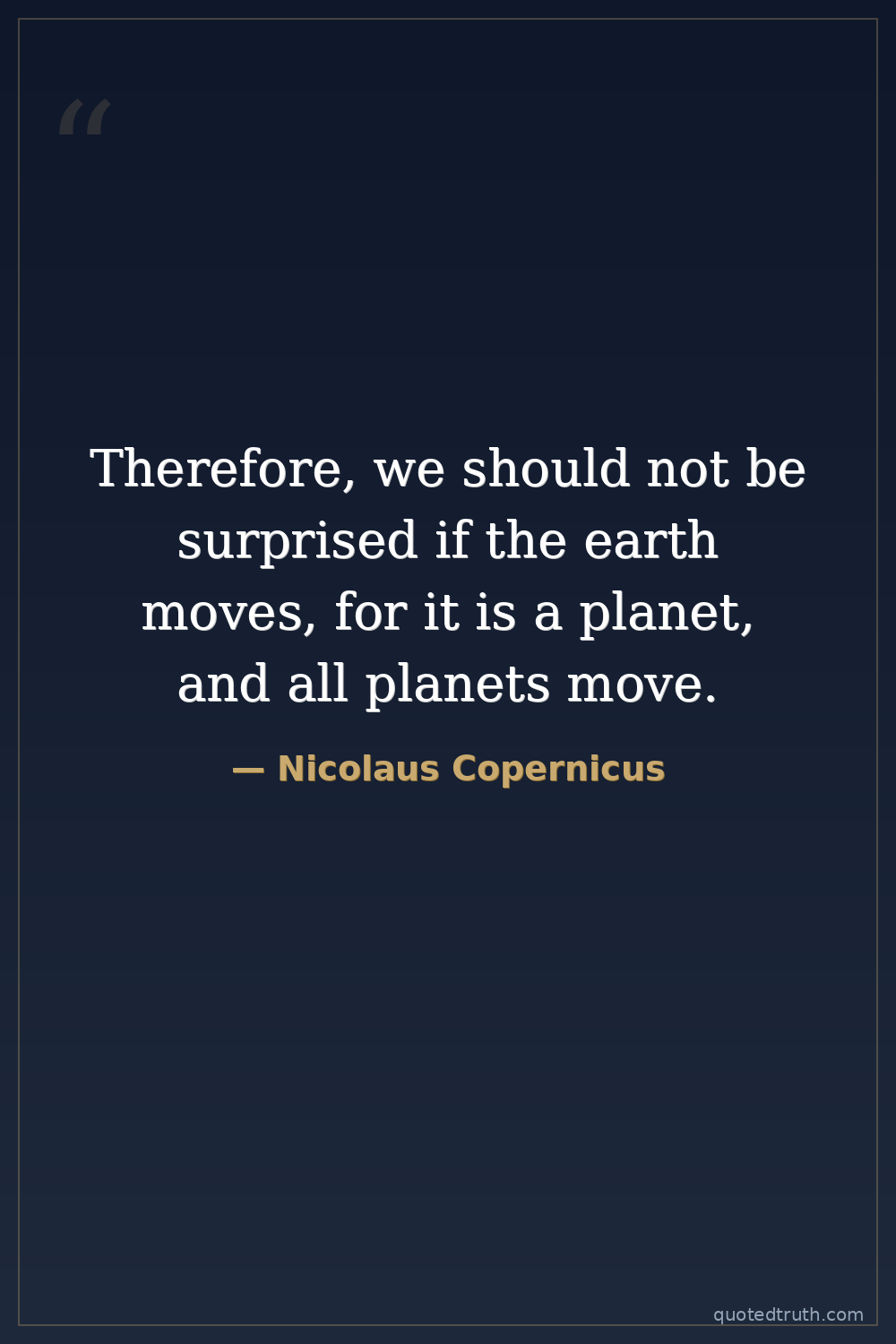
Nicolaus Copernicus — "Therefore, we should not be surprised if the earth moves, for it is a planet, an…"
Therefore, we should not be surprised if the earth moves, for it is a planet, and all planets move.
Therefore, we should not be surprised if the earth moves, for it is a planet, and all planets move.
Click any product to generate a realistic preview. Up to 3 at a time.
* Initial load can take up to 90 seconds — revising the preview in another color is nearly instant.
"The spheres of the planets do not revolve about the earth as their center, but about the sun."
"It is not incredible that the earth moves, but that it stands still, that is incredible."
"The earth, too, has other motions than that of the daily rotation."
"And so, in the first book, I describe the earth's general position and its various motions, and then I pass to the other planets, showing how their motions are related to the earth's."
"There are three kinds of motion of the earth, as I shall demonstrate below."
Found in 1 providers: grok
1 source checked
The earth moves, and that should not shock us — because Earth is a planet, and planets move. The real surprise was ever thinking otherwise. Once you classify Earth alongside Mars, Venus, and Jupiter as a planet orbiting the Sun, its motion follows automatically. The argument strips away emotional resistance to heliocentrism by making it a matter of simple category logic: same type of object, same behavior. Classification settles the debate.
Copernicus spent over 30 years building the mathematical case that Earth orbits the Sun, publishing De Revolutionibus Orbium Coelestium in 1543. A church canon, physician, and astronomer, he was methodical and cautious — withholding publication for decades. This quote embodies his approach: not emotional argument but cool logical consistency. If Earth belongs to the class 'planet,' it must follow planetary rules. His life's defining intellectual act was reclassifying Earth from cosmic center to ordinary planet.
Copernicus worked when Ptolemy's geocentric model — Earth fixed at the universe's center — had shaped both astronomy and Catholic theology for 1,400 years. Moving Earth was not just scientifically radical but cosmologically unsettling, dethroning humanity from the center of creation. The Church was simultaneously fracturing under the Protestant Reformation (1517). Copernicus delayed full publication until 1543, the year he died, knowing his theory would clash with entrenched religious and scholarly authority across Europe.
AI-generated insights based on extensive research and information for context. Factual errors? Email [email protected].
Your cart is empty