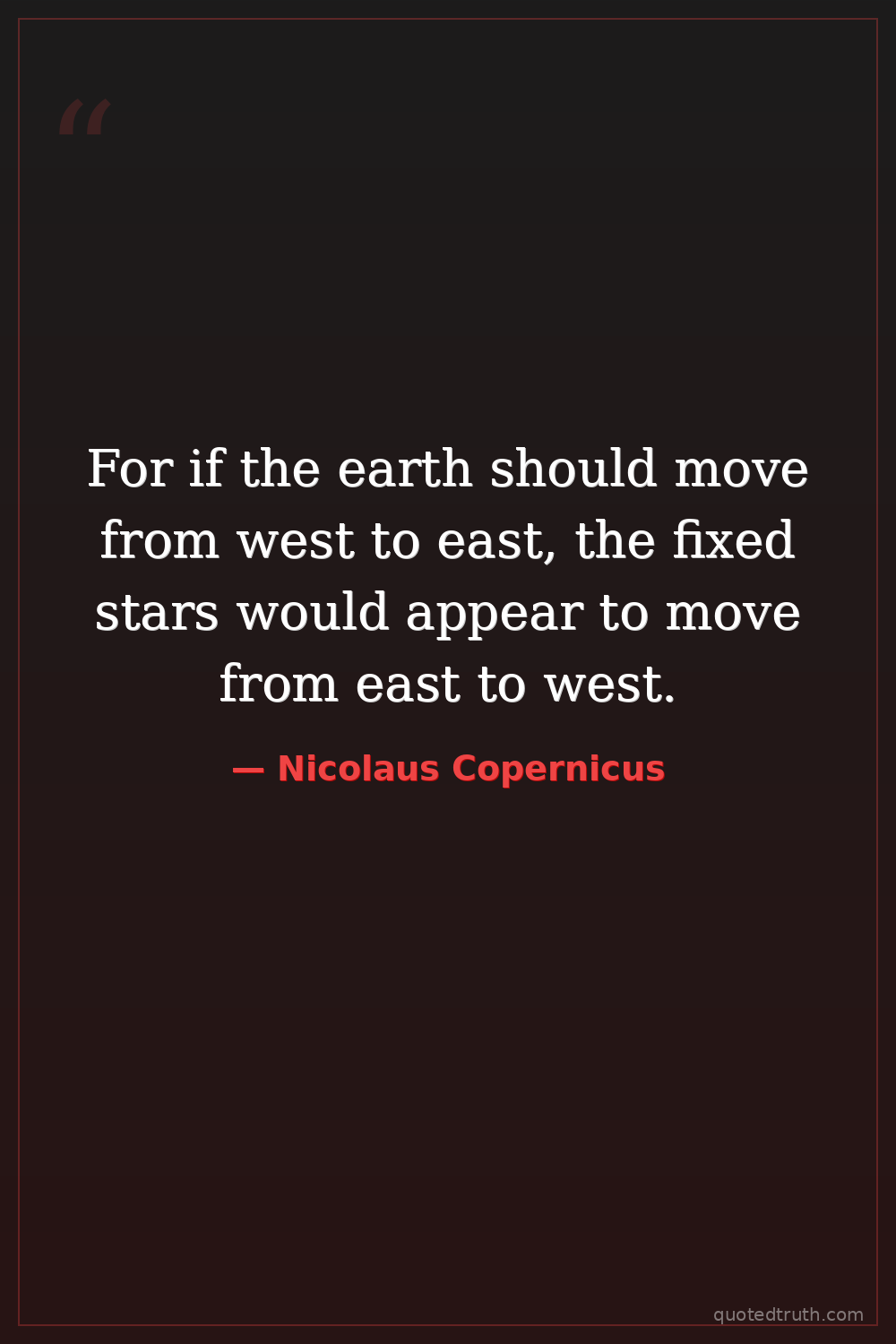
Nicolaus Copernicus — "For if the earth should move from west to east, the fixed stars would appear to …"
For if the earth should move from west to east, the fixed stars would appear to move from east to west.
For if the earth should move from west to east, the fixed stars would appear to move from east to west.
Click any product to generate a realistic preview. Up to 3 at a time.
* Initial load can take up to 90 seconds — revising the preview in another color is nearly instant.
"There are three kinds of motion of the earth, as I shall demonstrate below."
"When, therefore, I had long considered the uncertainty of the traditional mathematical doctrines concerning the order of the spheres of the universe, I began to be annoyed that no more accurate explan…"
"First of all, the world is spherical. This is because the sphere is the most perfect figure of all, and it is the form of the world."
"The earth has a spherical shape, for it is bounded on all sides by the circumference of a circle."
"For the universe, wrought for us by the best and most orderly Workman of all, is a wonderful work."
Found in 1 providers: grok
1 source checked
Earth rotates from west to east — when we stand on this moving platform, the fixed stars appear to drift in the opposite direction, east to west, across our sky. The motion we see in the heavens is not real stellar movement but an illusion created by our own motion. The observer is not stationary; the universe is not revolving around us. Apparent sky motion is a mirror of actual Earth motion.
Copernicus spent over 30 years refining the heliocentric model before publishing De Revolutionibus in 1543, the year he died. Working as a cathedral canon in Frauenburg, Poland — not a professional astronomer — he relied on mathematical reasoning rather than advanced instruments. This statement exemplifies his method: deriving testable predictions from theoretical premises. His career-defining insight was reframing observed stellar motion as a product of Earth's movement, inverting 1,400 years of astronomical assumption.
In the early 16th century, Ptolemaic geocentrism had dominated Western thought for 1,400 years. Universities, the Church, and Aristotelian philosophy all held Earth motionless at the universe's center, treating the nightly east-to-west parade of stars as literal cosmic movement. Copernicus wrote as the Protestant Reformation fractured religious authority across Europe. Recasting stellar motion as an illusion of Earth's rotation was not merely astronomical heresy — it dismantled the philosophical and theological framework that placed humanity at creation's fixed center.
AI-generated insights based on extensive research and information for context. Factual errors? Email [email protected].
Your cart is empty