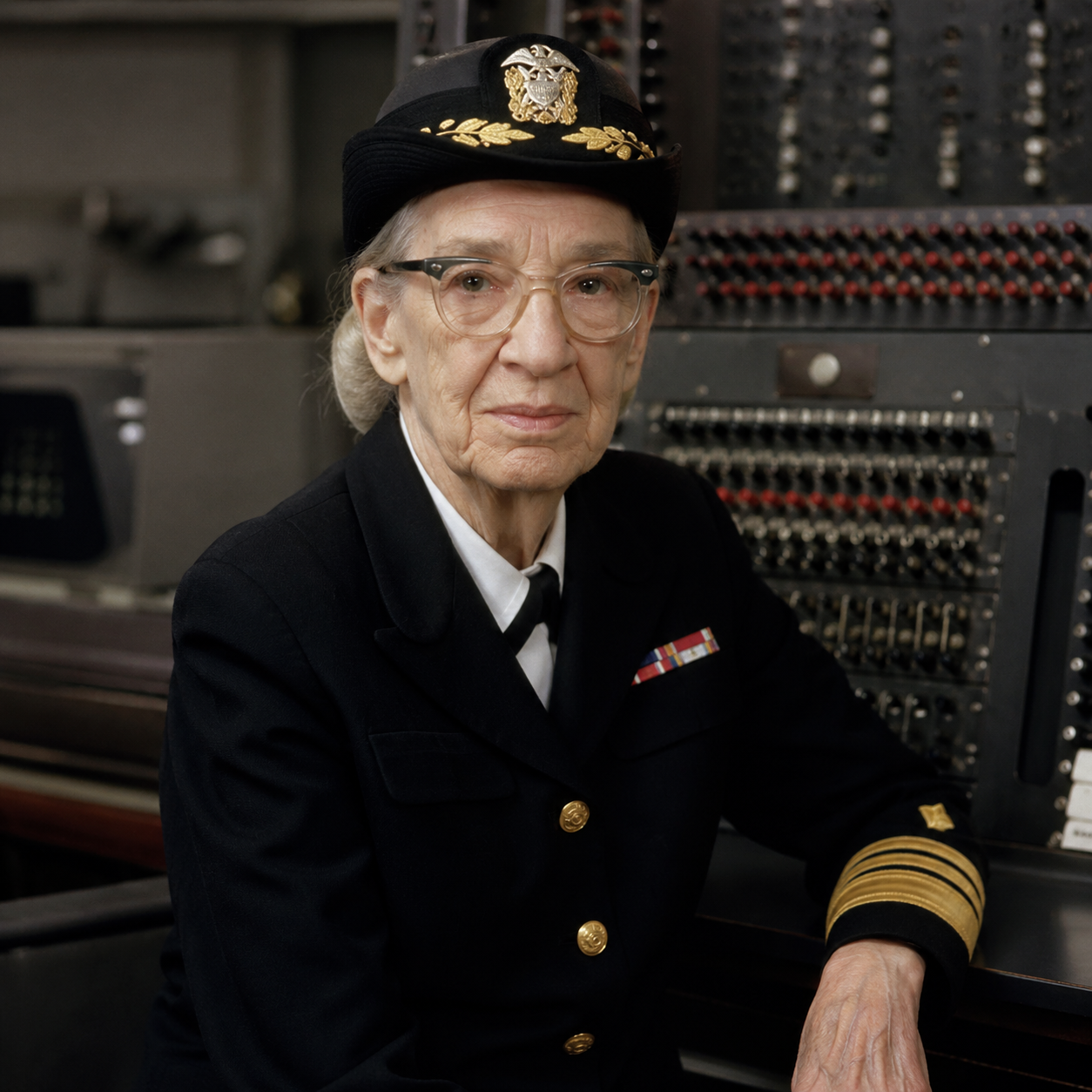
Grace Hopper — "They don't teach you that in school. You learn it by doing it."
They don't teach you that in school. You learn it by doing it.
They don't teach you that in school. You learn it by doing it.
Click any product to generate a realistic preview. Up to 3 at a time.
* Initial load can take up to 90 seconds — revising the preview in another color is nearly instant.
"The computer is the most powerful tool ever invented. It can do anything you tell it to do, but it won't tell you what to do."
"Never, never, never take the first no. There are a certain number of people in business, industry, and government who always say no the first time you suggest something new, because they're lazy... Bu…"
"The greatest danger is not in failure, but in succeeding too easily."
"If it isn't bolted down, bring it home."
"The most important thing I've accomplished, other than building the compiler, is training young people."
Found in 1 providers: grok
1 source checked
Some knowledge can't be taught in a classroom—it only emerges through direct experience. Formal education delivers theory and frameworks, but the practical judgment to apply them comes from actually doing the work: making mistakes, iterating, discovering what textbooks don't mention. Real competence is built in the doing, not the studying. Hands-on learning, apprenticeship, and trial-and-error are irreplaceable paths to genuine expertise.
Grace Hopper spent her career translating abstract computing concepts into practical realities—she invented the first compiler and co-developed COBOL because she believed computers should be programmable in human language, something no textbook had taught. As a Navy Rear Admiral and Harvard PhD, she bridged academia and hands-on engineering. Her famous nanosecond wire demonstrations and decades debugging early mainframes embodied learning-by-doing as a core professional philosophy.
Hopper worked during the 1940s through 1980s, when computing was entirely new—no computer science curricula existed, no textbooks covered what she was building, and universities debated whether programming merited serious study. Pioneers had to invent techniques as they went, making experiential learning mandatory rather than optional. The Cold War accelerated computing's military applications, putting enormous pressure on practitioners to solve novel problems faster than any institution could formally teach.
AI-generated insights based on extensive research and information for context. Factual errors? Email [email protected].
Your cart is empty