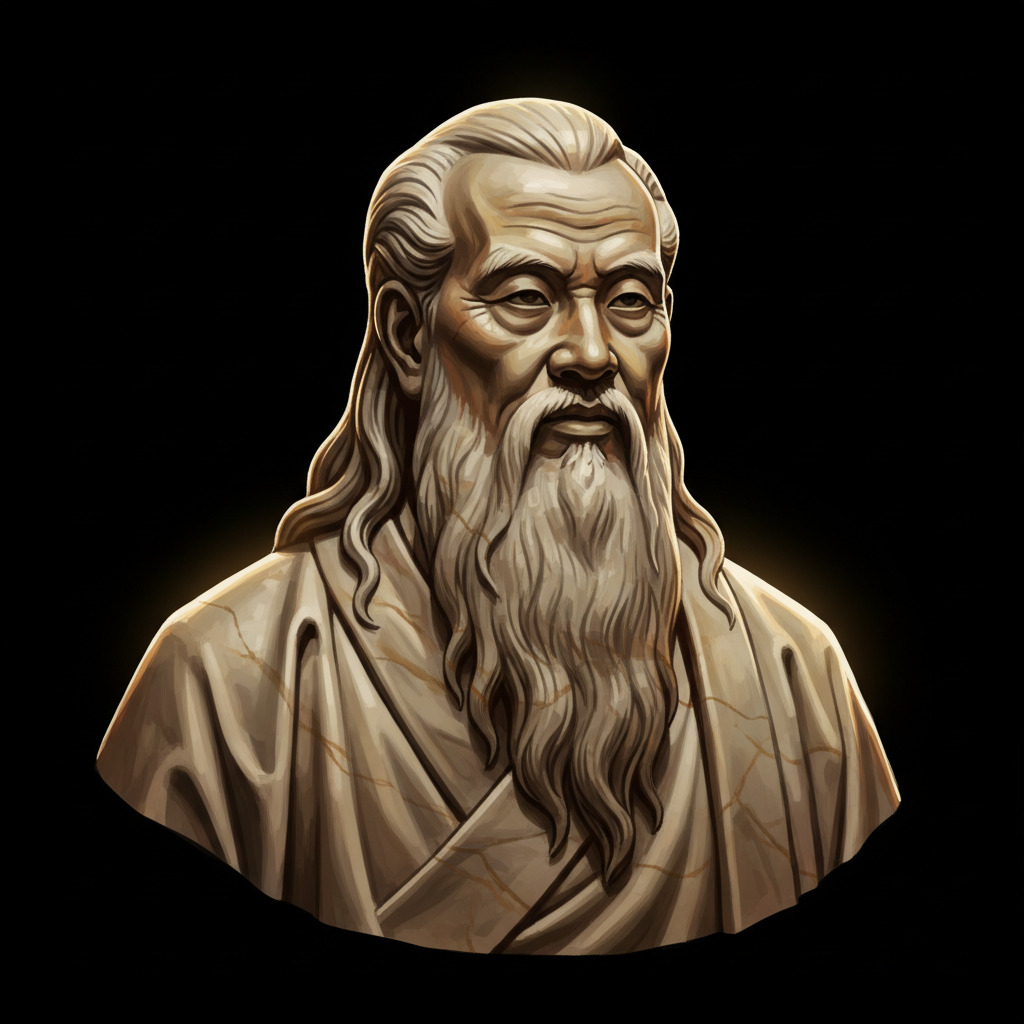
Laozi — "Those who know when to halt are unharmed."
Those who know when to halt are unharmed.
Those who know when to halt are unharmed.
Click any product to generate a realistic preview. Up to 3 at a time.
* Initial load can take up to 90 seconds — revising the preview in another color is nearly instant.
"If you would take, you must first give, this is the beginning of intelligence."
"Use justice to rule a country. Use surprise to wage war. Use non-action to govern the world."
"The Way is ever without action, yet nothing is left undone."
"Silence is a source of great strength."
"The sage is like water, which flows to the lowest places and yet is the strongest."
Reputed founder of Taoism and author of the Tao Te Ching, whose wu wei (effortless action) shaped East Asian philosophy. Closely associated with Zhuangzi (later Taoist who extended Laozi's framework). For an intellectual contrast, see Confucius, near-contemporary Chinese sage of social ritual and duty — Confucius systematized social order through ritual and hierarchy; Laozi argued that all such systems were the disease, not the cure — the two founding poles of Chinese moral philosophy.
Found in 1 providers: gemini
1 source checked
Recognizing the right moment to stop protects you from self-inflicted damage. Pushing past a natural limit—whether in ambition, argument, spending, eating, or conflict—tends to produce the exact loss you were trying to avoid. Knowing when enough is enough is itself a skill: you keep what you have gained, avoid overreach, and preserve your position. Restraint, timed well, is a form of quiet strength rather than weakness or missed opportunity.
Laozi, credited founder of Taoism, built his philosophy around wu wei—effortless action—and the danger of excess. The Tao Te Ching repeatedly warns that overreach invites ruin and that yielding preserves life. Legend says he left society itself when court life grew corrupt, riding west after writing his book—an embodiment of knowing when to halt. His teaching prizes contentment, limits, and stepping back over striving, exactly the restraint this line distills.
Laozi lived during China's late Zhou period, an age of collapsing royal authority sliding toward the Warring States. Feudal lords waged endless wars, ministers schemed, and ambitious men routinely destroyed themselves chasing power, territory, or wealth. Against this backdrop of ruinous striving, Taoist thought offered a counterweight: simplicity, humility, and retreat. Advising people to recognize their limits was not abstract wisdom but urgent practical counsel in a society where unchecked ambition frequently ended in execution, exile, or battlefield death.
AI-generated insights based on extensive research and information for context. Factual errors? Email [email protected].
Your cart is empty