Euclid — "To apply a given parallelogram to a given straight line in a given rectilinear a…"
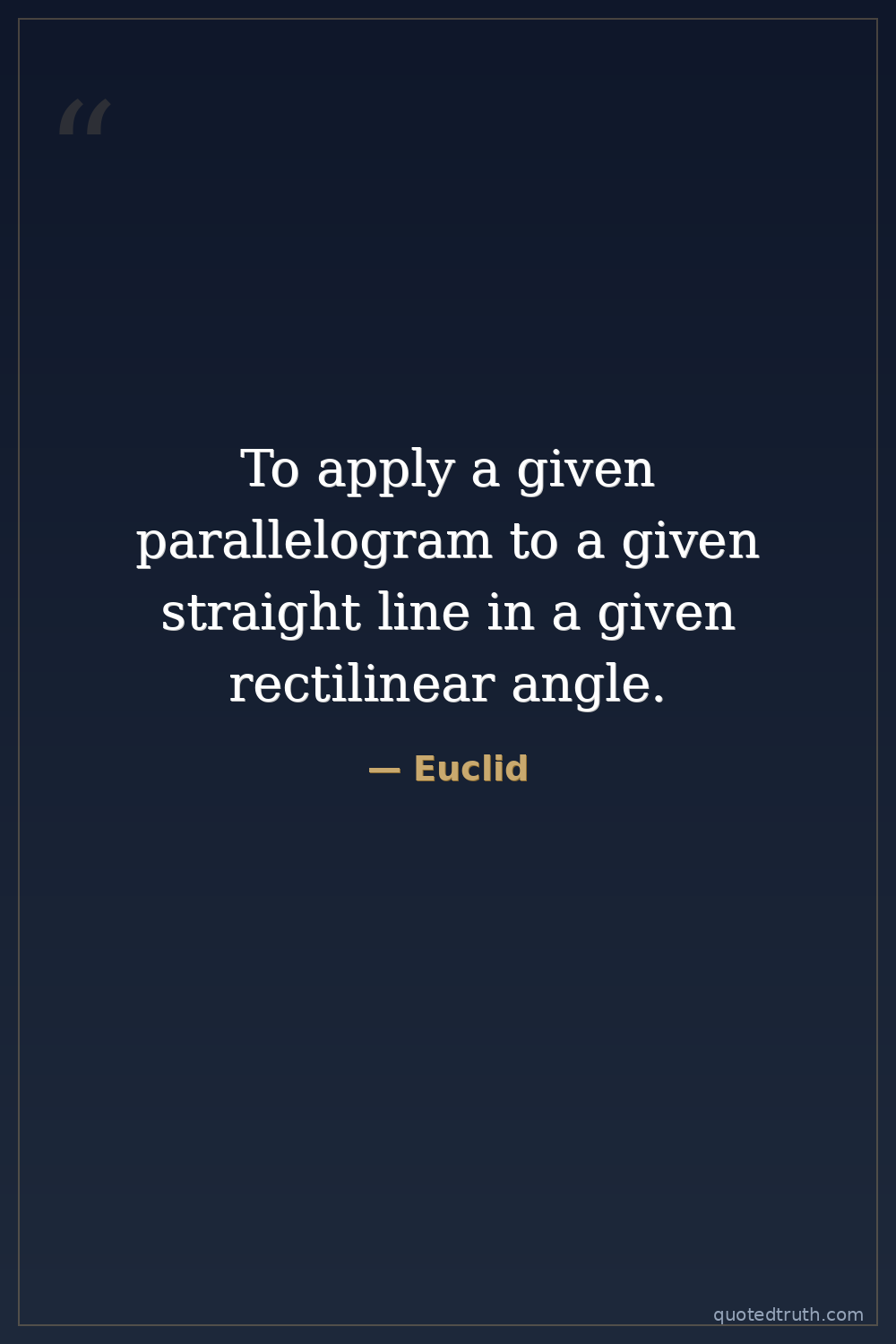
To apply a given parallelogram to a given straight line in a given rectilinear angle.
To apply a given parallelogram to a given straight line in a given rectilinear angle.
Click any product to generate a realistic preview. Up to 3 at a time.
* Initial load can take up to 90 seconds — revising the preview in another color is nearly instant.
"Parallel straight lines are straight lines which, being in the same plane and being produced indefinitely in both directions, do not meet one another in either direction."
"And that, if a straight line falling on two straight lines make the interior angles on the same side less than two right angles, the two straight lines, if produced indefinitely, meet on that side on …"
"To inscribe a regular hexagon in a given circle."
"A plane surface is a surface which lies evenly with the straight lines on itself."
"In isosceles triangles the angles at the base are equal to one another, and, if the equal straight lines be produced further, the angles under the base will be equal to one another."
Found in 1 providers: grok
1 source checked
This describes a precise geometric construction: taking a parallelogram of specific area and reshaping it so one side lies exactly along a given line, with its angles matching a specified angle. It captures the Greek mathematical ideal of transformation through rigorous constraint — you can change a shape's form while preserving its essential quantity, following exact rules without approximation or guesswork.
Euclid's Elements systematically built geometry from axioms through propositions exactly like this one. This construction appears in Book I, reflecting his lifelong method: reduce complex problems to elementary, reproducible steps. Working in Alexandria under Ptolemy I, Euclid believed mathematics demanded proof, not intuition — every transformation must be demonstrated, not assumed. This proposition embodies his philosophy that geometry is a logical edifice, not a craft.
Around 300 BCE, Alexandria was the intellectual capital of the Hellenistic world. Greek mathematicians were formalizing knowledge inherited from Babylonians and Egyptians, who used geometry practically for land surveying and construction. Euclid's innovation was demanding logical proof for everything. This proposition reflects a culture obsessed with order, proportion, and rational demonstration — mathematics as philosophy, not mere calculation, central to educated Greek civic identity.
AI-generated insights based on extensive research and information for context. Factual errors? Email [email protected].
Your cart is empty