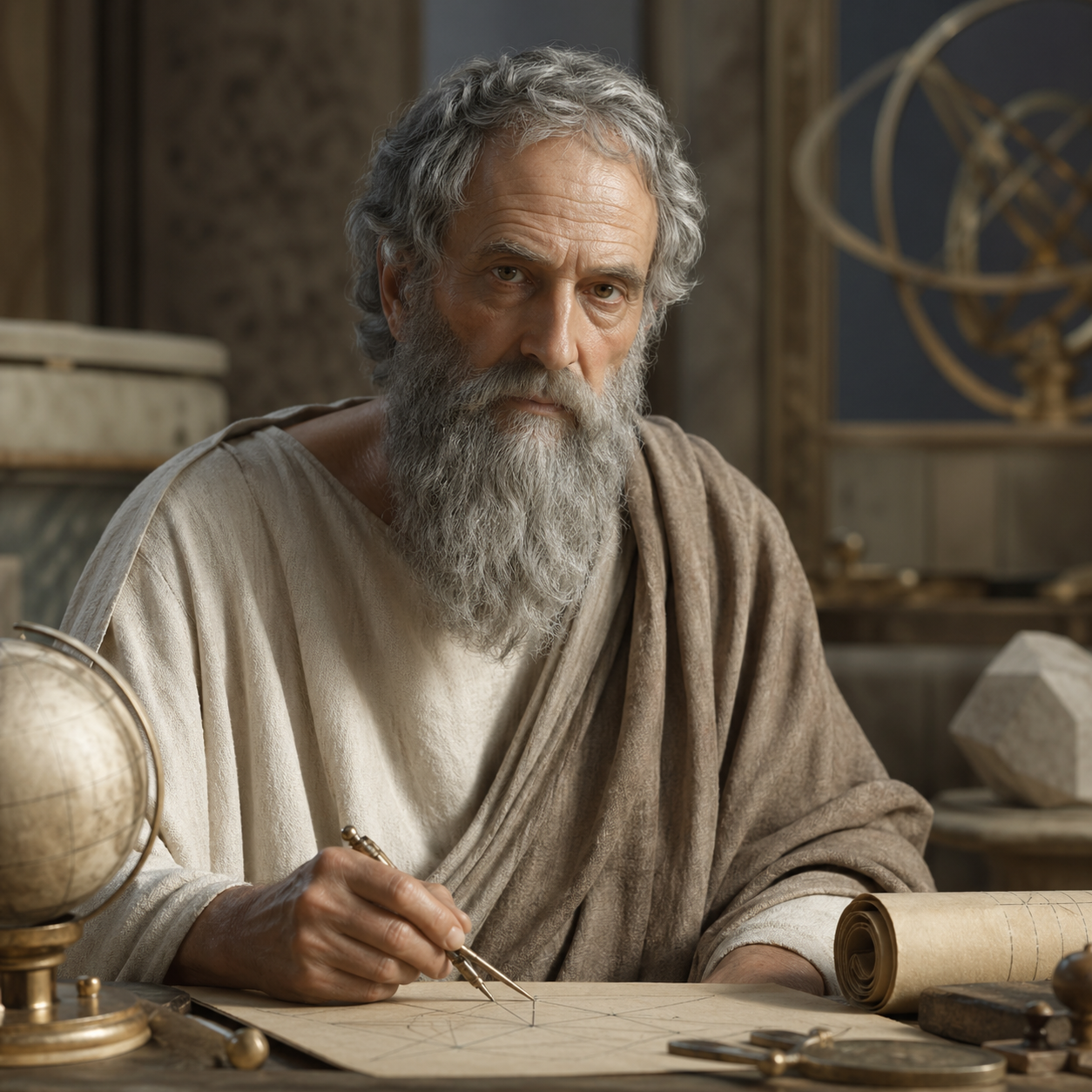
Euclid — "To bisect a given rectilinear angle."
To bisect a given rectilinear angle.
To bisect a given rectilinear angle.
Click any product to generate a realistic preview. Up to 3 at a time.
* Initial load can take up to 90 seconds — revising the preview in another color is nearly instant.
"A diameter of the circle is any straight line drawn through the center and terminated in both directions by the circumference of the circle, and such a straight line also bisects the circle."
"To construct a square on a given straight line."
"Rectilinear figures are those which are contained by straight lines, trilateral figures being those contained by three, quadrilateral those contained by four, and multilateral those contained by more …"
"A plane surface is a surface which lies evenly with the straight lines on itself."
"And the whole is greater than the part."
Found in 1 providers: grok
1 source checked
To split any straight-sided angle exactly in half using only a compass and straightedge. It expresses that even abstract spatial problems have precise, reproducible solutions achievable through pure logic and construction alone. No measurement or estimation is needed — just method. The statement reflects a conviction that complexity can always be reduced to simple, verifiable steps that anyone willing to follow the reasoning can confirm independently.
Euclid (~300 BCE) spent his career compiling all known Greek mathematics into the Elements, thirteen books built from five axioms. This proposition — Book I, Problem 9 — exemplifies his defining method: state the task plainly, construct it step by step, prove it valid. His genius was not inventing new shapes but imposing rigorous logical order on geometry, making it universally teachable and independently verifiable across cultures and centuries.
In Alexandria around 300 BCE, under Ptolemy I's patronage, Greek thinkers were building institutions of systematic knowledge. Practical geometry was critical: annual Nile floods erased land boundaries, requiring precise resurveying. Bisecting angles mattered for construction, navigation, and astronomy. Equally, Greek culture prized logical proof as the highest form of knowledge — turning a craftsman's trick into a theorem elevated geometry from trade skill to philosophy.
AI-generated insights based on extensive research and information for context. Factual errors? Email [email protected].
Your cart is empty