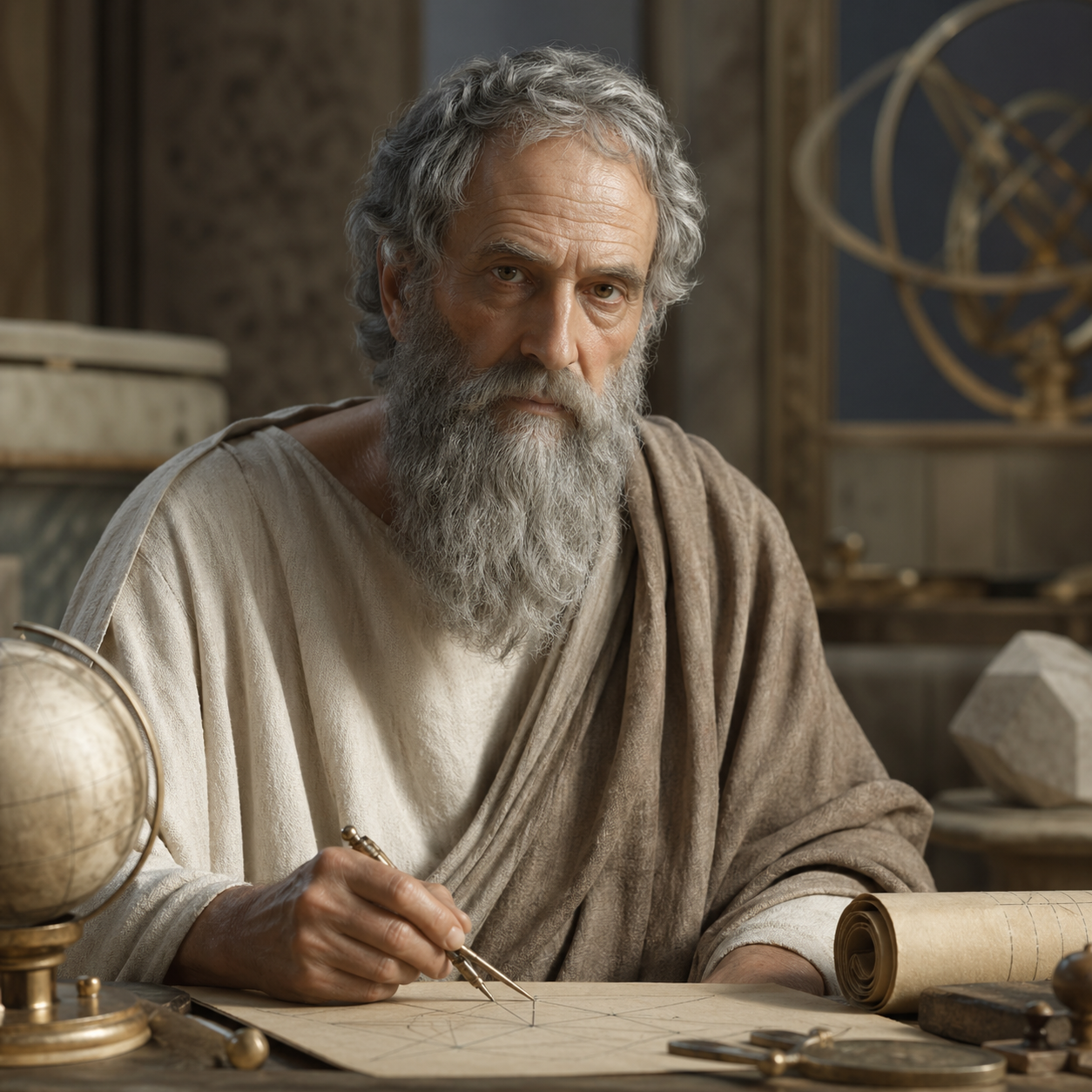
Euclid — "To construct a regular pentagon in a given circle."
To construct a regular pentagon in a given circle.
To construct a regular pentagon in a given circle.
Click any product to generate a realistic preview. Up to 3 at a time.
* Initial load can take up to 90 seconds — revising the preview in another color is nearly instant.
"There are infinitely many prime numbers."
"A surface is that which has length and breadth only."
"Let the following be postulated:"
"Of trilateral figures, an equilateral triangle is that which has its three sides equal, an isosceles triangle that which has two of its sides alone equal, and a scalene triangle that which has its thr…"
"The postulates are not self-evident, but they are necessary for the development of geometry."
Found in 1 providers: grok
1 source checked
This is a geometric construction problem — how to inscribe a perfect five-sided polygon inside a circle using only a compass and straightedge, no measuring allowed. It expresses that pure geometric forms can be built through pure logic and procedure. The difficulty: dividing a circle into five equal parts requires finding the golden ratio first, making this one of geometry's most elegant and demanding classical challenges.
Euclid's Elements systematically built geometry from simple axioms to complex propositions, and this pentagon construction appears in Book IV as a capstone achievement. Euclid taught in Alexandria around 300 BCE and believed geometric truth must be demonstrated, not assumed. The pentagon required him to first prove properties of the golden ratio, exemplifying his characteristic method of building each result on rigorous prior foundations.
In Alexandria around 300 BCE, under Ptolemy I's patronage, Greek scholars were systematizing all human knowledge. The regular pentagon carried deep cultural weight: the Pythagoreans used the pentagram as their secret symbol, and Plato linked the dodecahedron — twelve pentagons — to the cosmos itself. Constructing one rigorously, without approximation, answered a philosophical demand that mathematical truth be provable, not merely observed or believed.
AI-generated insights based on extensive research and information for context. Factual errors? Email [email protected].
Your cart is empty