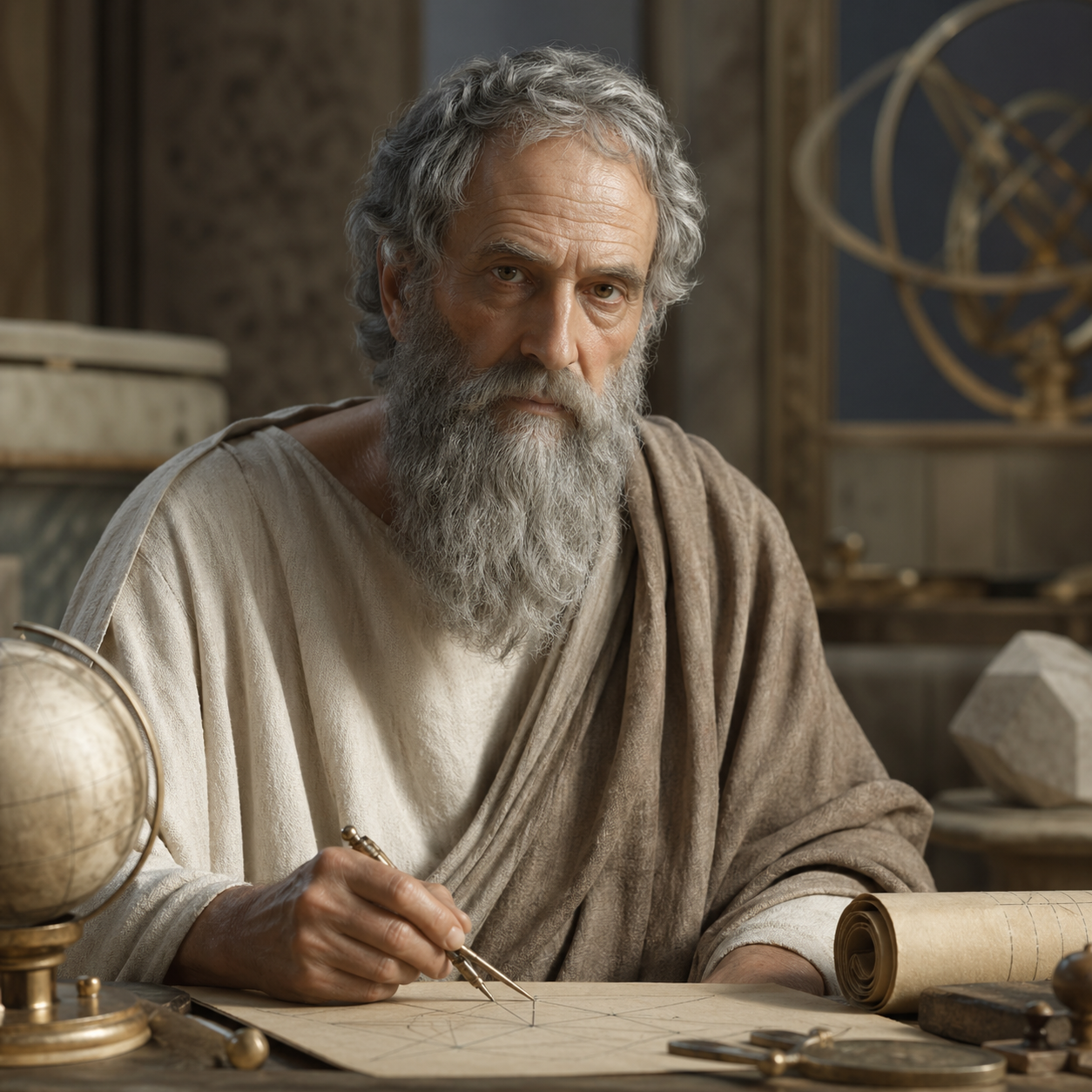
Euclid — "To produce a finite straight line continuously in a straight line."
To produce a finite straight line continuously in a straight line.
To produce a finite straight line continuously in a straight line.
Click any product to generate a realistic preview. Up to 3 at a time.
* Initial load can take up to 90 seconds — revising the preview in another color is nearly instant.
"Let it be granted that a finite straight line may be produced to any length in a straight line."
"Things which coincide with one another are equal to one another."
"A diameter of the circle is any straight line drawn through the center and terminated in both directions by the circumference of the circle, and such a straight line also bisects the circle."
"Of trilateral figures, an equilateral triangle is that which has its three sides equal, an isosceles triangle that which has two of its sides alone equal, and a scalene triangle that which has its thr…"
"Let it be granted that a straight line may be drawn from any one point to any other point."
Found in 1 providers: grok
1 source checked
A line segment can always be extended beyond its endpoints, continuing indefinitely in the same direction without interruption. This establishes that space itself is unbounded and that straightness is a consistent, uninterrupted property. Lines don't suddenly curve, stop, or change character — extension preserves the fundamental nature of the straight line, making infinite space geometrically coherent and workable.
This is Euclid's Second Postulate from Elements, the foundational text he wrote around 300 BCE. It reflects his method of building all geometry from irreducible, self-evident assumptions. Euclid's genius was not discovery of individual theorems but systematic axiomatization — establishing minimum assumptions from which all geometric truth could be logically derived. This postulate anchors his entire deductive architecture.
In Hellenistic Alexandria, circa 300 BCE, Greek thinkers were obsessed with certainty and logical proof — reacting against sophistry and opinion. Euclid wrote under Ptolemy I, whose Museum and Library made Alexandria the intellectual capital of the ancient world. Establishing geometry on unquestionable postulates mirrored the broader Greek philosophical drive to find unchanging truths beneath the flux of observable reality.
AI-generated insights based on extensive research and information for context. Factual errors? Email [email protected].
Your cart is empty