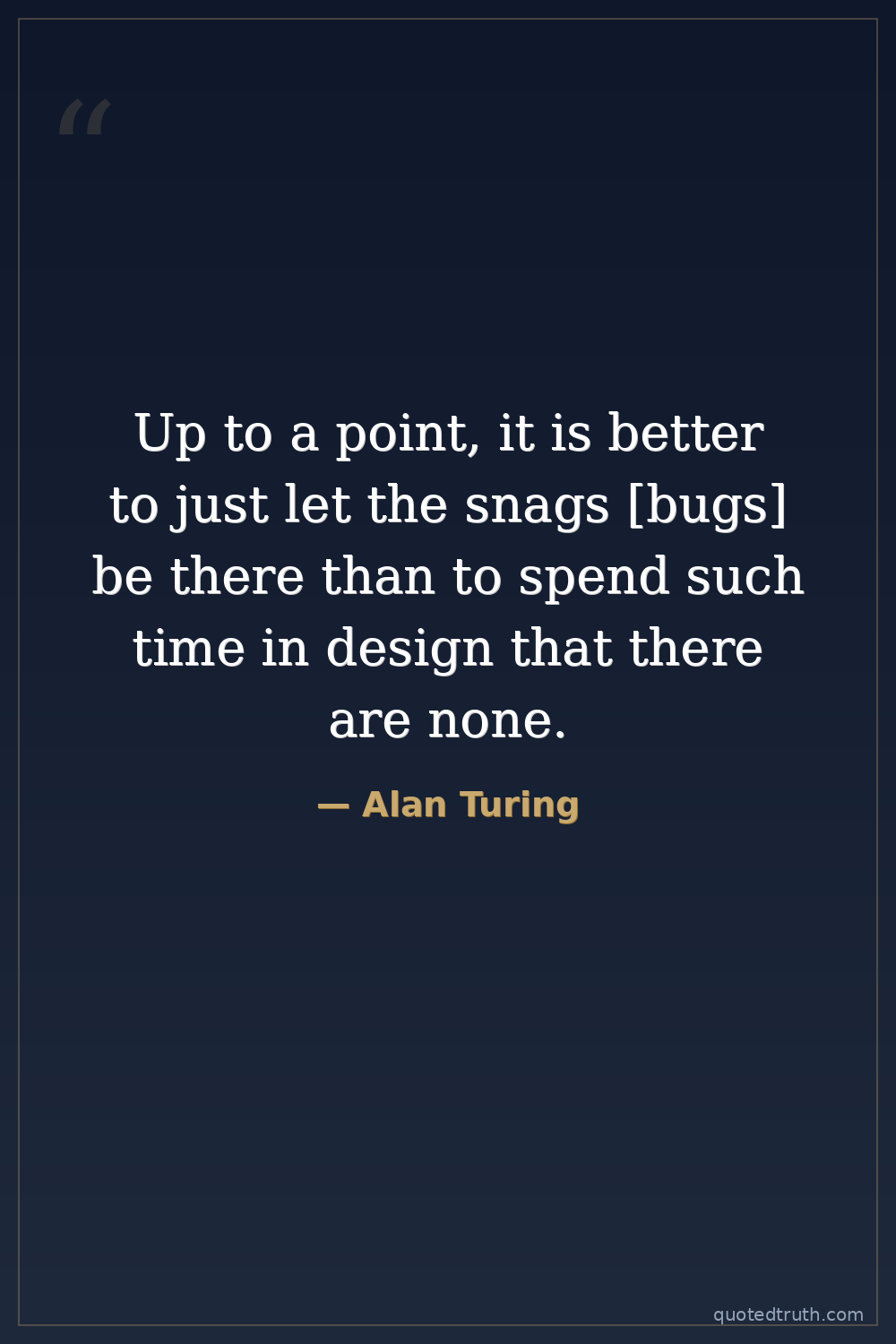
Alan Turing — "Up to a point, it is better to just let the snags [bugs] be there than to spend …"
Up to a point, it is better to just let the snags [bugs] be there than to spend such time in design that there are none.
Up to a point, it is better to just let the snags [bugs] be there than to spend such time in design that there are none.
Click any product to generate a realistic preview. Up to 3 at a time.
* Initial load can take up to 90 seconds — revising the preview in another color is nearly instant.
"The human brain is a very remarkable thing, but it is not infallible."
"The human brain is a machine, and it can be simulated by another machine."
"The most important thing for a mathematician is intuition."
"I believe that in about fifty years' time it will be possible to programme computers, with a storage capacity of about 10^9, to make them play the imitation game so well that an average interrogator w…"
"We are not interested in the fact that the brain has the consistency of cold porridge."
Within collected quotes, exact original source not specified but widely attributed.
Date: Unknown
Art & CreativityFound in 1 providers: gemini
1 source checked
A pragmatic argument against over-engineering: spending excessive time eliminating every flaw yields diminishing returns. At some threshold, a working system with minor bugs delivers more value than a theoretically perfect system never shipped. The real cost of chasing zero defects often exceeds the cost of the defects themselves. Accepting tolerable imperfections allows functional work to move forward rather than stall indefinitely in pursuit of an unreachable ideal.
Turing built the Bombe codebreaking machine at Bletchley Park under wartime urgency — perfectionism could cost lives. Designing early computers like the ACE and Manchester Mark 1, he favored iterative, empirical methods over exhaustive pre-design. His Turing Test similarly embraced practical uncertainty: a working behavioral test beats an unanswerable philosophical definition. Incompleteness was foundational to his mathematics, deeply shaped by Gödel's incompleteness theorems.
The 1940s–50s saw computing built from scratch with vacuum tubes, relay switches, and paper tape — hardware failures were routine. Wartime codebreaking demanded speed over perfection; delays cost intelligence. Post-war, the discipline of debugging was itself new — Grace Hopper famously logged a literal moth caught in a relay in 1947. Iterative progress on imperfect machines mattered far more than waiting for flawless theoretical designs.
AI-generated insights based on extensive research and information for context. Factual errors? Email [email protected].
Your cart is empty