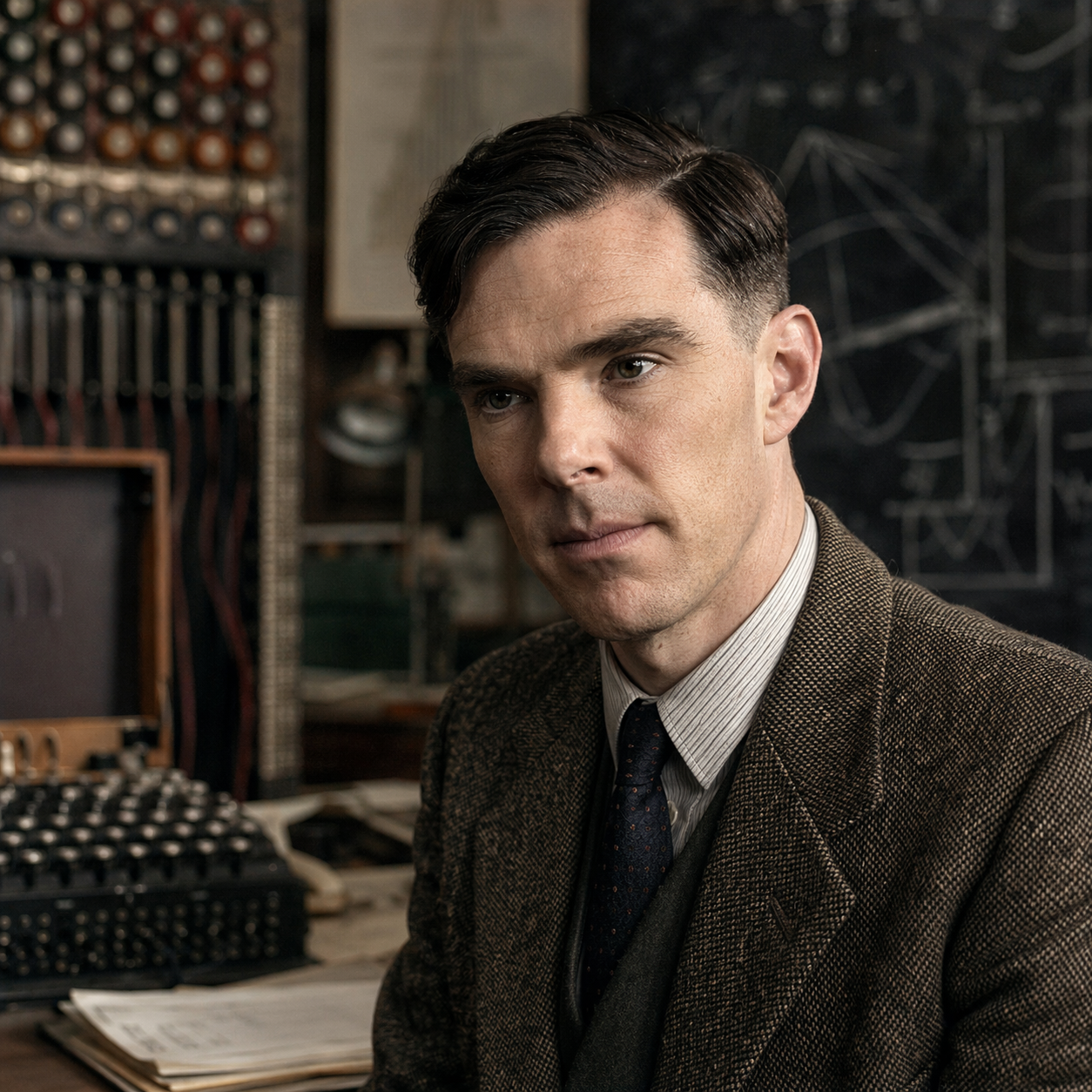
Alan Turing — "We are trying to construct a machine which will be able to do everything that a …"
We are trying to construct a machine which will be able to do everything that a man can do.
We are trying to construct a machine which will be able to do everything that a man can do.
Click any product to generate a realistic preview. Up to 3 at a time.
* Initial load can take up to 90 seconds — revising the preview in another color is nearly instant.
"The original question, 'Can machines think?' I believe to be too meaningless to deserve discussion. Nevertheless I believe that at the end of the century the use of words and general educated opinion …"
"I believe that in about fifty years' time it will be possible to programme computers, with a storage capacity of about 10^9, to make them play the imitation game so well that an average interrogator w…"
"The extent to which we regard mind as distinct from matter, is a matter of convention."
"If a machine can pass the Turing Test, then it is intelligent."
"A computer is a universal machine, capable of carrying out any calculation that can be performed by a human."
Found in 1 providers: grok
1 source checked
The quote expresses the ultimate ambition of machine intelligence: building a system capable of matching every human cognitive ability — not just arithmetic or rote tasks, but reasoning, creativity, language, and judgment. It frames artificial intelligence not as narrow automation but as full cognitive parity, directly challenging the deeply held assumption that human thought is uniquely irreducible to any mechanical or computational process.
Turing's 1950 paper 'Computing Machinery and Intelligence' posed 'Can machines think?' and introduced the imitation game, now called the Turing Test. His Universal Turing Machine theory proved one device could simulate any computation. At Bletchley Park, he demonstrated machines could tackle complex, human-seeming pattern recognition. Turing believed intelligence was purely functional — given the right program, any machine could replicate any mental process, making him the founder of AI.
In the late 1940s and early 1950s, computers were enormous single-purpose machines filling entire rooms, used mainly for ballistics and census calculations. The idea of a general-purpose thinking machine was radical and widely dismissed. Post-WWII scientists were only beginning to grasp what computation could achieve. Most philosophers and engineers believed human reasoning was uniquely unmechanizable, making Turing's flat assertion that machines could equal human capability genuinely shocking.
AI-generated insights based on extensive research and information for context. Factual errors? Email [email protected].
Your cart is empty