Alan Turing — "We can only see a short distance ahead, but we can see plenty there that needs t…"
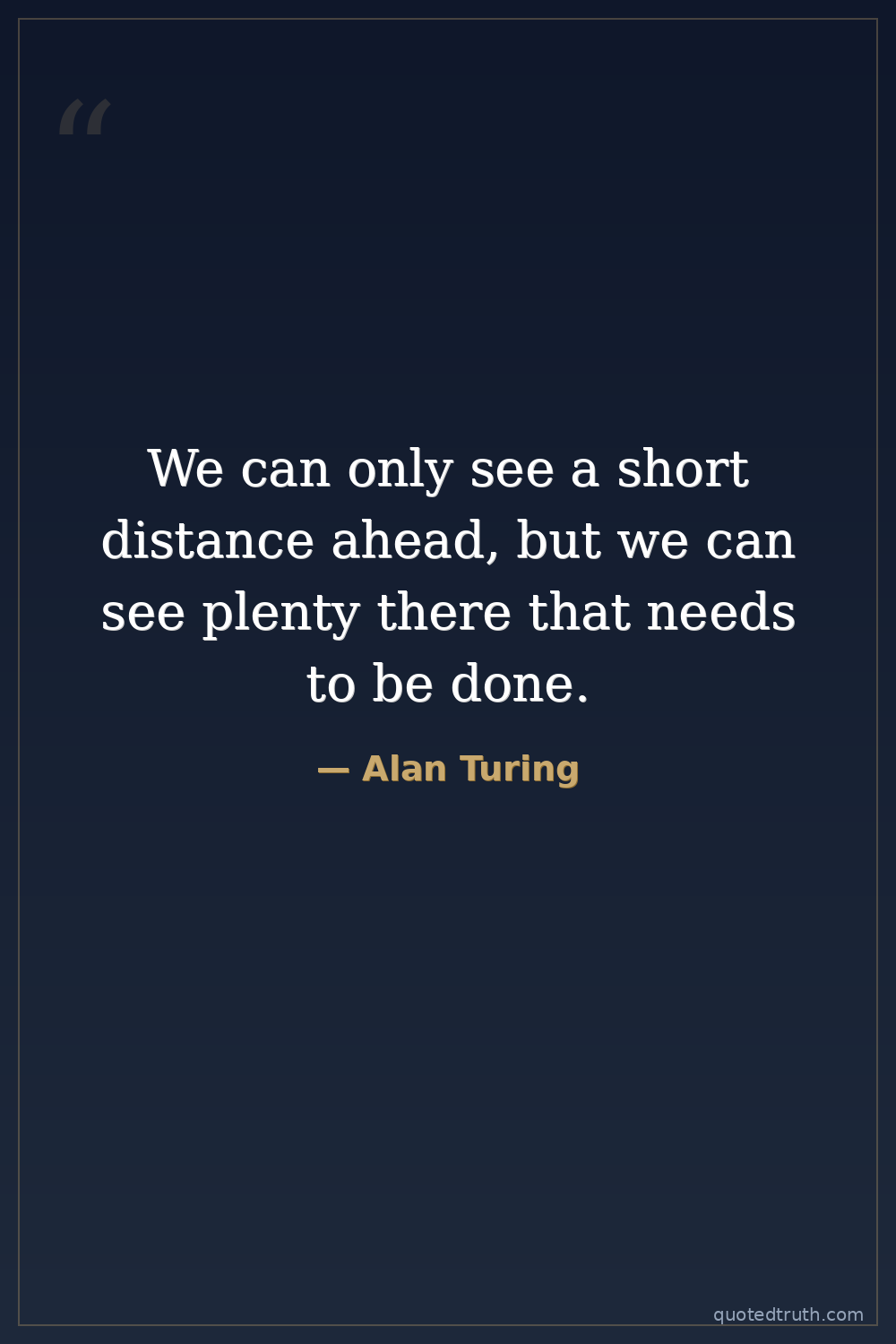
We can only see a short distance ahead, but we can see plenty there that needs to be done.
We can only see a short distance ahead, but we can see plenty there that needs to be done.
Click any product to generate a realistic preview. Up to 3 at a time.
* Initial load can take up to 90 seconds — revising the preview in another color is nearly instant.
"The question of whether machines can think is a philosophical one, not a scientific one."
"One day ladies will take their computers for walks in the park and tell each other, 'My little computer said such a funny thing this morning'."
"A human being is a machine for converting food into thoughts."
"There would be great opposition from the intellectuals who were afraid of being put out of a job. It is probable though that the intellectuals would be mistaken about this. There would be plenty to do…"
"Unless in communicating with it one says exactly what one means, trouble is bound to result."
Found in 2 providers: grok,gemini
2 sources checked
Despite limited foresight into the future, the immediate path ahead always presents clear, actionable problems worth solving. You don't need complete knowledge of where a journey ends to begin meaningful work. The visible horizon is enough to act on — progress comes from addressing what's directly in front of you rather than waiting for perfect clarity about distant outcomes.
Turing built the theoretical foundation of computing without knowing where it would lead. At Bletchley Park, he solved Enigma one day at a time, not knowing if the war would be won. His 1950 paper posing 'Can machines think?' tackled an immediate problem he could see clearly, even as the full implications of artificial intelligence remained unknowable decades away.
Written in 1950, amid post-WWII reconstruction and the Cold War's dawn, uncertainty pervaded every institution. Computing was embryonic — transistors invented just three years prior. Scientists like Turing operated without roadmaps, building disciplines from scratch. The atomic age had shattered confidence in long-range prediction, making this philosophy of focused, near-term problem-solving both practically necessary and intellectually honest.
AI-generated insights based on extensive research and information for context. Factual errors? Email [email protected].
Your cart is empty