Martin Luther — "We consider EVERYTHING allowable against the deception and depravity of the papa…"
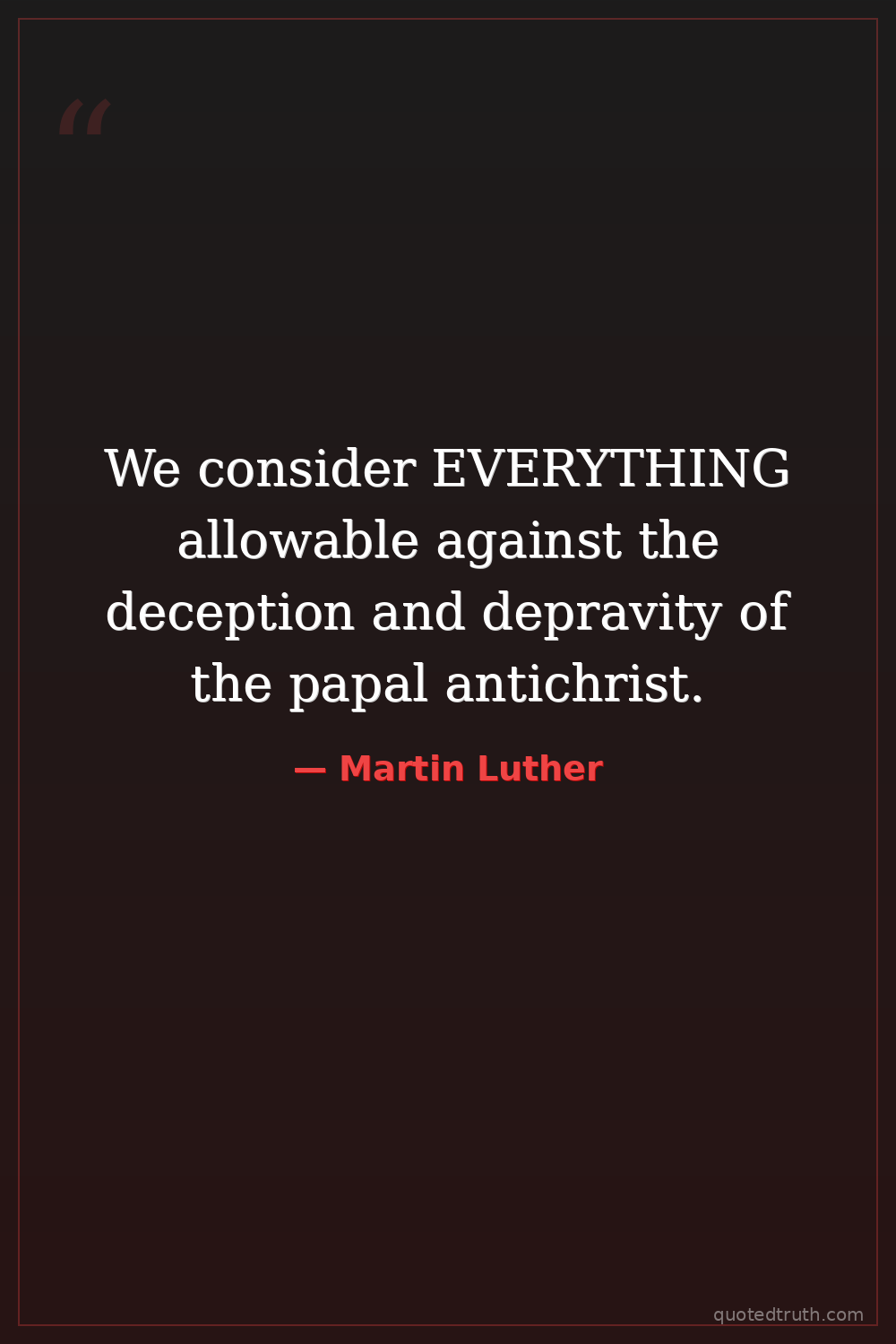
We consider EVERYTHING allowable against the deception and depravity of the papal antichrist.
We consider EVERYTHING allowable against the deception and depravity of the papal antichrist.
Click any product to generate a realistic preview. Up to 3 at a time.
* Initial load can take up to 90 seconds — revising the preview in another color is nearly instant.
"Reason is the greatest enemy that faith has; it never comes to the aid of spiritual things, but more frequently than not struggles against the divine Word, treating with contempt all that emanates fro…"
"True humility does not know that it is humble. If it did, it would be proud from the contemplation of so fine a virtue."
"I have often tried to be angry with the devil, but I cannot; he is such a merry knave."
"Your home, once the holiest of all, has become the most licentious den of thieves, the most shameless of all brothels, the kingdom of sin, death, and hell. It is so bad that even Antichrist himself, i…"
"You have as much laughter as you have faith."
German theologian whose 95 Theses (1517) launched the Protestant Reformation and broke the Catholic Church's monopoly on Western Christianity. Closely associated with Philipp Melanchthon (Lutheran systematizer) and John Calvin (later Reformer who built on Luther's break). For an intellectual contrast, see Pope Leo X, Renaissance pope (1513-1521) — Leo X's indulgence sales triggered Luther's break and Leo excommunicated him in 1521 — Luther's entire Reformation is structured as a direct answer to the indulgence-funded Vatican Leo represented.
Found in 1 providers: gemini
1 source checked
Luther declares that any means of opposition is justified when confronting what he views as the pope's lies and moral corruption. He frames the Roman Catholic leadership as so thoroughly evil that normal rules of restraint, decorum, or compromise no longer apply. In modern terms, he is saying the enemy is so illegitimate that resistance to it carries no limits, and believers owe it no deference, obedience, or polite treatment whatsoever.
Luther built his career attacking the papacy after his 95 Theses in 1517, and repeatedly called the pope the Antichrist in writings like Against the Roman Papacy. An Augustinian monk turned excommunicated reformer, he used blistering polemic as a core tool, defending vernacular scripture, justification by faith, and rejection of papal authority. This quote captures his uncompromising combativeness, his conviction that Rome was spiritually fraudulent, and his willingness to use any rhetorical weapon available.
In early modern Europe, the Reformation fractured Latin Christendom, fueled by the printing press, indulgence abuses, and rising princely power against Rome. Luther's 1521 excommunication, the Diet of Worms, the Peasants' War, and decades of religious warfare culminating in the 1555 Peace of Augsburg defined the age. Calling the pope Antichrist was dangerous but widespread among reformers, and polemical extremity was rewarded because survival depended on mobilizing princes, cities, and congregations against a still-dominant Catholic Church.
AI-generated insights based on extensive research and information for context. Factual errors? Email [email protected].
Your cart is empty