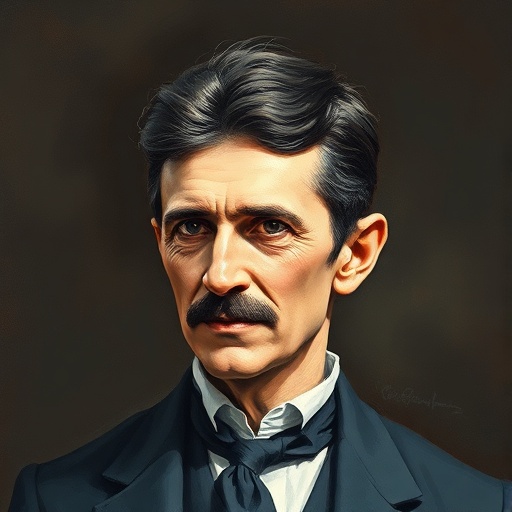
Nikola Tesla — "We crave for new sensations but soon become indifferent to them. The wonders of …"
We crave for new sensations but soon become indifferent to them. The wonders of yesterday are today common occurrences.
We crave for new sensations but soon become indifferent to them. The wonders of yesterday are today common occurrences.
Click any product to generate a realistic preview. Up to 3 at a time.
* Initial load can take up to 90 seconds — revising the preview in another color is nearly instant.
"I could only with difficulty understand the enthusiasm of others for any but engineering achievements."
"From childhood I was compelled to concentrate attention upon myself. This caused me much suffering but, to my present view, it was a blessing in disguise for it has taught me to appreciate the inestim…"
"The harness of the forces of nature is the only means of true progress."
"I have been feeding pigeons, thousands of them, for years. But there was one, a beautiful bird, pure white with light grey tips on its wings; that one was different."
"I could hear a fly walking across the room."
Serbian-American inventor and electrical engineer whose alternating-current designs powered the modern electrical grid; died poor and largely forgotten. Closely associated with George Westinghouse (his AC-power business partner) and Mihajlo Pupin (fellow Serbian-American physicist at Columbia). For an intellectual contrast, see Thomas Edison, American inventor and direct-current advocate — Edison's direct-current power-distribution scheme was displaced by Tesla-Westinghouse AC in the 1890s 'War of Currents'. Edison ran a public-relations campaign electrocuting animals to discredit AC — the most famous engineering-ethics rivalry in American history. Tesla's AC won and powers nearly every electrical grid on Earth.
Profound observation on human nature, adaptation, and the fleeting nature of wonder.
Date: Approximate
PhilosophicalFound in 1 providers: gemini
1 source checked
Humans constantly chase novelty and excitement, but once something new becomes familiar, it loses its power to impress us. What once seemed miraculous quickly becomes mundane routine. We adapt so rapidly that yesterday's breakthrough feels ordinary today, leaving us always hungry for the next sensation rather than appreciating what we already have.
Tesla witnessed his own revolutionary inventions—AC power, radio transmission, rotating magnetic fields—become everyday utilities within his lifetime. He dedicated decades to discoveries that the public initially marveled at, then took for granted. His later work on wireless energy transmission struggled for funding partly because society had already normalized his earlier miracles, leaving him perpetually chasing recognition.
Tesla lived through an unprecedented technological explosion: electric lighting replaced gas lamps, telephones connected cities, automobiles appeared on streets, and airplanes took flight—all within decades. Society absorbed each shock quickly. By the early 20th century, electricity itself had transformed from spectacle to infrastructure, perfectly illustrating how rapidly the extraordinary becomes ordinary during industrialization's relentless forward march.
AI-generated insights based on extensive research and information for context. Factual errors? Email [email protected].
Your cart is empty