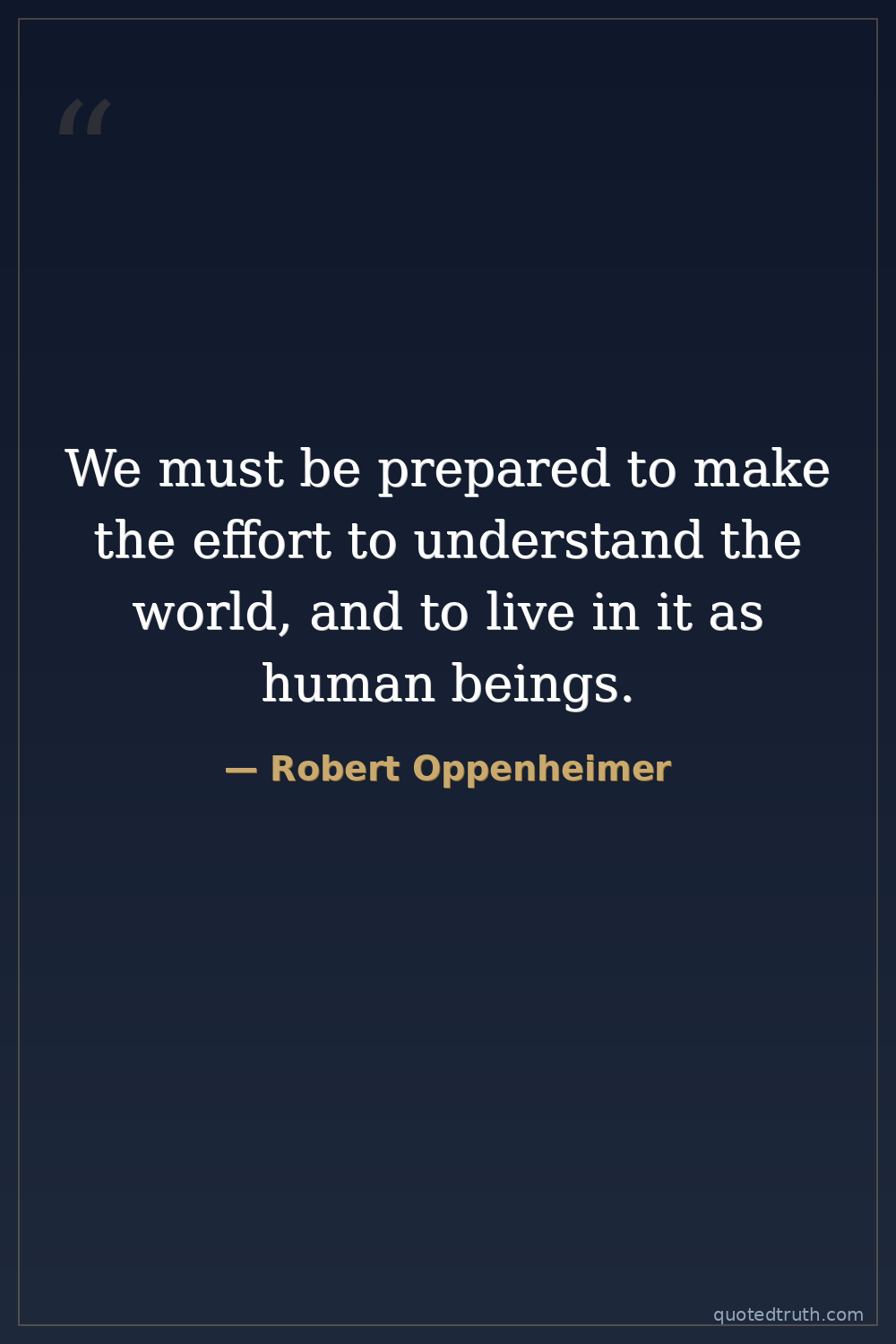
Robert Oppenheimer — "We must be prepared to make the effort to understand the world, and to live in i…"
We must be prepared to make the effort to understand the world, and to live in it as human beings.
We must be prepared to make the effort to understand the world, and to live in it as human beings.
Click any product to generate a realistic preview. Up to 3 at a time.
* Initial load can take up to 90 seconds — revising the preview in another color is nearly instant.
"In some sort of crude sense which no vulgarity, no humor, no overstatement can quite extinguish, the physicists have known sin; and this is a knowledge which they cannot lose."
"The experience of one's own country and of other countries, the experience of men and women, of cities and of the earth, is an experience which can only be had in freedom."
"We do not believe any group of men adequate enough or wise enough to operate without scrutiny or without criticism. We know that the only way to avoid error is to detect it, that the only way to detec…"
"The atomic bomb has taught us that we are not masters of our own destiny."
"If you are a scientist, you believe that it is good to find out how the world works; that it is good to find out what the realities are; that it is good to turn over to mankind at large the greatest p…"
American theoretical physicist who directed the Manhattan Project's Los Alamos Laboratory and oversaw the atomic bombs; lost his security clearance in 1954. Closely associated with Niels Bohr (Manhattan Project consultant and atomic-policy advisor) and Hans Bethe (Los Alamos theoretical-division chief). For an intellectual contrast, see Edward Teller, Hungarian-American physicist and 'father of the H-bomb' — Teller pushed the H-bomb against Oppenheimer's objections and testified against him at his 1954 security hearing — the precise moment that ended Oppenheimer's career. The canonical 'physicist-of-conscience vs physicist-of-state' pairing in nuclear-age ethics; Christopher Nolan's Oppenheimer (2023) dramatized this rivalry for a mass audience.
Found in 1 providers: grok
1 source checked
Understanding the world demands active, sustained effort — not passive drift. But knowledge alone isn't sufficient; we must also engage with life as moral, feeling beings capable of empathy and judgment. The quote insists on combining intellectual rigor with human responsibility, rejecting both willful ignorance and cold expertise divorced from ethics. Think hard, but never lose sight of what it means to be human while doing so.
Oppenheimer directed the Manhattan Project, helping create weapons that killed over 100,000 people in Hiroshima and Nagasaki. Afterward he famously quoted the Bhagavad Gita: 'Now I am become Death.' He spent his post-war years advocating for nuclear arms control and warning against unchecked weapons development, ultimately losing his security clearance in 1954. This quote captures his core tension: a physicist of extraordinary brilliance who believed scientific mastery must be tempered by moral reckoning.
Oppenheimer's era saw science transformed into unprecedented destructive power. The 1945 atomic bombings ended WWII but opened the nuclear age. The Cold War brought hydrogen bomb development, Soviet nuclear tests, and existential fear of annihilation. Scientists faced urgent ethical questions about complicity in weapons research. McCarthyism then punished dissent, culminating in Oppenheimer's 1954 security hearing. This climate made the question of how to live as responsible human beings — not just effective scientists — acutely pressing.
AI-generated insights based on extensive research and information for context. Factual errors? Email [email protected].
Your cart is empty