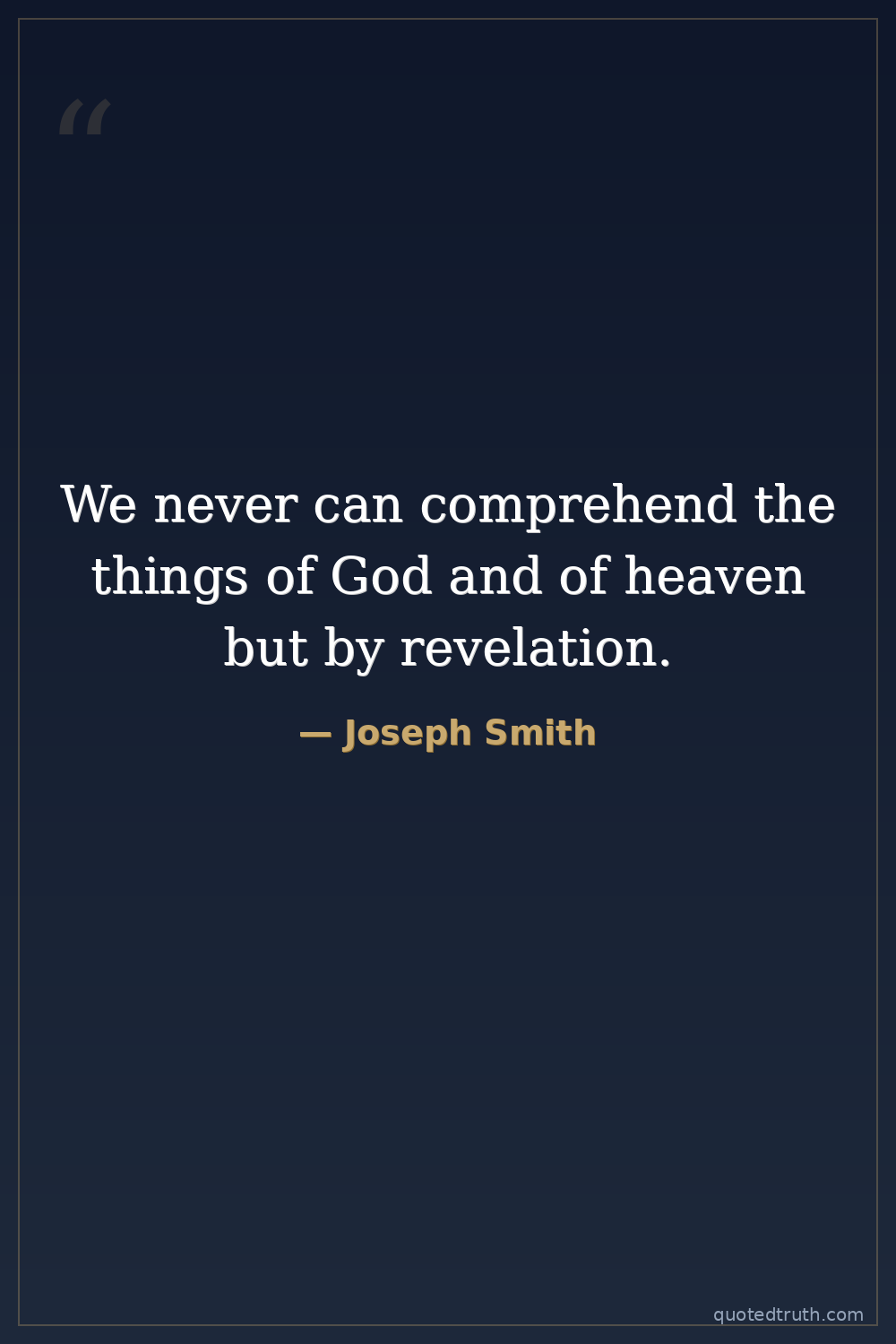
Joseph Smith — "We never can comprehend the things of God and of heaven but by revelation."
We never can comprehend the things of God and of heaven but by revelation.
We never can comprehend the things of God and of heaven but by revelation.
Click any product to generate a realistic preview. Up to 3 at a time.
* Initial load can take up to 90 seconds — revising the preview in another color is nearly instant.
"I am a man of love, and I will love God and all men to the end."
"I am a rough stone. The sound of the hammer and chisel is continually upon me. I desire the voice of the Lord to ring in my ears, and I am willing to bear the consequence."
"I have the best of feelings for all men, and I wish them all to be saved."
"I am a man of God, and I will stand for the truth, though the heavens fall."
"I am a man of God, and I desire to do the will of God."
Found in 1 providers: gemini
1 source checked
Human reason and intellect alone cannot access divine truth. Only revelation — direct communication from God — bridges the gap between mortal understanding and heavenly knowledge. This rejects purely philosophical or academic approaches to theology, insisting that spiritual reality operates on a different plane than ordinary experience. To know God, one must receive what God chooses to disclose; it cannot be deduced, reasoned, or discovered through human effort alone.
Smith's entire prophetic identity depended on revelation. He claimed a First Vision in 1820 where God and Jesus appeared to him, then received golden plates translated into the Book of Mormon, and produced over 130 revelations compiled in Doctrine and Covenants. He wasn't merely an interpreter of existing scripture — he was an active conduit for new divine communication, making this quote the literal charter of his authority and the LDS Church's founding logic.
Smith preached during the Second Great Awakening of the 1820s through 1840s, America's most intense religious revival, when competing denominations fought over scriptural authority and thousands reported spiritual experiences. Simultaneously, Enlightenment rationalism pushed religion toward reason-based theology. Smith's insistence that God reveals new truth to living prophets challenged both Protestant consensus that revelation closed with the Bible and secular rationalism, positioning him as either dangerous heretic or miraculous answer to the era's religious confusion.
AI-generated insights based on extensive research and information for context. Factual errors? Email [email protected].
Your cart is empty