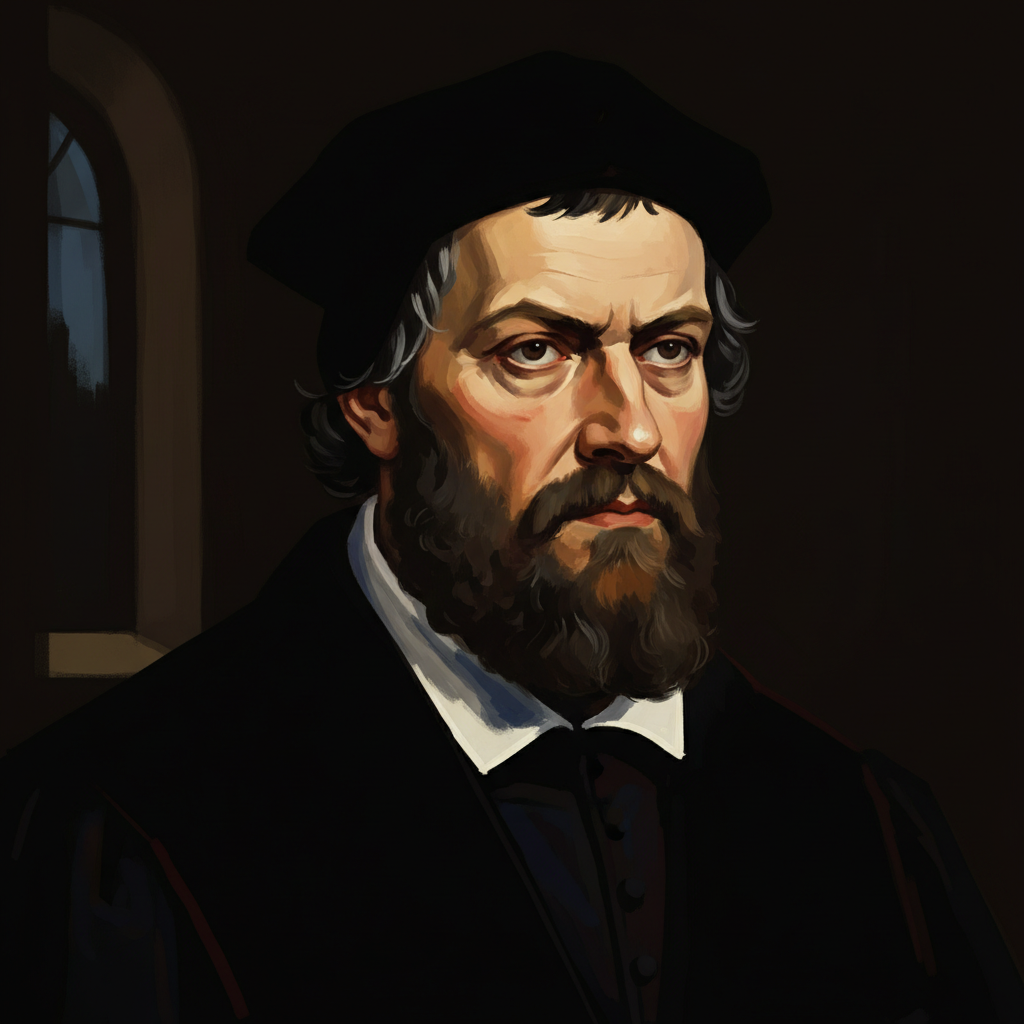
Martin Luther — "What devilish unchristian thing would you not undertake?"
What devilish unchristian thing would you not undertake?
What devilish unchristian thing would you not undertake?
Click any product to generate a realistic preview. Up to 3 at a time.
* Initial load can take up to 90 seconds — revising the preview in another color is nearly instant.
"God does not need our good works, but our neighbor does."
"To gather with God's people in united adoration of the Father is as necessary to the Christian life as prayer."
"My conscience is captive to the Word of God. I cannot and I will not recant anything, for to go against conscience is neither right nor safe. Here I stand, I can do no other. God help me. Amen."
"Sixthly, they ought to be deprived of the opportunity to practice usury, and all their cash and treasure of silver and gold should be taken from them and put aside for safekeeping."
"Whoever smells it first, out of him it crept."
German theologian whose 95 Theses (1517) launched the Protestant Reformation and broke the Catholic Church's monopoly on Western Christianity. Closely associated with Philipp Melanchthon (Lutheran systematizer) and John Calvin (later Reformer who built on Luther's break). For an intellectual contrast, see Pope Leo X, Renaissance pope (1513-1521) — Leo X's indulgence sales triggered Luther's break and Leo excommunicated him in 1521 — Luther's entire Reformation is structured as a direct answer to the indulgence-funded Vatican Leo represented.
Found in 1 providers: gemini
1 source checked
This is a sharp rhetorical accusation aimed at opponents, suggesting they have no moral limits and will stoop to any wicked or ungodly act to achieve their goals. In modern terms, it is the equivalent of saying, 'Is there any vile thing you wouldn't do?' It frames the target as utterly unscrupulous, implying their willingness to betray Christian principles whenever it suits their ambitions or interests.
Luther was famous for blistering polemical rhetoric against the papacy, Catholic authorities, peasants, Jews, and fellow reformers who crossed him. An Augustinian monk turned reformer, he weaponized language as fiercely as theology, routinely branding adversaries as agents of the devil. This line fits his combative style perfectly, reflecting his conviction that the institutional Church had corrupted Christianity so thoroughly that its defenders would commit any sin to preserve their power.
In early-modern Europe, the Reformation shattered Western Christendom. After Luther's 1517 Ninety-Five Theses, printing-press pamphlets enabled savage public quarrels between Catholics and Protestants. Accusations of devilry, heresy, and antichrist-status were standard weapons, and religious disputes fueled real violence, including the Peasants' War and later wars of religion. Calling opponents 'devilish' and 'unchristian' was not hyperbole but a serious charge with social, political, and sometimes lethal consequences in a society where heresy meant damnation and disorder.
AI-generated insights based on extensive research and information for context. Factual errors? Email [email protected].
Your cart is empty