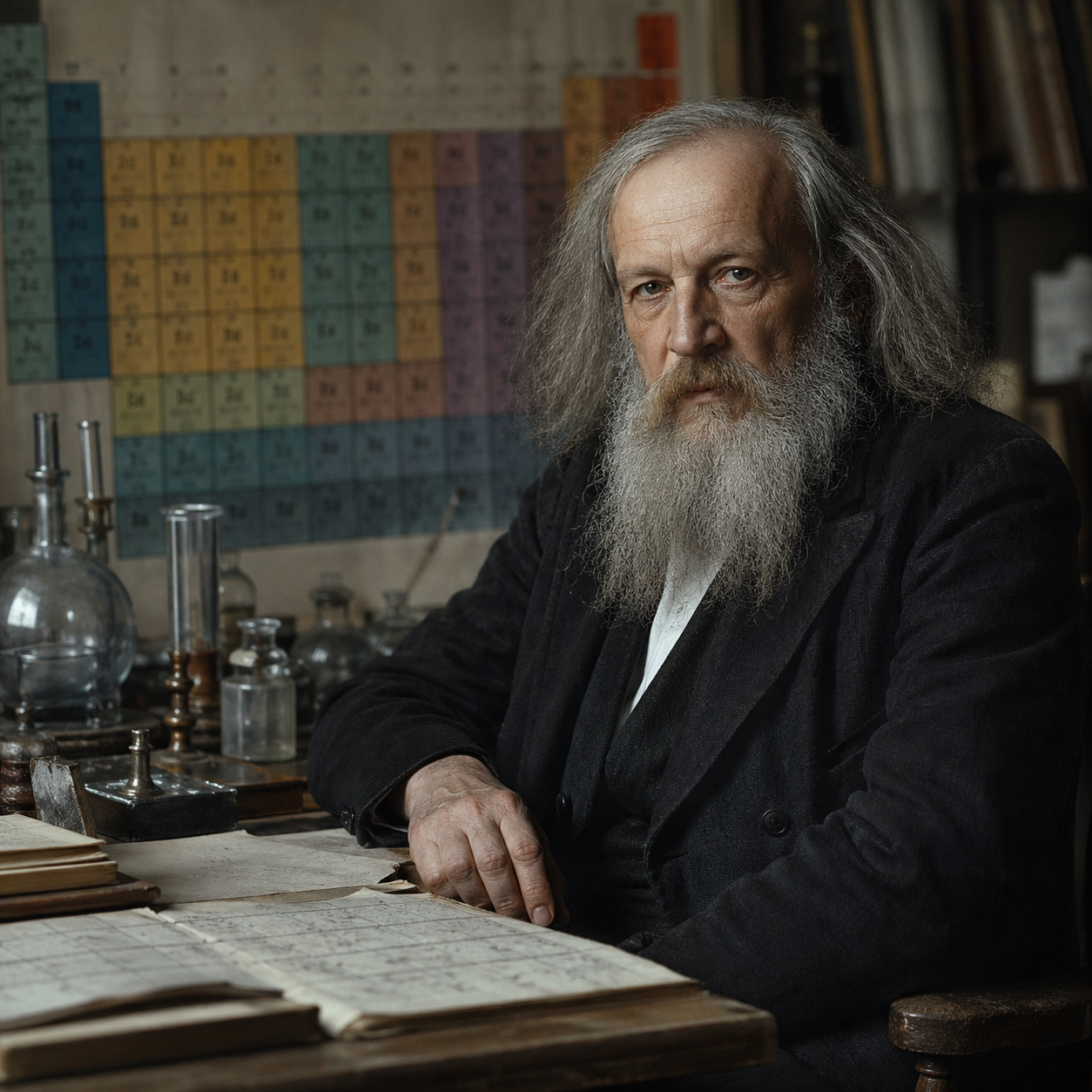
Dmitri Mendeleev — "What has been sown for the field of science will grow up for the people's welfar…"
What has been sown for the field of science will grow up for the people's welfare.
What has been sown for the field of science will grow up for the people's welfare.
Click any product to generate a realistic preview. Up to 3 at a time.
* Initial load can take up to 90 seconds — revising the preview in another color is nearly instant.
"The universe is a vast chemical laboratory."
"If statements of fact themselves depend upon the person who observes them, how much more distinct is the reflection of the personality of him who gives an account of methods and of philosophical specu…"
"Science begins where measurement begins."
"It was clear that in the United States there was a development not of the best, but of the middle and worst sides of European civilization; the notorious general voting, the tendency to politics... al…"
"Hypotheses help and guide scientific work — the search for truth — as the tiller's plough helps the cultivation of useful plants."
Emphasizing the societal benefits and practical applications of scientific research.
Date: Undated
PhilosophicalFound in 1 providers: gemini
1 source checked
Effort invested in scientific research eventually benefits everyone. Seeds planted today through careful study and experimentation may not produce immediate results, but over time they grow into discoveries, technologies, and improvements that serve humanity. The metaphor frames science as patient agriculture: researchers cultivate knowledge, and society harvests the practical gains. Progress requires trust that rigorous inquiry, even when abstract, ultimately translates into real improvements in daily life and public wellbeing.
Mendeleev devoted his career to applying chemistry for public benefit, not just theoretical glory. Beyond creating the periodic table in 1869, he advised the Russian government on agriculture, petroleum, tariffs, and weights and measures, believing scientists owed their work to society. He tirelessly promoted industrial development in Russia and taught generations of students. This saying captures his conviction that pure research and national progress were inseparable duties.
Mendeleev worked during late 19th-century Russia, when the empire was racing to industrialize and catch up with Western Europe after serfdom's abolition in 1861. Science was seen as a tool for national modernization, and chemistry especially promised agricultural yields, fuel, and manufactured goods. Universities expanded, and reformers pushed education as salvation. In this climate, linking laboratory work to the welfare of ordinary people was both a patriotic statement and a defense of state investment in research.
AI-generated insights based on extensive research and information for context. Factual errors? Email [email protected].
Your cart is empty