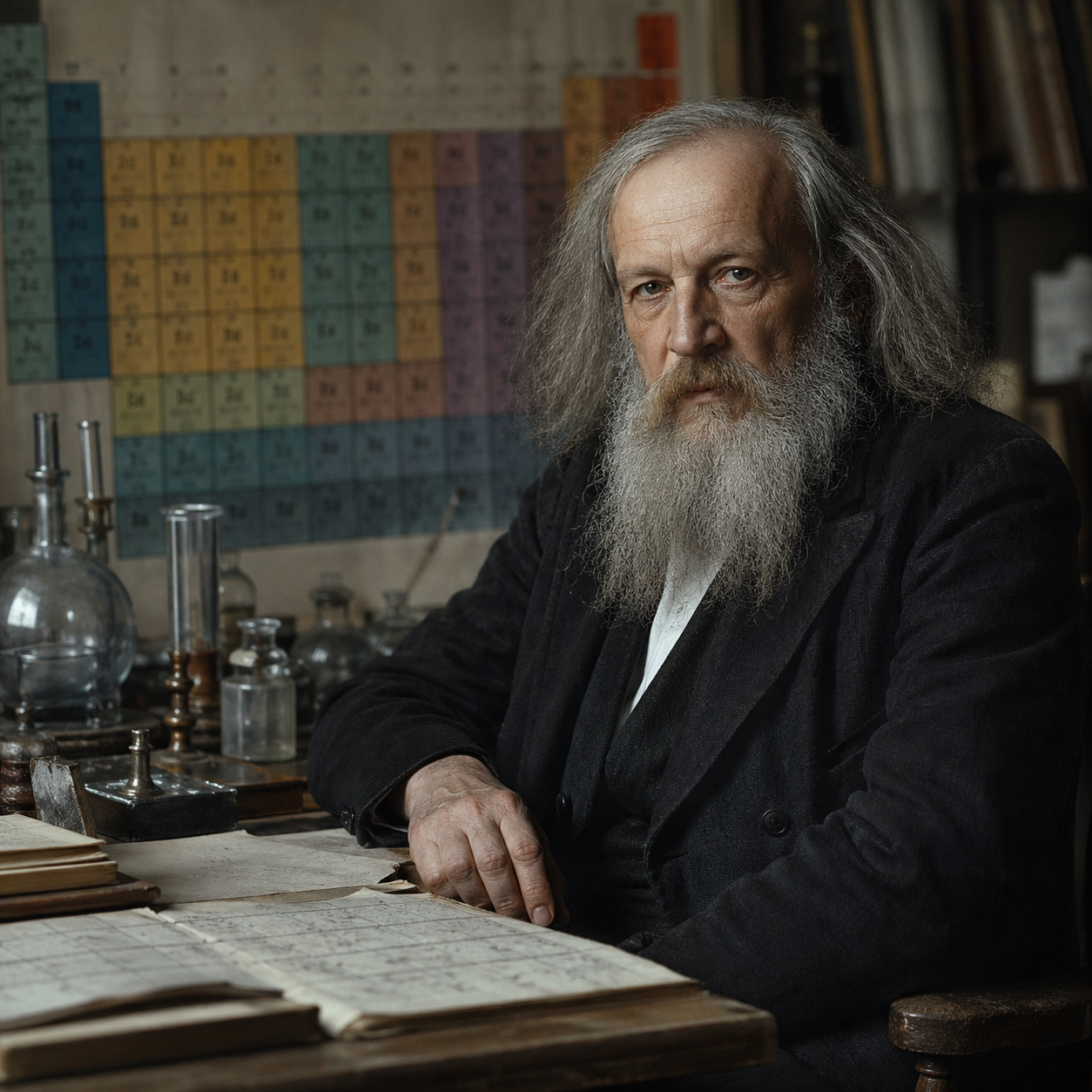
Dmitri Mendeleev — "Knowledge is a holy thing, and it is a sacred duty to transmit it to others."
Knowledge is a holy thing, and it is a sacred duty to transmit it to others.
Knowledge is a holy thing, and it is a sacred duty to transmit it to others.
Click any product to generate a realistic preview. Up to 3 at a time.
* Initial load can take up to 90 seconds — revising the preview in another color is nearly instant.
"The future of Russia is in its oil and its people."
"Hypotheses help and guide scientific work — the search for truth — as the tiller's plough helps the cultivation of useful plants."
"What has been sown for the field of science will grow up for the people's welfare."
"Without order, our science is nothing but a miserable collection of facts."
"The universe is a vast chemical laboratory."
On the importance of education and sharing knowledge
Date: Undated, from his pedagogical writings
BiblicalFound in 1 providers: grok
1 source checked
Knowing things matters deeply, and sharing what you know with other people is not optional but a serious responsibility. Holding onto understanding privately wastes it. Teachers, researchers, and experts owe the next generation an honest transfer of what they have learned, treating the act of passing along insight with the same seriousness people reserve for things they consider genuinely important or even sacred.
Mendeleev built his career teaching chemistry at Saint Petersburg University, and he wrote his landmark textbook Principles of Chemistry precisely because he could not find a suitable one for his students. His periodic table itself was a teaching tool, organizing elements so learners could grasp them. He also pushed for broader Russian education reform, making the transmission of scientific knowledge a lifelong personal mission, not merely an academic duty.
Nineteenth-century Russia lagged Western Europe in science, with a largely illiterate population and weak universities outside the capitals. Mendeleev lived through reforms under Alexander II that expanded schooling and modernized industry. Chemistry itself was exploding internationally, with new elements announced yearly. Treating knowledge as sacred carried political weight in a tsarist society where educated Russians saw teaching peasants and training engineers as patriotic work essential to dragging the empire into the modern era.
AI-generated insights based on extensive research and information for context. Factual errors? Email [email protected].
Your cart is empty