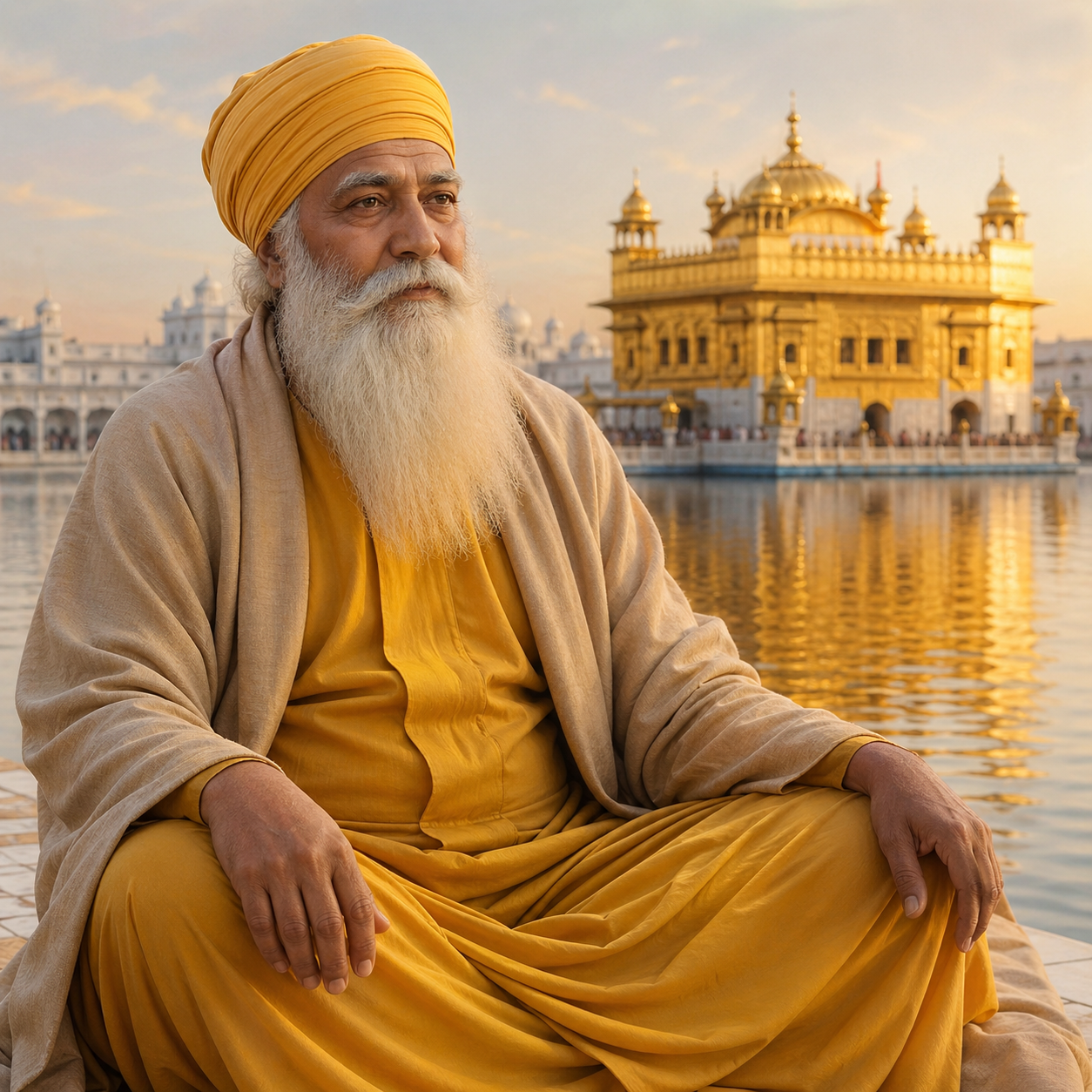
Guru Nanak — "What is the use of bathing at sacred shrines, if the mind is full of impurity?"
What is the use of bathing at sacred shrines, if the mind is full of impurity?
What is the use of bathing at sacred shrines, if the mind is full of impurity?
Click any product to generate a realistic preview. Up to 3 at a time.
* Initial load can take up to 90 seconds — revising the preview in another color is nearly instant.
"Do not fear, for God is with you. Also, maybe bring a jacket, it's getting chilly."
"He who sees the Lord in all, he alone is truly wise."
"Without fear, there is no love for God."
"The world is burning in the fire of desire, hatred, and ego. Save it, O Lord, by Your Grace."
"May your spirit be uplifted and your internet connection be stable."
Founder of Sikhism and the first of the Ten Sikh Gurus, whose teachings of one universal God and rejection of caste shaped Punjab. Closely associated with Kabir (mystical poet whose verses appear in the Sikh Guru Granth Sahib). For an intellectual contrast, see Brahmanical orthodoxy, the Hindu caste-and-ritual establishment of his era — Sikhism was founded as a deliberate alternative to both Hindu ritual hierarchy and Islamic exclusivism — Nanak's universalism was a structural rejection of caste and priestly mediation.
Found in 1 providers: grok
1 source checked
External rituals mean nothing without internal transformation. Bathing at holy rivers or shrines was believed to cleanse sin, but if your mind holds greed, ego, hatred, or deception, the water changes nothing. Real purity is moral and mental — it lives in honest thought and compassionate action, not in pilgrimage. You cannot wash away inner corruption with outer water.
Guru Nanak (1469–1539) traveled across South Asia and the Middle East on journeys called Udasis precisely to challenge empty ritualism. He rejected caste hierarchy and Brahminical orthodoxy, teaching that God dwells within the heart, not in temples or rivers. This quote reflects his core doctrine: that naam simran and ethical living outweigh any mechanical religious observance performed for social standing.
In 15th–16th century Punjab, pilgrimage to sacred rivers like the Ganges was central to Hindu religious life, with Brahmins controlling access to ritual merit. Rigid caste and purity laws defined who could approach which shrines. Simultaneously, the Bhakti movement was challenging these orthodoxies. Guru Nanak's teaching emerged directly into that tension, offering radical egalitarian spirituality that bypassed priestly gatekeepers entirely.
AI-generated insights based on extensive research and information for context. Factual errors? Email [email protected].
Your cart is empty