Isaac Newton — "The causes of gravity are not yet discovered. It is by experiments and observati…"
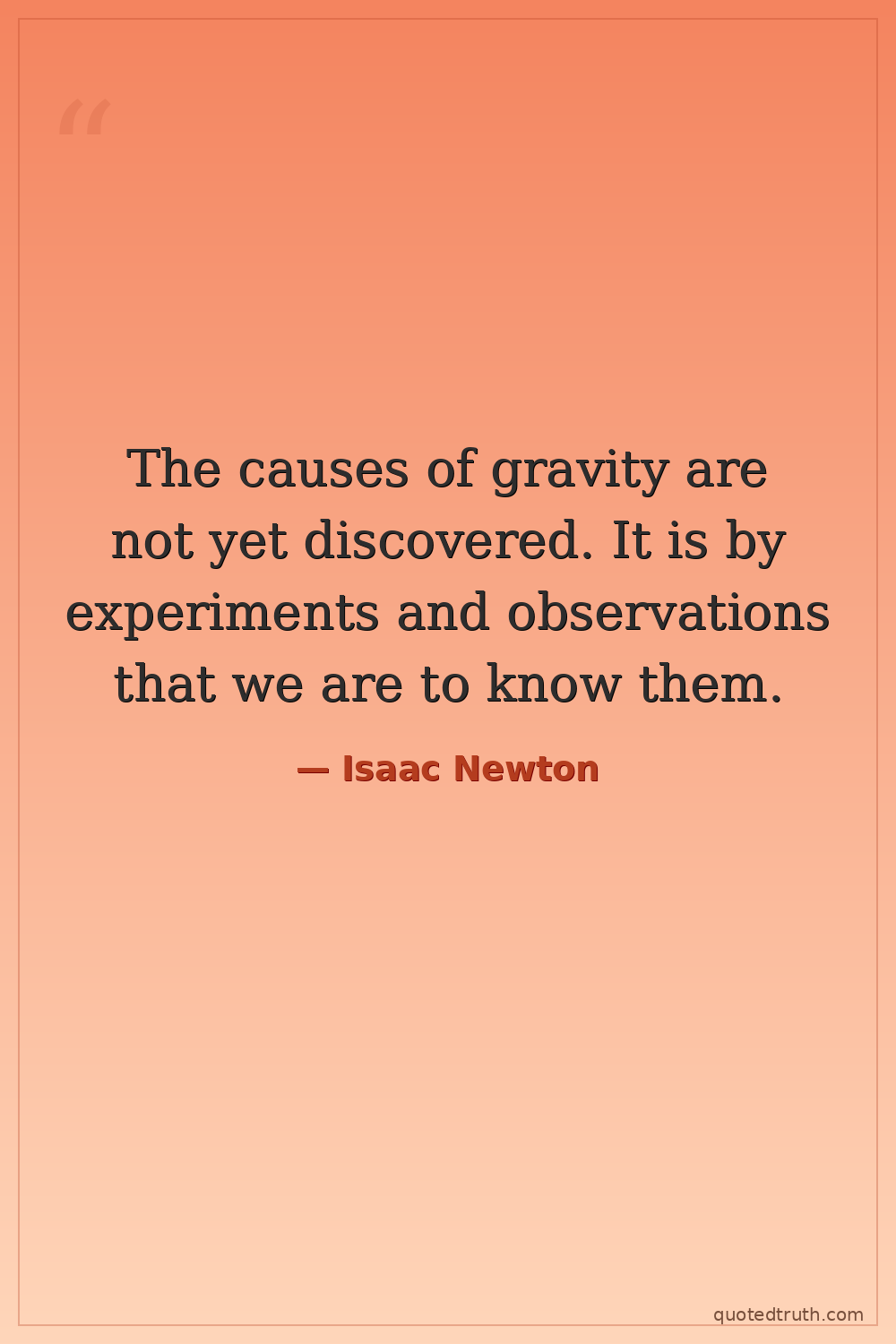
The causes of gravity are not yet discovered. It is by experiments and observations that we are to know them.
The causes of gravity are not yet discovered. It is by experiments and observations that we are to know them.
Click any product to generate a realistic preview. Up to 3 at a time.
* Initial load can take up to 90 seconds — revising the preview in another color is nearly instant.
"A man may imagine things that are false, but he can only understand things that are true, for if the things be false, the apprehension of them is not understanding."
"God is the same God, always and everywhere."
"I built my first telescope with my own hands."
"The best and safest method of philosophizing seems to be, first to inquire diligently into the properties of things, and to establish those properties by experiments, and then to proceed more slowly t…"
"I do not define time, space, place, and motion, as being well known to all."
Found in 1 providers: grok
1 source checked
Newton admits he can describe precisely how gravity behaves mathematically but refuses to claim he knows what produces it. He insists the answer must come from real-world evidence—experiments and observations—not philosophical speculation. This separates measurable description from unverified explanation, a standard modern science still demands. Knowing how something works and knowing why it works are two entirely different questions, and Newton refused to blur that line without proof.
Newton's famous Latin declaration 'hypotheses non fingo'—I frame no hypotheses—runs through the Principia Mathematica, his masterwork on motion and gravity. He derived universal gravitation with extraordinary precision yet consistently refused to speculate on its physical cause. This quote proves that restraint wasn't modesty but method: Newton separated what evidence demonstrated from what it couldn't yet reach, practicing rigorous intellectual discipline even while dismantling centuries of Aristotelian natural philosophy.
In the 17th century, natural philosophers competed to explain gravity through metaphysical speculation—Descartes proposed swirling vortices; others invoked divine action. The Scientific Revolution was displacing Aristotelian authority, but theorizing without experimental proof remained acceptable. Newton's insistence that causes require observational confirmation directly challenged Cartesian mechanical philosophy and the broader culture of armchair cosmology. At a moment when claiming to know gravity's cause would have impressed peers, Newton's public admission of ignorance was quietly revolutionary.
AI-generated insights based on extensive research and information for context. Factual errors? Email [email protected].
Your cart is empty