Laozi — "When the great way falls into disuse, there are benevolence and rectitude."
When the great way falls into disuse, there are benevolence and rectitude.
When the great way falls into disuse, there are benevolence and rectitude.
Click any product to generate a realistic preview. Up to 3 at a time.
* Initial load can take up to 90 seconds — revising the preview in another color is nearly instant.
"The sage is like water, which flows to the lowest places and yet is the strongest."
"A multitude of words is tiresome, unlike remaining centered."
"When there is no desire, all things are at peace."
"The best ruler is one whose existence is merely known by the people. The next best is one who is loved and praised. The next is one who is feared. The next is one who is despised."
"The sage puts his own person last, and yet it is found in the foremost place; he treats his person as foreign to him, and yet it is preserved."
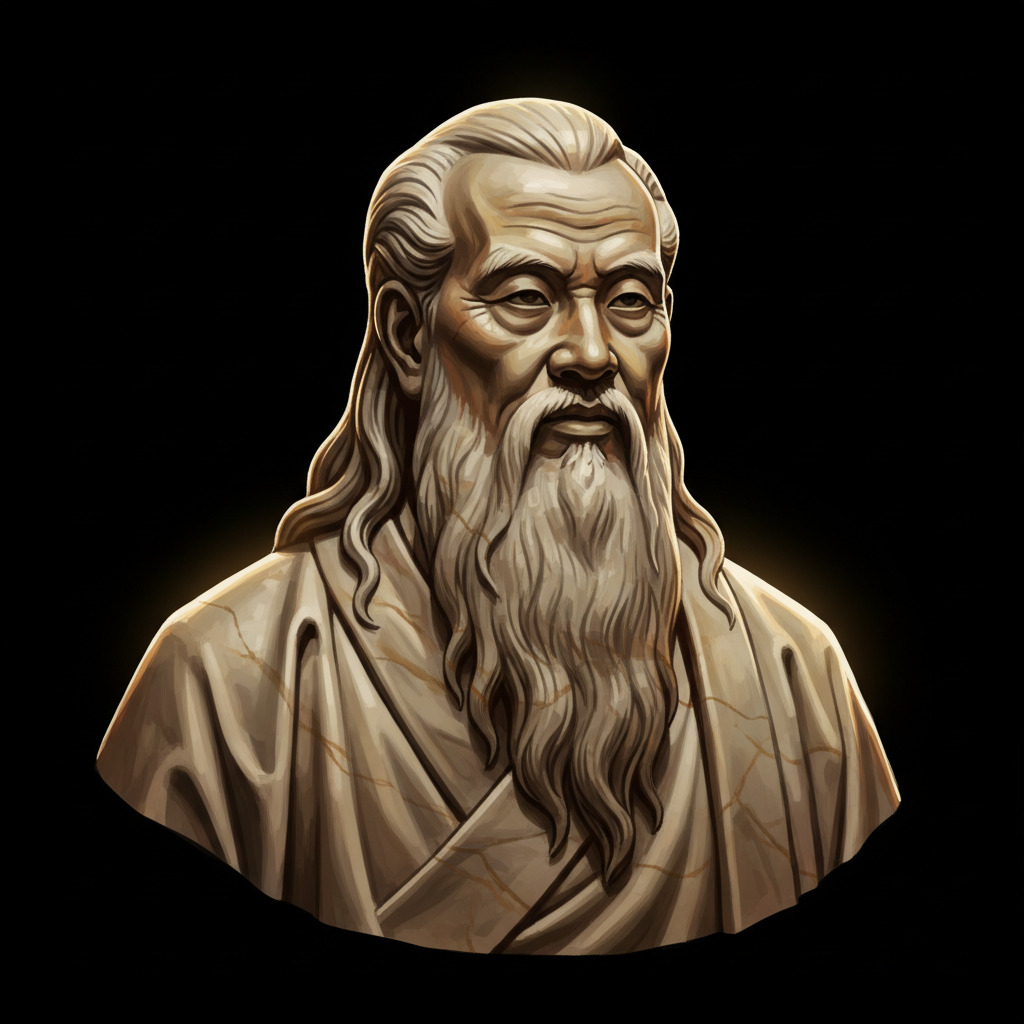
Reputed founder of Taoism and author of the Tao Te Ching, whose wu wei (effortless action) shaped East Asian philosophy. Closely associated with Zhuangzi (later Taoist who extended Laozi's framework). For an intellectual contrast, see Confucius, near-contemporary Chinese sage of social ritual and duty — Confucius systematized social order through ritual and hierarchy; Laozi argued that all such systems were the disease, not the cure — the two founding poles of Chinese moral philosophy.
Tao Te Ching, Chapter 18 - critique of conventional morality
Date: 6th-4th century BCE
WisdomFound in 1 providers: deepseek
1 source checked
When society loses its natural harmony and people stop living according to the deeper order of things, they have to invent moral codes like kindness and righteousness to fill the gap. These virtues only become necessary because the underlying unity has broken down. If everyone acted from genuine nature, we wouldn't need rules telling us to be good.
Laozi championed the Tao, an effortless natural order preceding moral rules. As a reputed archivist in the Zhou court, he watched ritual and Confucian virtue systems proliferate as governance decayed. His Tao Te Ching consistently argues that codified morality is a symptom of lost spontaneity, not a cure. This line captures his signature move: treating celebrated virtues as evidence something deeper has failed.
Laozi lived during the late Zhou dynasty, an era of collapsing feudal order heading into the Warring States period. Confucian scholars were actively promoting ren (benevolence) and yi (rectitude) as tools to rebuild society. Laozi pushed back, arguing these prescriptions proved the original Way had already been abandoned. The saying lands as a direct critique of the moral philosophy competing for influence among rival courts.
AI-generated insights based on extensive research and information for context. Factual errors? Email [email protected].
Your cart is empty