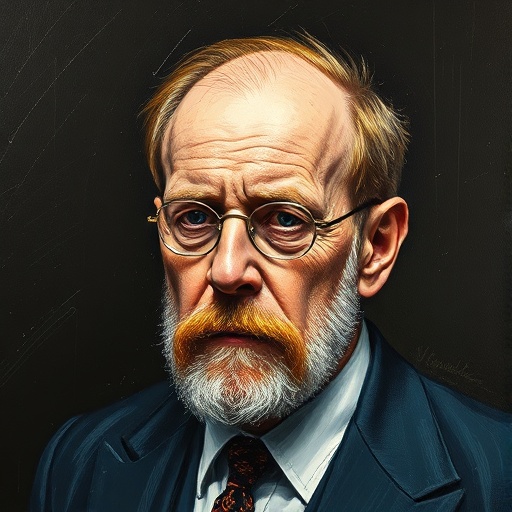
Werner Heisenberg — "When we speak of a picture of reality, we always mean a classical picture."
When we speak of a picture of reality, we always mean a classical picture.
When we speak of a picture of reality, we always mean a classical picture.
Click any product to generate a realistic preview. Up to 3 at a time.
* Initial load can take up to 90 seconds — revising the preview in another color is nearly instant.
"The human mind cannot be content with a description of phenomena; it wants to understand them."
"If we want to describe what happens in an atomic event, we must realize that the word 'happens' can apply only to the observation, not to the state of affairs between two observations."
"I don't believe a word of the whole thing they must have spent the whole of their £500. million in separating isotopes. and then it's possible."
"I am firmly convinced that we must never judge political movements by their aims, no matter how loudly proclaimed or how sincerely upheld, but only by the means they use to realize these aims."
"We have to remember that what we observe is not nature in itself but nature exposed to our method of questioning."
Found in 1 providers: grok
1 source checked
Whenever we try to visualize or describe reality, we automatically fall back on familiar, everyday concepts like solid objects, definite positions, and predictable motion. Our mental images are stuck in the world of ordinary experience, where things have clear locations and behaviors. So any picture we draw of how nature works is really a picture built from old, pre-quantum assumptions, not a true representation of how the deeper layers of reality actually behave.
Heisenberg cofounded quantum mechanics and proved through his uncertainty principle that subatomic particles cannot have simultaneously defined position and momentum. He struggled throughout his career to explain quantum weirdness to colleagues like Einstein and Bohr, noticing that even physicists resorted to classical analogies. This quote captures his hard-won insight that the mathematical formalism of quantum theory worked perfectly, yet human intuition stubbornly demanded billiard-ball imagery his equations had dismantled.
Writing in the early-to-mid twentieth century, Heisenberg lived through the revolution that overthrew Newtonian certainty. Between 1925 and 1935, quantum mechanics and relativity shattered assumptions physics had held for 250 years. Philosophers, physicists, and the public wrestled with wave-particle duality, indeterminism, and Schrodinger's cat. Amid rising Nazi Germany and later postwar rebuilding, Heisenberg defended the Copenhagen interpretation, arguing that our classical language and visual thinking simply could not capture the strange new microworld.
AI-generated insights based on extensive research and information for context. Factual errors? Email [email protected].
Your cart is empty