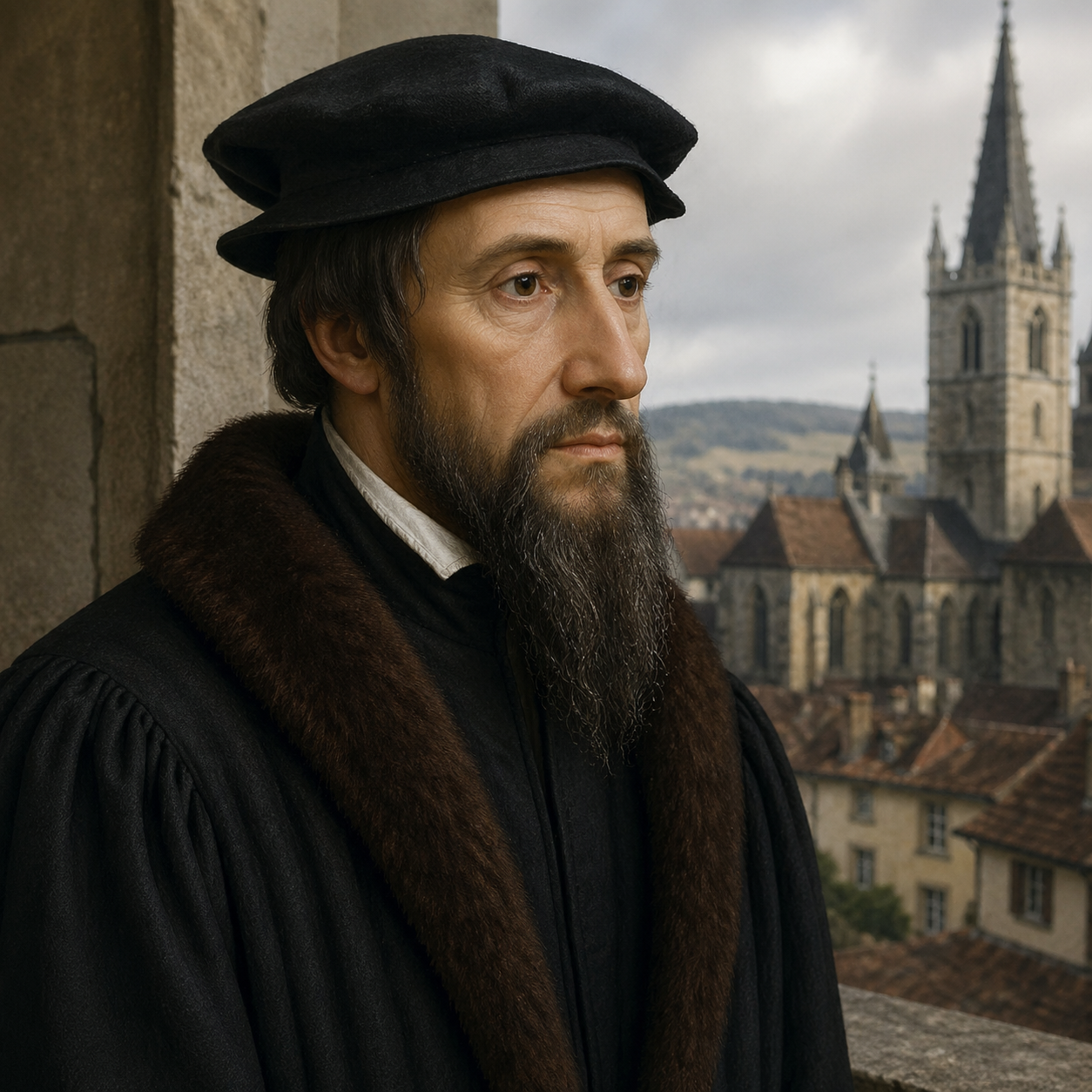
John Calvin — "Without knowledge of God, there is no true knowledge of self."
Without knowledge of God, there is no true knowledge of self.
Without knowledge of God, there is no true knowledge of self.
Click any product to generate a realistic preview. Up to 3 at a time.
* Initial load can take up to 90 seconds — revising the preview in another color is nearly instant.
"The reprobate are left to their own wickedness, and are justly punished for it."
"By predestination we mean the eternal decree of God, by which he has determined with himself whatever he wills to happen with regard to every man."
"Free-will cannot will good and of necessity serves sin."
"God will not suffer that one of his children should be lost."
"We must live as if we were always in the presence of God."
French theologian whose Institutes of the Christian Religion (1536) systematized Protestant Reformed doctrine, including predestination. Closely associated with Martin Luther (Reformation founder, Calvin's predecessor). For an intellectual contrast, see Jacobus Arminius, Dutch Reformed theologian (1560-1609) — Arminius's rejection of strict double-predestination founded Arminianism — the theological tradition modern Methodism, most evangelicalism, and Pentecostalism descend from. The Calvinist-Arminian debate has divided Protestantism for 400 years.
Found in 1 providers: grok
1 source checked
True self-understanding requires knowing God first — without that foundation, any picture of yourself is incomplete or distorted. The quote argues that human nature, purpose, and moral condition only make sense when viewed through a divine lens. Who you are, why you fail, and what you're capable of cannot be answered honestly without reference to the God who created you. Self-knowledge without theology is, at best, shallow.
This quote opens Calvin's masterwork, the Institutes of the Christian Religion — it wasn't incidental but the cornerstone of his entire theology. A trained lawyer who applied rigorous logic to doctrine, Calvin built his system on dual knowledge: God and humanity are mutually illuminating. His doctrine of total depravity — that human nature is fundamentally corrupted — made divine reference essential; you cannot diagnose the patient without knowing the standard of health.
The 16th-century Reformation erupted as Renaissance humanism was promoting Socratic self-examination and elevating human reason. Calvin's Geneva was a flashpoint — Protestant and Catholic factions fought across Europe over who defined Christian truth. Amid this upheaval, Calvin anchored identity in Scripture and God rather than Church hierarchy or human philosophy. The printing press spread his Institutes widely, making this theological claim about self-knowledge a direct counter to humanist autonomy circulating simultaneously.
AI-generated insights based on extensive research and information for context. Factual errors? Email [email protected].
Your cart is empty