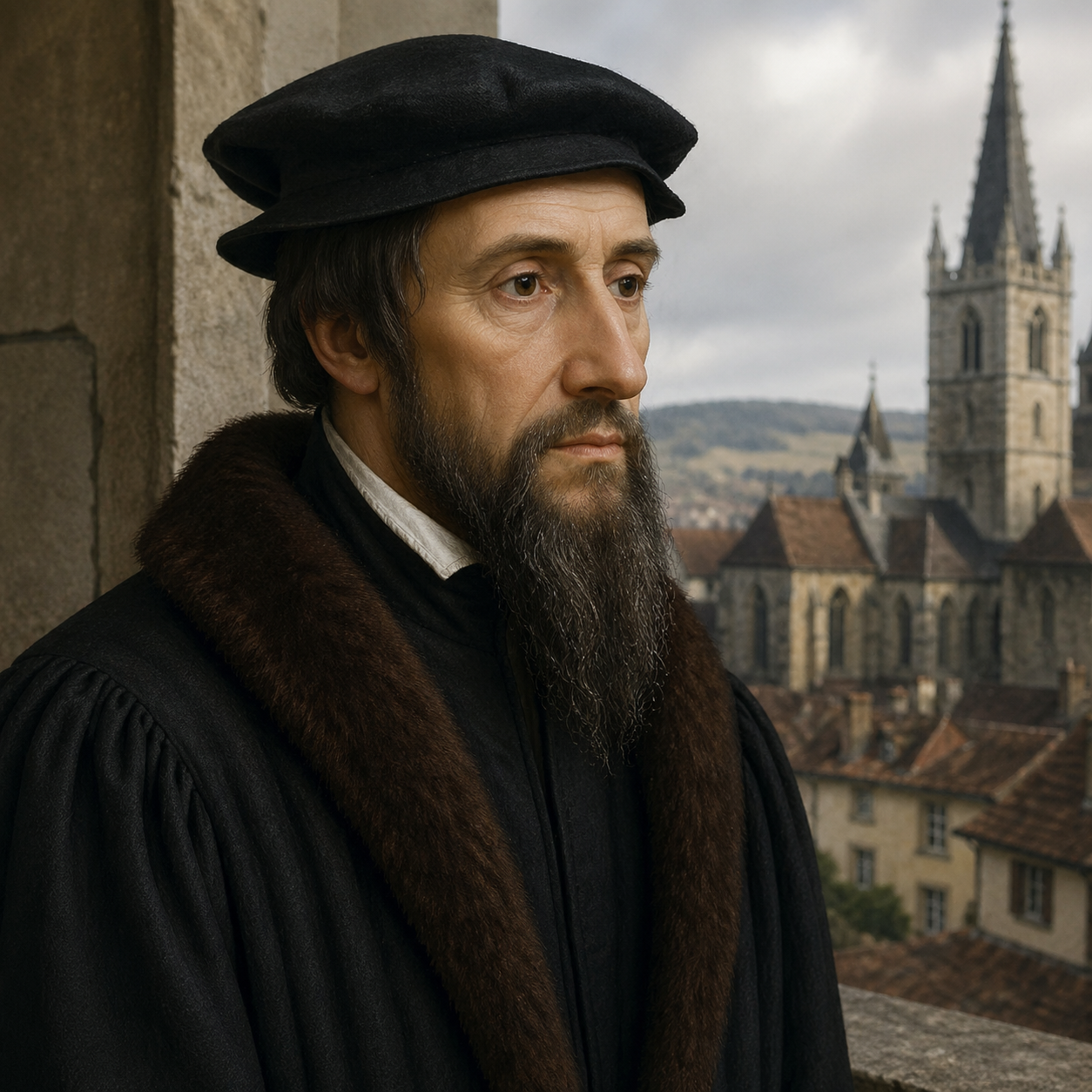
John Calvin — "Without knowledge of self there is no knowledge of God."
Without knowledge of self there is no knowledge of God.
Without knowledge of self there is no knowledge of God.
Click any product to generate a realistic preview. Up to 3 at a time.
* Initial load can take up to 90 seconds — revising the preview in another color is nearly instant.
"The will of God is the cause of all things, and there is no other cause."
"We are poor, miserable sinners, but God is rich in mercy."
"The human heart is an idol factory."
"But if we are elected in Christ, we cannot find in ourselves the reason of our election; neither can we, by any means, comprehend it in our own understanding."
"God blinds the minds of the reprobate, and hardens their hearts, that they may not believe."
French theologian whose Institutes of the Christian Religion (1536) systematized Protestant Reformed doctrine, including predestination. Closely associated with Martin Luther (Reformation founder, Calvin's predecessor). For an intellectual contrast, see Jacobus Arminius, Dutch Reformed theologian (1560-1609) — Arminius's rejection of strict double-predestination founded Arminianism — the theological tradition modern Methodism, most evangelicalism, and Pentecostalism descend from. The Calvinist-Arminian debate has divided Protestantism for 400 years.
Found in 1 providers: deepseek
1 source checked
Self-knowledge and knowledge of God are mutually dependent — understanding your own nature, limitations, and sinfulness is the necessary starting point for grasping the divine. You cannot comprehend God without first confronting what you are: finite, flawed, dependent. Honest self-examination exposes the gap between human inadequacy and divine perfection, making God's nature legible by contrast. Ignorance of yourself produces ignorance of God.
Calvin opened "Institutes of the Christian Religion" — his defining theological masterwork — with precisely this premise. His doctrine of total depravity held that humans must squarely face their sinful, corrupted nature before they can understand grace or salvation. His legal training gave him a systematizer's discipline; his leadership of Geneva demanded rigorous moral self-scrutiny from every citizen. For Calvin, self-knowledge was not introspection for its own sake — it was the gateway to God.
The 16th-century Reformation shattered the Catholic Church's monopoly on religious knowledge. As Calvin wrote, the printing press was distributing Scripture directly to laypeople, and Protestant reformers were dismantling priestly mediation. Renaissance humanism celebrated self-examination as a virtue. Religious wars tore Europe apart over who could access God and how. Calvin's insistence that individuals encounter God through self-knowledge was both theologically radical and politically charged — it made conscience, not clergy, the starting point of faith.
AI-generated insights based on extensive research and information for context. Factual errors? Email [email protected].
Your cart is empty