Thomas Edison — "You will have many opportunities in life to keep your mouth shut: You should tak…"
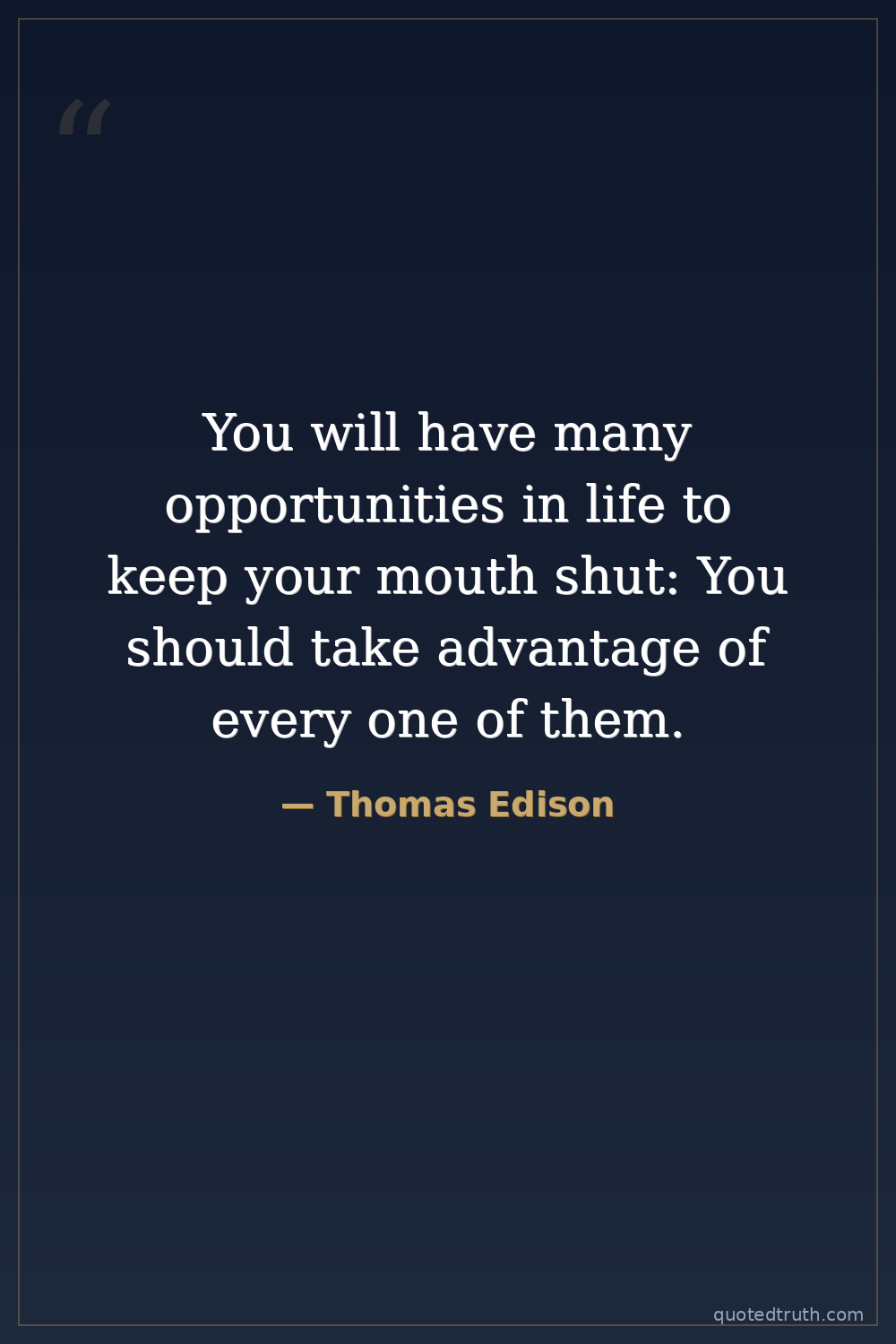
You will have many opportunities in life to keep your mouth shut: You should take advantage of every one of them.
You will have many opportunities in life to keep your mouth shut: You should take advantage of every one of them.
Click any product to generate a realistic preview. Up to 3 at a time.
* Initial load can take up to 90 seconds — revising the preview in another color is nearly instant.
"I am not a vegetarian. I eat meat, but I don't eat much meat. I eat very little meat."
"I have no respect for the man who says he is too busy to read. He is too busy to live."
"To invent, you need a good imagination and a pile of junk."
"I am proud of the fact that I never invented weapons to kill."
"I don't think there's any substitute for a good idea."
Found in 1 providers: gemini
1 source checked
Life constantly tempts you to speak when silence would serve better. Every moment you could offer an opinion, correction, criticism, or unsolicited advice is a chance to stay quiet instead. Choosing not to talk often protects relationships, preserves dignity, avoids conflict, and prevents self-inflicted damage. The saying urges deliberate restraint, treating silence as an active skill worth practicing rather than a passive default, because words once spoken cannot be taken back.
Edison spent decades in cutthroat patent wars, press battles with Tesla and Westinghouse, and high-stakes investor negotiations where a single careless remark could sink a deal or leak a discovery. Running Menlo Park, he managed teams, reporters, and financiers simultaneously. His progressive deafness also forced him to listen carefully and speak sparingly. A pragmatic self-made man, he valued results over rhetoric, knowing that protecting ideas and reputation often required biting his tongue.
Edison worked from the 1870s through the 1920s, an age of fierce industrial competition, sensational newspapers, and the rise of celebrity inventors. Reporters chased every quote, rivals mined public statements for weaknesses, and the War of the Currents played out in headlines. Telegraph and telephone accelerated gossip across continents. In this environment, discretion meant survival: a boastful interview could tip off competitors, spook backers, or invite lawsuits, making guarded speech a genuine professional advantage.
AI-generated insights based on extensive research and information for context. Factual errors? Email [email protected].
Your cart is empty