Enrico Fermi — "Young man, if I could remember the names of these [muons, pions, etc.] particles…"
Young man, if I could remember the names of these [muons, pions, etc.] particles, I would have been a botanist.
Young man, if I could remember the names of these [muons, pions, etc.] particles, I would have been a botanist.
Click any product to generate a realistic preview. Up to 3 at a time.
* Initial load can take up to 90 seconds — revising the preview in another color is nearly instant.
"I believe that science is a universal language, and that it can bring people together from all over the world."
"The world is full of wonders, and it is our job to explore them."
"The world is full of interesting things to do with neutrons."
"The universe is a grand experiment, and we are all part of it."
"Before the war, I was doing pure physics. Now I am doing applied physics. But it is still physics."
Found in 1 providers: gemini
1 source checked
The quote mocks rote memorization masquerading as science. Fermi complained that 1950s particle physics had devolved into a naming exercise — muons, pions, kaons, lambdas discovered almost weekly — with no unifying framework. Real physics, he implies, is about grasping fundamental principles, not cataloging labels like a taxonomist. If memorizing names were the actual skill required, he'd have chosen botany, where classification is genuinely the point.
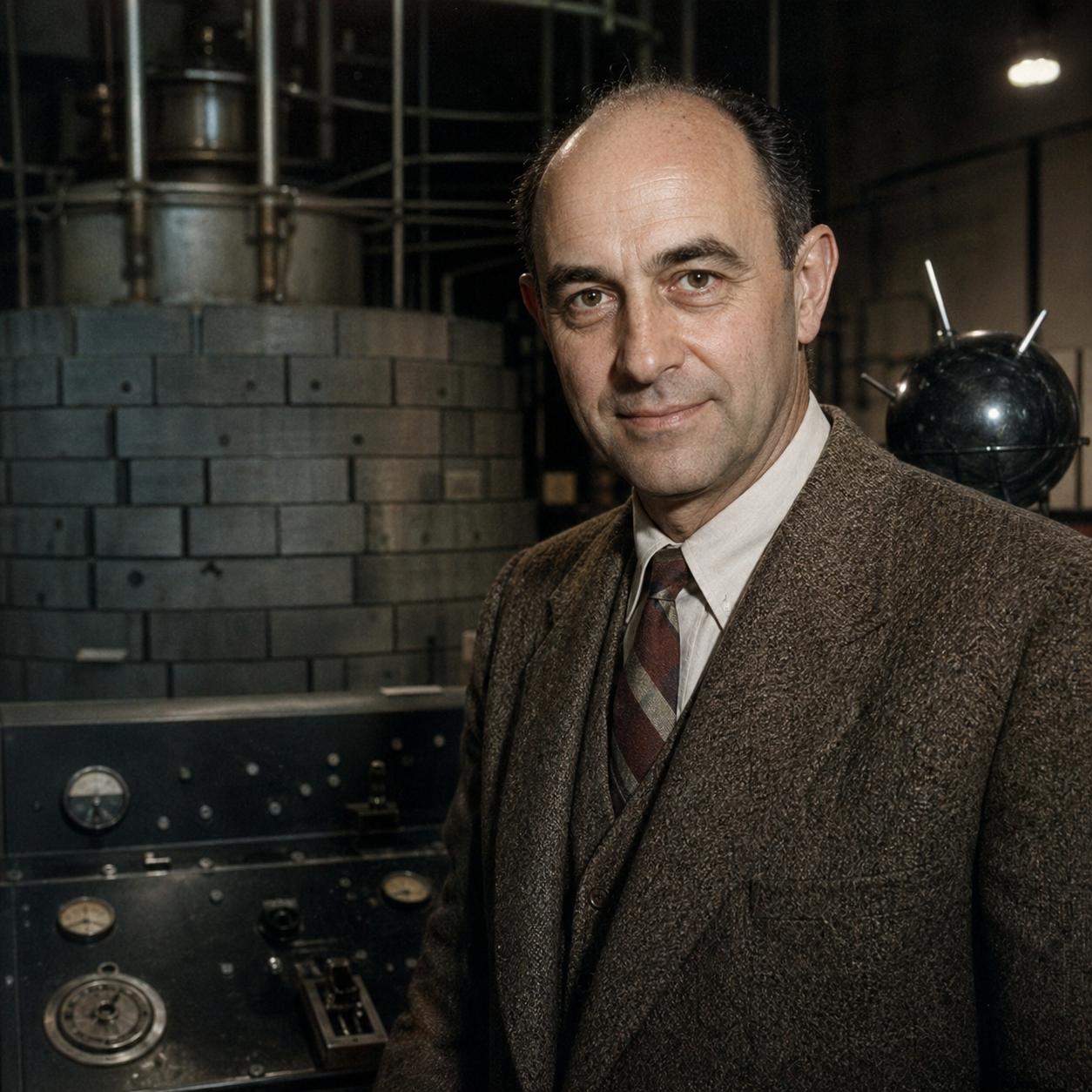
Fermi was legendary for physical intuition — his back-of-envelope Fermi estimations solved complex problems from first principles alone. He built the world's first nuclear reactor under Chicago's Stagg Field in 1942 and won the 1938 Nobel Prize for neutron work. His genius lay in synthesizing deep rules, not accumulating facts. The postwar particle zoo — dozens of hadrons and mesons with arbitrary names — directly clashed with his instinct that nature must be reducible to a few elegant principles.
The late 1940s–1950s was the particle zoo era. Accelerators at Brookhaven and elsewhere churned out new particles — pions (1947), kaons (1947), lambda baryon (1950), sigma, xi, and more — faster than theory could explain them. Physics temporarily resembled taxonomy rather than fundamental science. This chaos eventually forced Gell-Mann's quark model (1964) to restore order. Fermi's quip captured a generation's anxiety: a discipline built on elegant laws suddenly feeling overwhelmed by its own experimental success.
AI-generated insights based on extensive research and information for context. Factual errors? Email [email protected].
Your cart is empty