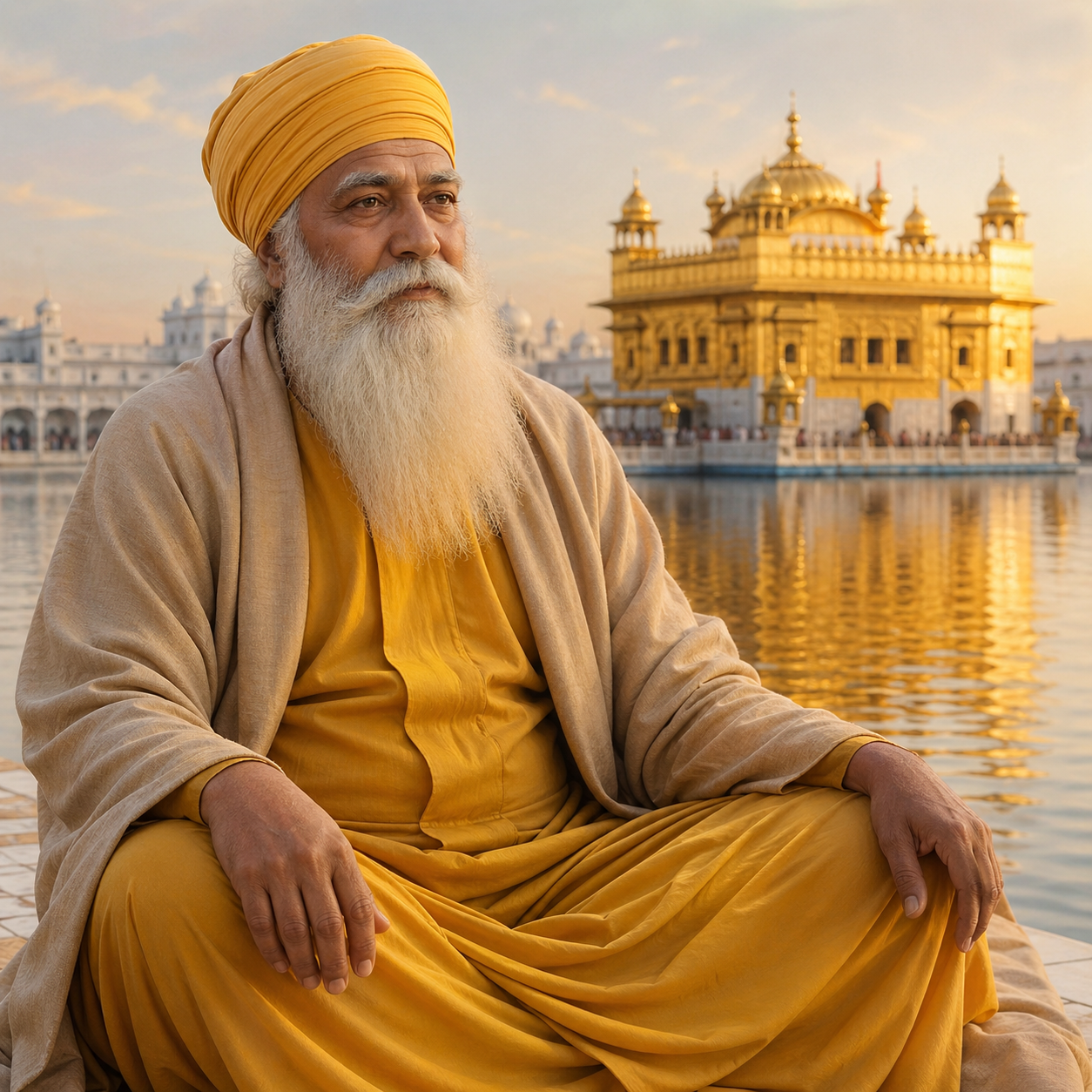
Guru Nanak — "Your Mercy is my social status."
Your Mercy is my social status.
Your Mercy is my social status.
Click any product to generate a realistic preview. Up to 3 at a time.
* Initial load can take up to 90 seconds — revising the preview in another color is nearly instant.
"One stone is lovingly decorated as a deity, while another stone is walked upon. If one is a god, then the other must also be a god. Namdev says I am not going to worship a stone installed as god. I wo…"
"Before becoming a Muslim, a Hindu, a Christian, a Jew, let us become a Human."
"The sun and moon, O Lord, are Thy lamps; the firmament Thy salver; the orbs of the stars the pearls encased in it."
"Material wealth is temporary, while love and spiritual devotion are eternal."
"I am neither a child, a young man, nor an ancient; nor am I of any caste."
Founder of Sikhism and the first of the Ten Sikh Gurus, whose teachings of one universal God and rejection of caste shaped Punjab. Closely associated with Kabir (mystical poet whose verses appear in the Sikh Guru Granth Sahib). For an intellectual contrast, see Brahmanical orthodoxy, the Hindu caste-and-ritual establishment of his era — Sikhism was founded as a deliberate alternative to both Hindu ritual hierarchy and Islamic exclusivism — Nanak's universalism was a structural rejection of caste and priestly mediation.
Found in 1 providers: gemini
1 source checked
The quote declares that divine grace — not wealth, lineage, or caste — is the speaker's only true social standing. In a world obsessed with rank and title, this is a radical act of humility: I claim no earthly credential. My worth comes entirely from God's mercy. Modern readers might recognize this as rejecting status anxiety entirely, grounding identity in something beyond human hierarchies, inherited privilege, or material achievement.
Guru Nanak was born Khatri-caste but spent his life dismantling caste divisions — eating with untouchables, rejecting Brahminical ritual. Central to his theology is Nadar, divine grace, as the sole path to liberation. He taught that no ritual performance or social rank earns salvation; only God's mercy grants it. His declaration 'There is no Hindu, there is no Muslim' embodied this same collapse of worldly identity into pure divine relationship.
Guru Nanak lived 1469–1539, during the Lodi Sultanate's collapse and Babur's Mughal conquest of India. Hindu caste hierarchy rigidly determined social worth; Brahmins monopolized spiritual authority. Islamic rule introduced new power structures but didn't erase caste. The Bhakti movement was spiritually challenging these divisions. Declaring divine mercy as one's only social credential was politically explosive — a direct attack on every institution that rationed human dignity by birth.
AI-generated insights based on extensive research and information for context. Factual errors? Email [email protected].
Your cart is empty