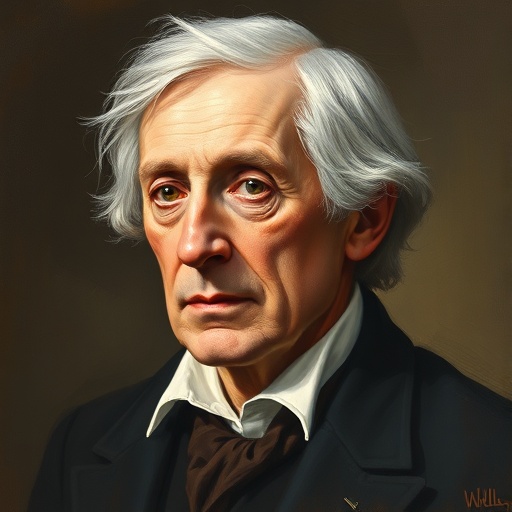
William Wordsworth

Romantic poet

Modern influential 53 sayings

Sayings by William Wordsworth

The Child is father of the Man.

1802 — From his poem 'My Heart Leaps Up' (also known as 'The Rainbow'), a famous paradox suggesting that ou…
Strange & Unusual Confirmed

The world is too much with us; late and soon, Getting and spending, we lay waste our powers.

1802 — From his sonnet 'The World Is Too Much with Us,' a critique of humanity's absorption in materialism …
Strange & Unusual Confirmed

To me the meanest flower that blows can give thoughts that do often lie too deep for tears.

1804 — From his 'Ode: Intimations of Immortality from Recollections of Early Childhood,' expressing a profo…
Strange & Unusual Unverifiable

Earth has not anything to show more fair.

1802 — The opening line of his sonnet 'Composed Upon Westminster Bridge, September 3, 1802,' expressing imm…
Strange & Unusual Unverifiable

Bliss was it in that dawn to be alive, But to be young was very heaven!

1805 — From 'The Prelude,' Book XI, referring to his fervent idealism and joy during the early days of the …
Strange & Unusual Confirmed

One impulse from a vernal wood May teach you more of man, Of moral evil and of good, Than all the sages can.

1798 — From 'The Tables Turned,' advocating for learning from nature's direct experience over academic book…
Strange & Unusual Confirmed

I have learned to look on nature, not as in the hour of thoughtless youth; but hearing oftentimes the still, sad music of humanity.

1798 — From 'Lines Composed a Few Miles above Tintern Abbey,' revealing a more mature and reflective, perha…
Strange & Unusual Confirmed

Sweet childish days, that were as long As twenty days are now.

1800 — From 'The Fountain,' reflecting on the subjective and elongated perception of time in childhood comp…
Strange & Unusual Unverifiable

Poetry is the spontaneous overflow of powerful feelings: it takes its origin from emotion recollected in tranquillity.

1800 — From the Preface to the second edition of 'Lyrical Ballads,' his foundational critical statement on …
Strange & Unusual Confirmed

My heart leaps up when I behold A rainbow in the sky.

1802 — The opening lines of his poem 'My Heart Leaps Up' (The Rainbow), expressing a consistent, profound j…
Strange & Unusual Unverifiable

Fill your paper with the breathings of your heart.

1807 — Letter to Lady Beaumont
Strange & Unusual Unverifiable

Our birth is but a sleep and a forgetting.

1807 — Ode: Intimations of Immortality from Recollections of Early Childhood
Strange & Unusual Unverifiable

Come forth into the light of things, Let Nature be your teacher.

1798 — The Tables Turned
Strange & Unusual Unverifiable

Dust as we are, the immortal spirit grows Like harmony in music; there is a dark Inscrutable workmanship that reconciles Discordant elements, makes them cling together In one society.

1805 (published 1850) — The Prelude, Book I
Strange & Unusual Unverifiable

And 'tis my faith that every flower Enjoys the air it breathes.

1798 — Lines Written in Early Spring
Strange & Unusual Unverifiable

I wandered lonely as a cloud That floats on high o'er vales and hills,

1807 — I Wandered Lonely as a Cloud (Daffodils)
Strange & Unusual Unverifiable

The best portion of a good man's life, his little, nameless, unremembered acts of kindness and of love.

1798 — Lines Composed a Few Miles Above Tintern Abbey
Strange & Unusual Unverifiable

Poetry is the breath and finer spirit of all knowledge; it is the impassioned expression which is in the countenance of all Science.

1800 — Preface to Lyrical Ballads, with Other Poems
Strange & Unusual Unverifiable

To the solid ground Of nature trusts the mind that builds for aye.

1800 — A Poet's Epitaph
Strange & Unusual Unverifiable

Wisdom is ofttimes nearer when we stoop Than when we soar.

1814 — The Excursion, Book III
Strange & Unusual Unverifiable