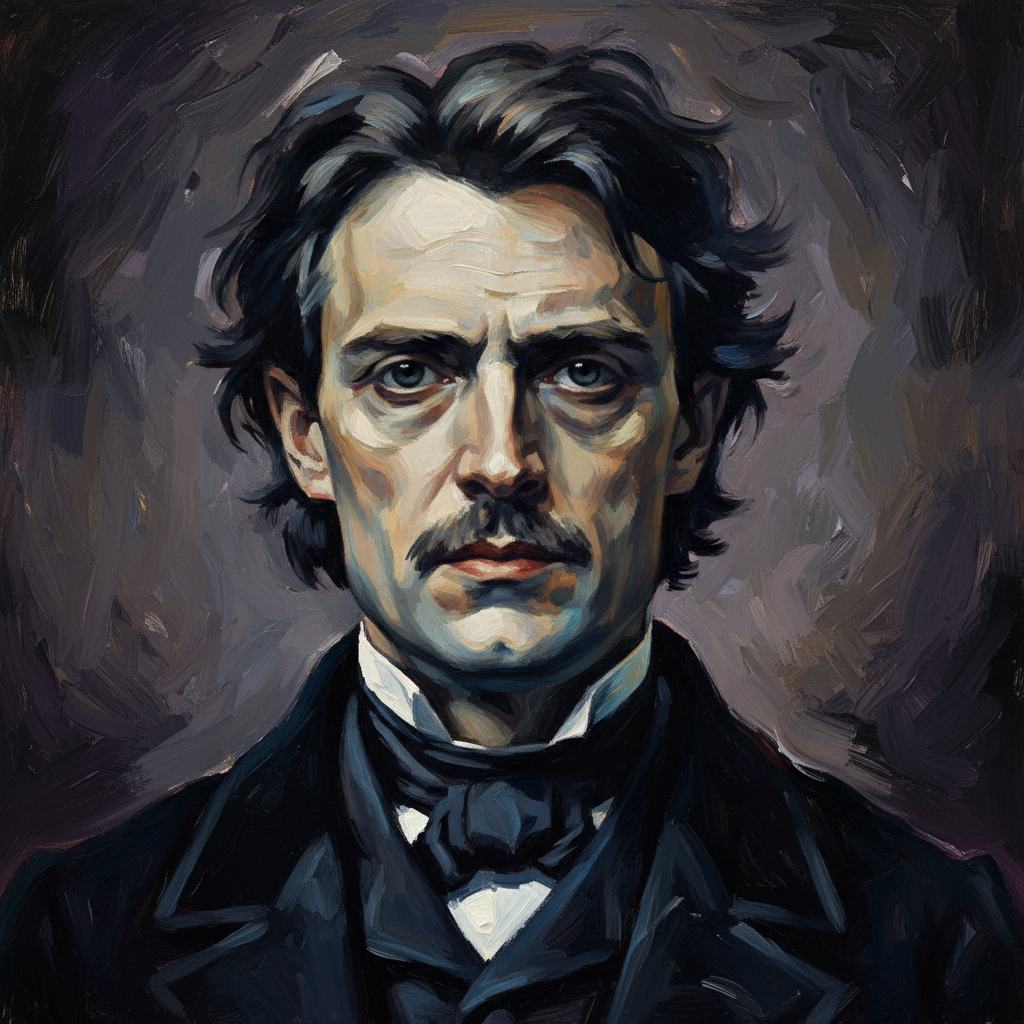
Edgar Allan Poe
Horror, detective fiction
Sayings by Edgar Allan Poe
I have no faith in human perfectibility. I think that human integrity has been ruined by the fall, and that I am a member of the ruined species.
That pleasure which is at once the most pure, the most elevating, and the most intense, is derived, I maintain, from the contemplation of the beautiful.
The ‛Imp of the Perverse’ is a radical, a primitive impulse—elementary, and altogether indissoluble.
With me, poetry has been not a purpose, but a passion; and the passions should be held in reverence: they must not be profaned by a superficial interest.
Sleep, those little slices of death; Oh how I loathe them.
I would define, in brief, the Poetry of words as The Rhythmical Creation of Beauty. Its sole arbiter is Taste. With the Intellect or with the Conscience, it has only collateral relations. Unless, indeed, we are enabled to perceive a semblance of consequence in the construction of Beauty, or of sublimity in the two, or of truth in the three.
There are some secrets which do not permit themselves to be told.
It is by no means an irrational fancy that, in a future existence, we shall look upon what we think are the works of God with a sentiment of profoundest reverence, as the highest manifestations of the beautiful.
The death of a beautiful woman is, unquestionably, the most poetical topic in the world—and equally is it beyond doubt that the lips best suited for such topic are those of a bereaved lover.
I have often thought that the sole regret of the transformed butterfly must be that it can only live for a day.
Were I to be asked what it is that gives me the most intense delight, I should say a conversation with a beautiful woman.
The best things in life make you sweaty.
I wish I could write as I feel—no, I mean as I feel in the day-time—for at night I feel like a demon.
Beauty of whatever kind, in its supreme development, invariably excites the sensitive soul to tears.
I regard society as a species of animal which preys upon its own kind.
From childhood's hour I have not been As others were—I have not seen As others saw—I could not bring My passions from a common spring.
The want of an object for my love is the sole reason why I am not a maniac.
The true genius is the man who can do the average thing when everyone else around him is losing his mind.
I have been to hell and back, and let me tell you, it was glorious.
To be thoroughly conversant with at least one branch of human knowledge is a desideratum of the first importance.