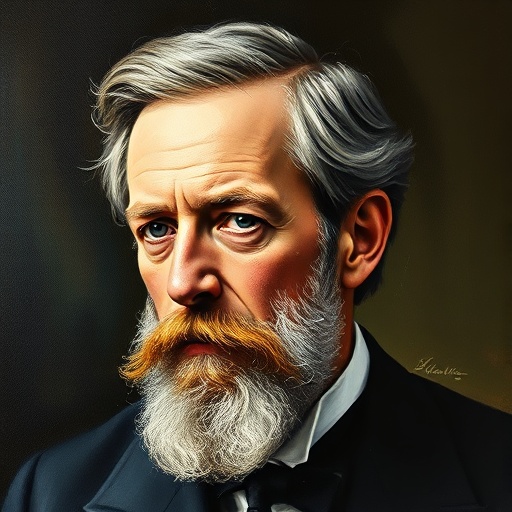
Portrait of William James

William James

Pragmatism, psychology

Modern influential 70 sayings

Sayings by William James

The absolutely initial fact of all our knowing is the fact that we are immediately conscious of a feeling of being alive.

1911 — From 'Some Problems of Philosophy'
Wisdom Unverifiable

The difference between a bad habit and a good one is that a bad habit is easy to acquire and difficult to get rid of, while a good habit is difficult to acquire and easy to get rid of.

1890 — Reflects his discussion of habit formation in 'The Principles of Psychology'.
Wisdom Unverifiable

The tears of the world are a constant quantity. For every one who begins to weep, somewhere else another stops. The same is true of the laughter.

1890 — From 'The Principles of Psychology'
Wisdom Unverifiable

The intellectual life of man consists almost wholly in his substituting a conceptual order for the perceptual order in which his experience originally comes.

1911 — From 'Some Problems of Philosophy'
Educational Unverifiable

Man, biologically considered, and whatever else he may be into the bargain, is the most formidable of all the beasts of prey.

1910 — From 'The Moral Equivalent of War'
Wisdom Unverifiable

The greatest discovery of all time is that a person can change his future by merely changing his attitude.

Unknown — Very similar to an earlier quote, often attributed in slightly varied forms.
Educational Unverifiable

The deepest principle in human nature is the craving to be appreciated.

Unknown, early 20th century — Attributed, widely cited, aligns with his psychological insights.
Nature & World Confirmed

What is new is not necessarily true, and what is true is not necessarily new.

Unknown — Reflects his pragmatic approach to truth and ideas.
Wisdom Unverifiable

The first thing that a man will do for his ideals is to lie.

1910 — From 'The Moral Equivalent of War'
Wisdom Unverifiable

The meaning of a statement is the conceivable practical consequences of its truth.

1907 (from 'Pragmatism') — Core tenet of his pragmatism, often summarized this way.
Wisdom Unverifiable

Habit is the enormous fly-wheel of society, its most precious conservative agent.

1890 — From 'The Principles of Psychology'
Political Unverifiable

We must make our nervous system our ally instead of our enemy.

1890 — From 'The Principles of Psychology'
War & Conflict Unverifiable

The education of the will is the object of our whole training.

1899 — From 'Talks to Teachers on Psychology: And to Students on Some of Life's Ideals'
Educational Unverifiable

Act as if what you do makes a difference. It does.

Unknown — Attributed, often cited, embodies his philosophy of the 'will to believe' and action.
Wisdom Unverifiable

A chain is no stronger than its weakest link, and life is no stronger than its weakest moment.

Unknown — Attributed, reflects his emphasis on individual moments and choices.
Power & Leadership Unverifiable

The world is a place of peril, and we must learn to be brave.

Unknown, early 20th century — Reflects his call for a 'moral equivalent of war' and facing life's challenges.
Educational Unverifiable

The perception of beauty is a moral test.

1910 — From 'The Moral Equivalent of War'
Art & Creativity Unverifiable

The will to believe is the will to act on our hopes.

1896 — Summary of his essay 'The Will to Believe'
Inspirational Unverifiable

To be spiritual is to be alive to the infinite possibilities of life.

Unknown, early 20th century — Reflects themes in 'The Varieties of Religious Experience'.
Wisdom Unverifiable

The deepest craving of human nature is the need to be appreciated.

Unknown — Similar to an earlier quote, variations exist.
Nature & World Unverifiable
Your Cart

Your cart is empty