What it means
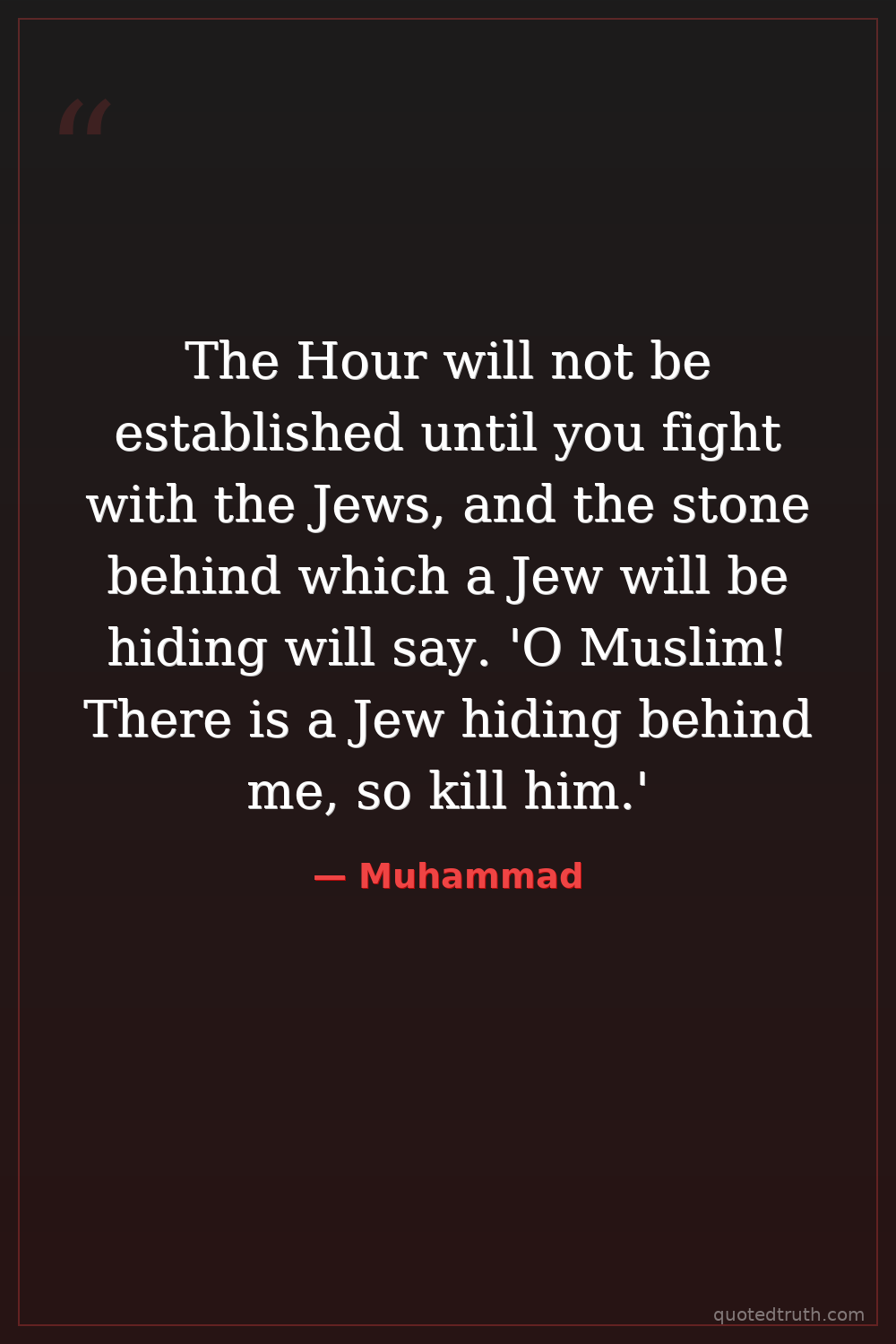
This statement predicts a future end-times conflict where Muslims will fight Jewish people, and even inanimate objects like stones will miraculously speak to expose those hiding behind them. It frames an apocalyptic scenario in which nature itself takes sides in the confrontation, leaving no place to hide. The passage is eschatological, describing signs believers expect before the Day of Judgment rather than offering guidance for ordinary daily conduct.
Relevance to Muhammad
Attributed to Muhammad in hadith collections compiled generations after his death, this saying reflects the apocalyptic genre common in his later Medinan teachings, where he established a religious-political community and navigated sharp conflicts with local Jewish tribes like the Banu Qurayza and Banu Nadir. As both prophet and statesman, he frequently spoke of end-times signs, and his role as military leader during Medina's inter-tribal warfare shaped the combative imagery preserved here.
The era
In 7th-century Arabia, Muhammad's Medina hosted Jewish, Christian, and polytheist tribes whose shifting alliances sparked repeated wars. Apocalyptic expectation permeated the Near East after Byzantine-Sasanian exhaustion, and prophetic end-times sayings circulated across Jewish, Christian, and emerging Islamic communities. Oral tradition preserved such pronouncements for two centuries before written hadith compilation by Bukhari and Muslim in the 9th century, where scribes shaped and selected narrations amid ongoing sectarian and geopolitical tensions in the Abbasid caliphate.
AI-generated insights based on extensive research and information for context. Factual errors? Email [email protected].