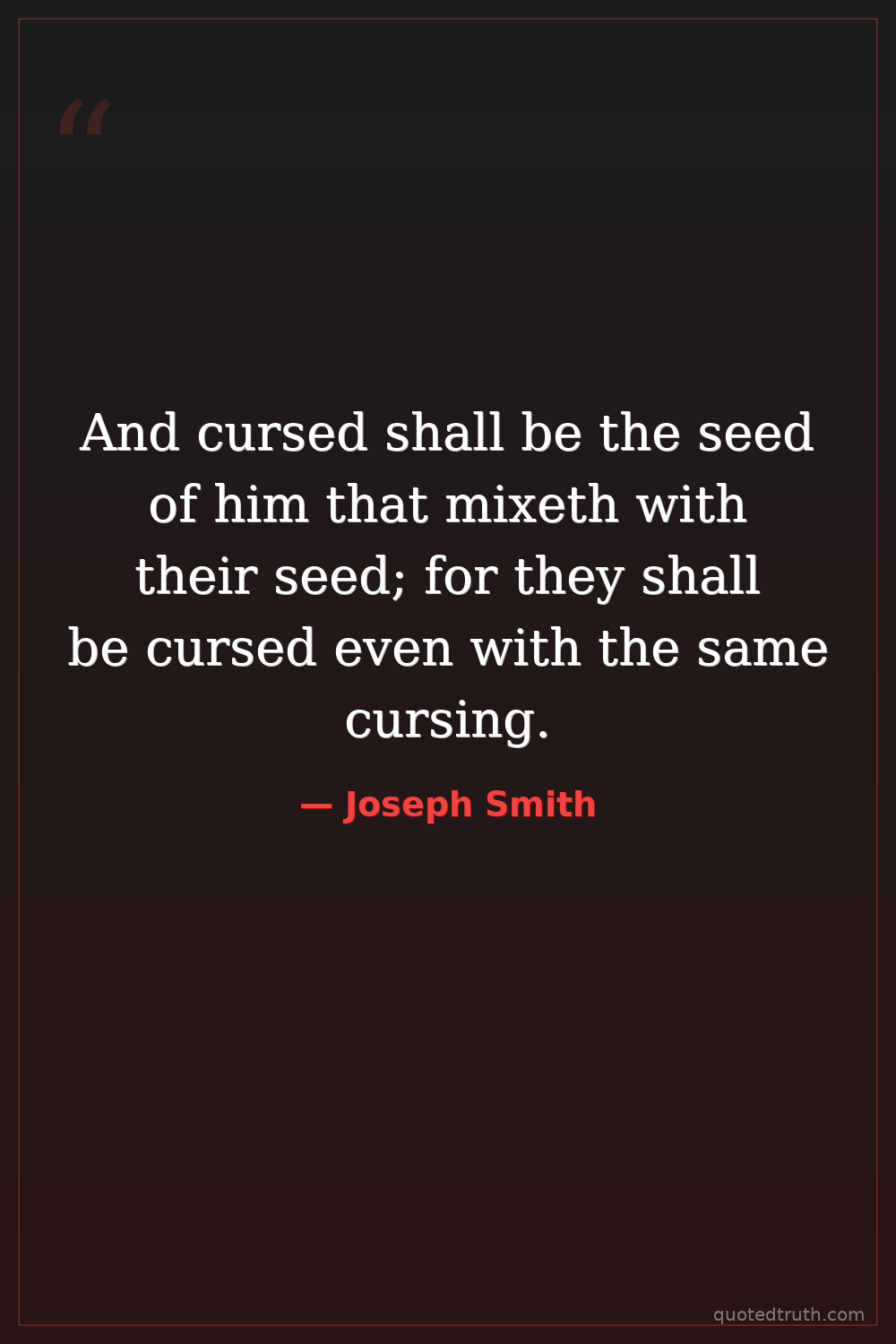
Joseph Smith — "And cursed shall be the seed of him that mixeth with their seed; for they shall …"
And cursed shall be the seed of him that mixeth with their seed; for they shall be cursed even with the same cursing.
And cursed shall be the seed of him that mixeth with their seed; for they shall be cursed even with the same cursing.
Click any product to generate a realistic preview. Up to 3 at a time.
* Initial load can take up to 90 seconds — revising the preview in another color is nearly instant.
"I have seen the Lord, and he has talked with me face to face."
"I am a man of brotherly kindness, and I will be kind to all men."
"I have been called of God to lay the foundation of a great work."
"All spirits are pure that come from the presence of God."
"I am a man of temperance, and I will be temperate in all things."
Abraham 1:23 (from the Pearl of Great Price, a scripture canonized by the LDS Church)
Date: 1835-1842 (translation period)
GeneralFound in 1 providers: gemini
1 source checked
The quote warns that anyone who intermarries with a cursed people inherits that same divine curse through their offspring. It frames bloodline mixing as a spiritually dangerous act carrying hereditary punishment — condemnation passes not through personal sin but through ancestry. In modern terms: marrying into a condemned group makes your children condemned too, treating ethnic or racial separation as a theological imperative rather than mere social preference.
Joseph Smith embedded racial hierarchy directly into LDS scripture, presenting skin color as divine punishment for sin. This passage reflects his broader theological framework in the Book of Mormon, where the Lamanites — understood as ancestors of Native Americans — were marked with dark skin as a curse. The LDS Church Smith founded enforced a priesthood ban on Black members until 1978, a policy rooted in such textual foundations from his revelatory writings.
Smith wrote in the 1820s–30s, when Congress passed the Indian Removal Act (1830), slavery was legally entrenched, and racial pseudoscience was gaining academic legitimacy. White Protestant America widely framed indigenous and African peoples as spiritually or biologically inferior. Smith's theology didn't merely reflect these views — it sacralized them, giving racial separation a divine mandate at precisely the moment American expansion required moral justification for displacing and subjugating non-white populations.
AI-generated insights based on extensive research and information for context. Factual errors? Email [email protected].
Your cart is empty