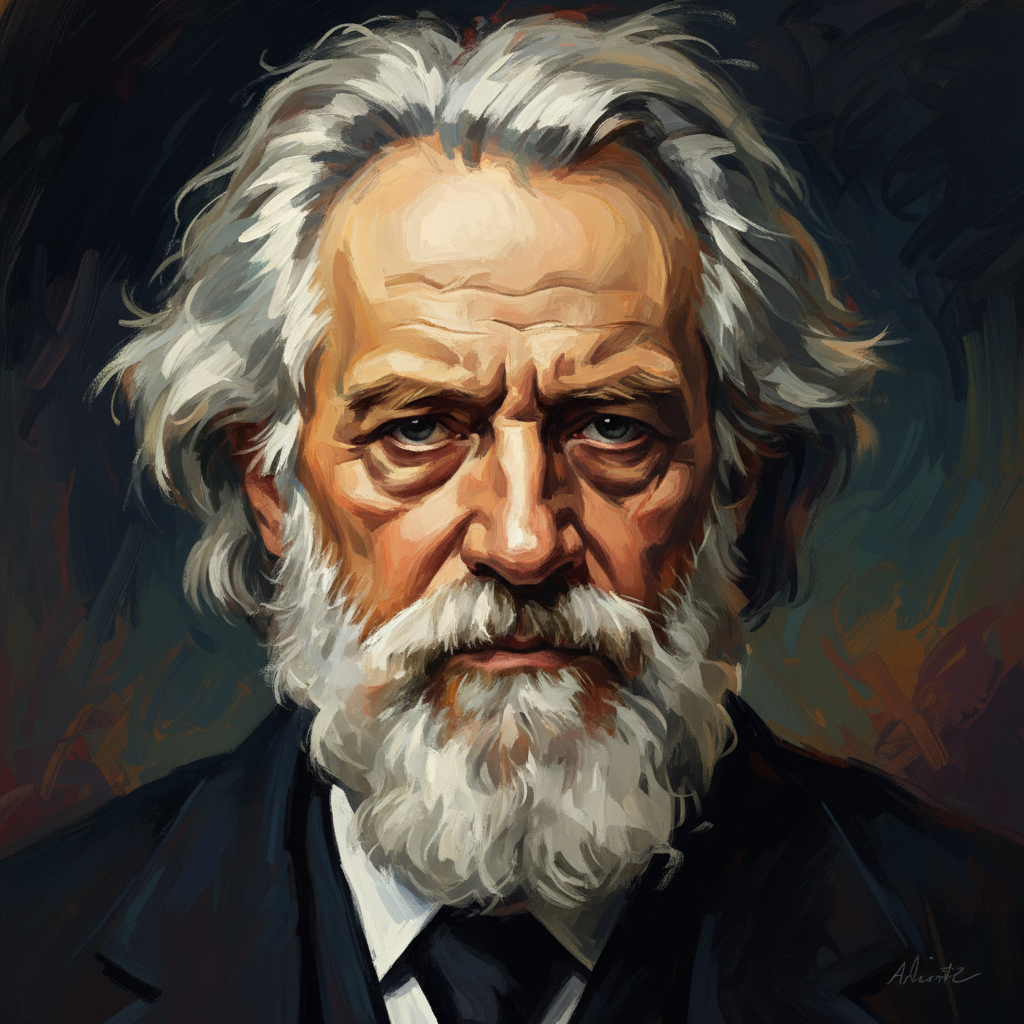
Arthur Schopenhauer — "All truth passes through three stages. First, it is ridiculed. Second, it is vio…"
All truth passes through three stages. First, it is ridiculed. Second, it is violently opposed. Third, it is accepted as being self-evident.
All truth passes through three stages. First, it is ridiculed. Second, it is violently opposed. Third, it is accepted as being self-evident.
Click any product to generate a realistic preview. Up to 3 at a time.
* Initial load can take up to 90 seconds — revising the preview in another color is nearly instant.
"The greatest of follies is to sacrifice health for any other kind of happiness."
"The intellect is a mere tool in the service of the will."
"The animal enjoys the present without the burden of memory or anxiety about the future; man, on the other hand, is tormented by reflection."
"To be alone is the fate of all great minds – a fate deplored at times, but still always chosen as the less grievous of two evils."
"It would be better if there were nothing. Since there is more pain than pleasure on earth, every satisfaction is only transitory, creating new desires and new distresses, and the agony of the devoured…"
German philosopher of pessimism whose The World as Will and Representation (1819) defined the suffering-and-renunciation tradition. Closely associated with Immanuel Kant (the system Schopenhauer built on and revised). For an intellectual contrast, see G.W.F. Hegel, German Idealist of the rational unfolding of Spirit — Schopenhauer scheduled his Berlin lectures opposite Hegel's and spent decades attacking Hegel's optimistic system as deliberately mystifying nonsense — the foundational rivalry of 19th-century German philosophy.
The standard scholarly entry points to Arthur Schopenhauer's work: Bryan Magee (Oxford, populariser-philosopher) — The Philosophy of Schopenhauer (1983); Christopher Janaway (Southampton, Schopenhauer specialist) — Self and World in Schopenhauer's Philosophy (1989); David E. Cartwright (Wisconsin–Whitewater) — Schopenhauer: A Biography (2010). These are the works graduate seminars cite when teaching Arthur Schopenhauer.
Your cart is empty