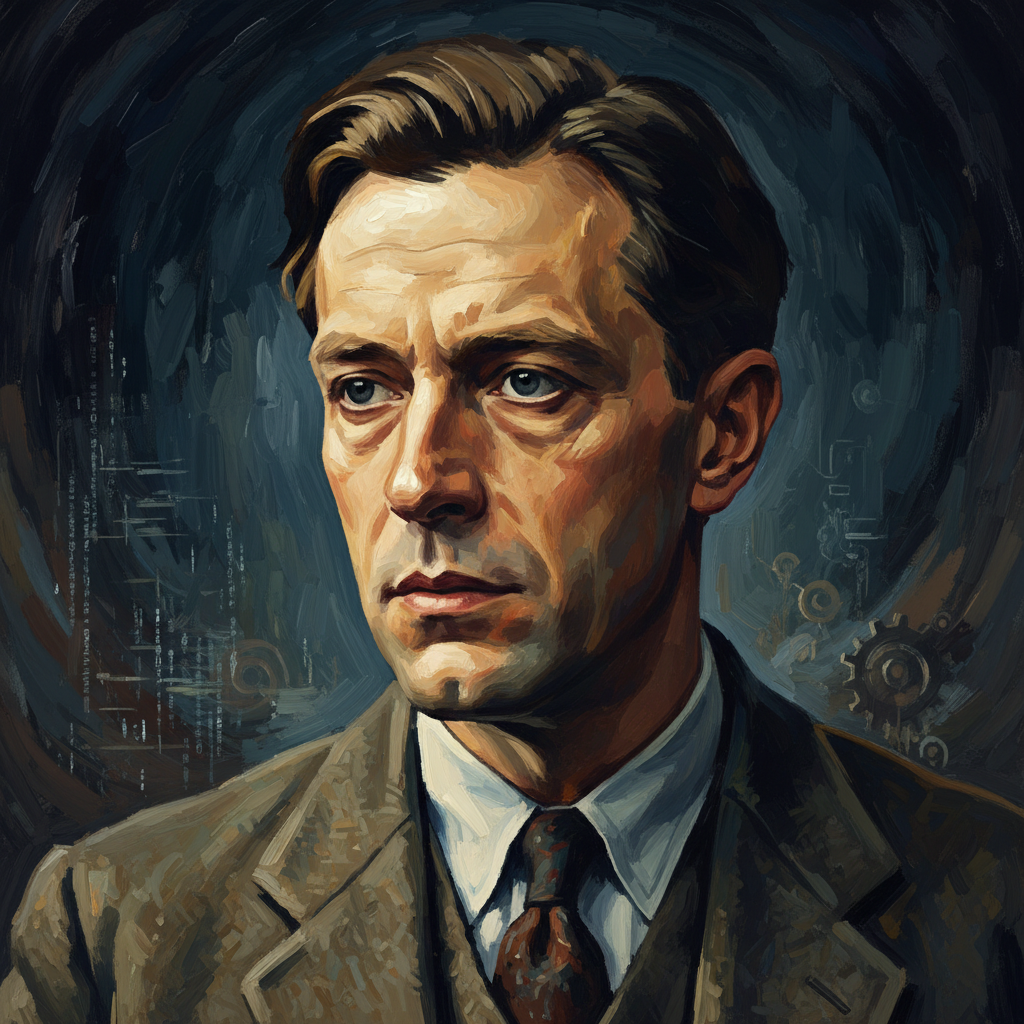
Alan Turing — "Science is a differential equation. Religion is a boundary condition."
Science is a differential equation. Religion is a boundary condition.
Science is a differential equation. Religion is a boundary condition.
Click any product to generate a realistic preview. Up to 3 at a time.
* Initial load can take up to 90 seconds — revising the preview in another color is nearly instant.
"There are many questions which we shall have to answer, for example, what is the nature of consciousness?"
"The problem of creating intelligent machines is one of the most challenging and exciting problems in all of science."
"If you cannot explain it simply, you do not understand it well enough."
"I am a homosexual. I have been convicted of gross indecency. I have been subjected to chemical castration."
"We can only see a short distance ahead, but we can see plenty there that needs to be done."
Found in 3 providers: gemini,grok,deepseek
3 sources checked
A differential equation defines how a system evolves — its rules of change — but yields infinite valid solutions. A boundary condition pins down one specific answer. Turing is saying science describes the mechanics of how the universe operates, while religion supplies the fixed assumptions that select which solution actually holds. They aren't rivals on the same plane; one governs process, the other fixes the frame within which that process resolves.
Turing built the theoretical foundation of computation and cracked Enigma by reducing problems to precise logical rules. His 1950 paper on machine intelligence openly wrestled with consciousness and whether machines could have souls. He didn't treat metaphysical questions as beneath him — he formalized them. This quote shows his signature move: rather than dismissing religion, he assigns it an exact mathematical role, the boundary condition that anchors science's infinite possibilities to one actual world.
Post-WWII Britain saw science achieve terrifying new power — atomic weapons, computers, the discovery of DNA — while Christian moral authority still shaped law and culture. Darwin's legacy remained contested in schools. Turing himself was prosecuted in 1952 under statutes rooted in religious morality and subjected to chemical castration. In this climate, the boundary between scientific reasoning and religious doctrine was not abstract. His metaphor reframes them as logically distinct but structurally dependent — a precise, almost merciful, resolution.
AI-generated insights based on extensive research and information for context. Factual errors? Email [email protected].
Your cart is empty