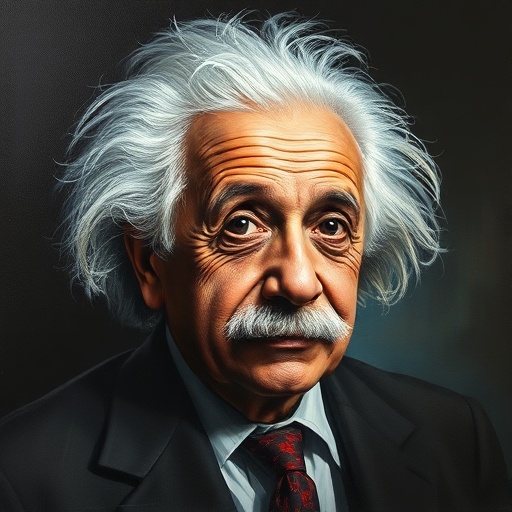
Albert Einstein — "Peace cannot be kept by force; it can only be achieved by understanding."
Peace cannot be kept by force; it can only be achieved by understanding.
Peace cannot be kept by force; it can only be achieved by understanding.
Click any product to generate a realistic preview. Up to 3 at a time.
* Initial load can take up to 90 seconds — revising the preview in another color is nearly instant.
"Imagination is the preview of life's coming attractions."
"Falling in love is not at all the most stupid thing that people do-but gravitation cannot be held responsible for it."
"With fame I become more and more stupid, which of course is a very common phenomenon."
"I am against any form of violence, for I know that violence only leads to more violence."
"The Negroes are certainly more primitive than us, but not in a negative sense."
Found in 1 providers: grok
1 source checked
Force — military might, coercion, threat of violence — cannot sustain lasting peace. Real peace requires mutual understanding: people and nations genuinely grasping each other's perspectives, needs, and humanity. When you suppress conflict through power alone, you create resentment that resurfaces. Only when parties actually comprehend one another can agreements hold without constant enforcement. Understanding dissolves the underlying tensions that make violence feel necessary in the first place.
Einstein was a committed pacifist who fled Nazi Germany in 1933, witnessing firsthand how militarism destroys rather than secures peace. His scientific work depended on cross-border intellectual collaboration, embodying understanding as method. He co-signed the Russell-Einstein Manifesto in 1955 urging nuclear disarmament, and publicly opposed both World Wars, believing dialogue among nations was the only path away from atomic catastrophe. His entire career proved ideas — not armies — change the world.
Einstein lived through both World Wars, the rise of fascism, and the dawn of the nuclear age. His most active decades saw nations deploy overwhelming force — mustard gas, firebombing, atomic bombs — yet achieve only fragile armistices, not durable peace. The League of Nations collapsed, and the subsequent Cold War arms race made his argument urgent: coercion breeds cycles of retaliation, while diplomacy and genuine empathy between adversaries remain the only sustainable path forward.
AI-generated insights based on extensive research and information for context. Factual errors? Email [email protected].
Your cart is empty