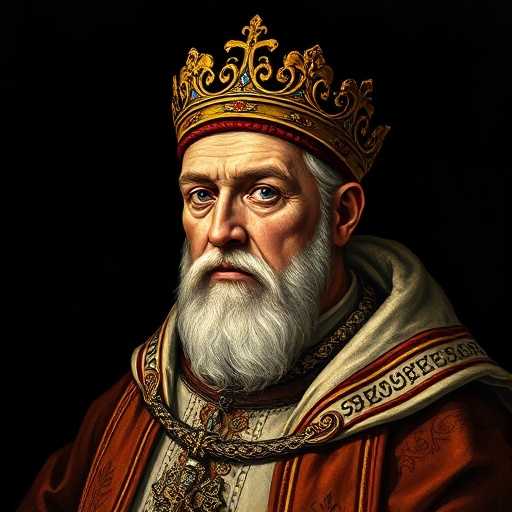
Pope Urban II — "The way to the Holy Sepulchre is now open, a way which was closed before."
The way to the Holy Sepulchre is now open, a way which was closed before.
The way to the Holy Sepulchre is now open, a way which was closed before.
Click any product to generate a realistic preview. Up to 3 at a time.
* Initial load can take up to 90 seconds — revising the preview in another color is nearly instant.
"Let no one who is rich hold back, and let no poor man hesitate, for God will be his guide and provider."
"All who are burdened with debt and wish to escape it, let them join this holy expedition."
"We exhort and command you, brethren, to strive with all your might to drive out the Turks from the confines of the Christians, and to aid the Christians, who are now subjected to their yoke."
"They violate the women of the Christians."
"God wills it! God wills it!"
Pope (1088-1099) whose Council of Clermont speech (November 1095) launched the First Crusade — the founding event of nine centuries of Christian-Muslim military conflict. Closely associated with Pope Gregory VII (his predecessor on papal-imperial reform). For an intellectual contrast, see Saladin, Kurdish-Muslim Sultan of Egypt and Syria (1138-1193) — Saladin recaptured Jerusalem in 1187, undoing the First Crusade Urban II launched 92 years earlier. Saladin's chivalrous treatment of Christian prisoners became the canonical Muslim counter-image to Crusader brutality. The cleanest before/after pairing of the Crusades' moral arc.
Found in 1 providers: deepseek
1 source checked
A path that was once blocked has now been opened. The speaker declares that access to a sacred destination, previously denied or obstructed, is now available. This conveys triumph over an obstacle and an invitation for action — the barrier is gone, the journey is possible, and those who desired this passage can now pursue it without the impediment that once stopped them.
Urban II launched the First Crusade at the Council of Clermont in 1095, rallying Western Christians with the cry to reclaim Jerusalem from Seljuk Turkish control. As pope, his authority over Christendom made him uniquely positioned to declare holy wars. His papacy centered on reforming the Church and asserting papal supremacy — making this declaration of an opened sacred path both a military call and a theological assertion of divine will working through him.
In 1095, Seljuk Turks had disrupted Christian pilgrimages to Jerusalem, a city central to medieval faith. Pilgrimage was not casual tourism — it was penance, devotion, and salvation-seeking. Byzantine Emperor Alexios I had also appealed for Western military aid. Urban's proclamation tapped into deep medieval anxieties about sacred geography and Christian duty, igniting a movement that mobilized tens of thousands across Europe in one of history's most consequential military-religious campaigns.
AI-generated insights based on extensive research and information for context. Factual errors? Email [email protected].
Your cart is empty