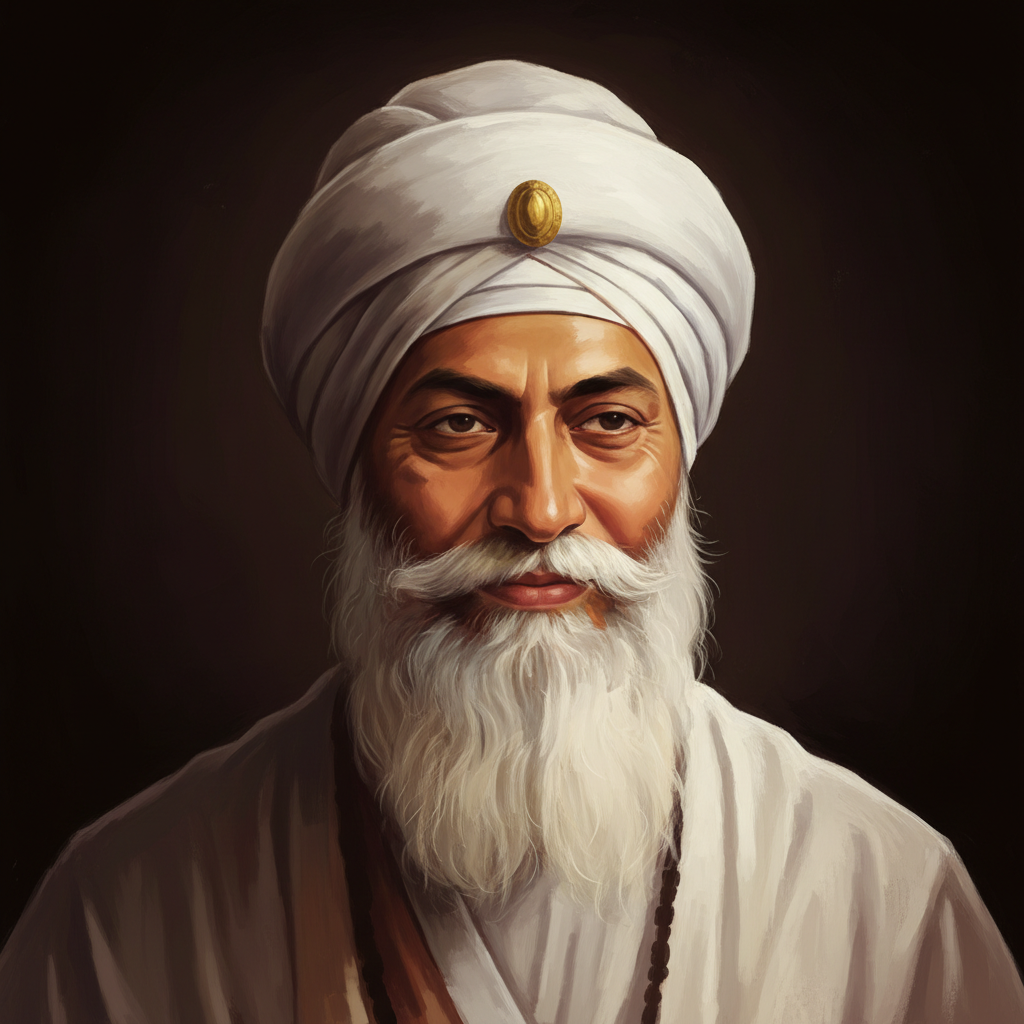
Guru Nanak — "By the grace of the Guru, one obtains the treasure of the True Name."
By the grace of the Guru, one obtains the treasure of the True Name.
By the grace of the Guru, one obtains the treasure of the True Name.
Click any product to generate a realistic preview. Up to 3 at a time.
* Initial load can take up to 90 seconds — revising the preview in another color is nearly instant.
"There is no Hindu, there is no Muslim. There's just people trying to figure out what's for dinner."
"Even if you have a hundred thousand friends, you are alone if you don't have a good cup of tea."
"There is no Hindu, there is no Muslim, there is only one human race."
"The mind is a mad elephant, intoxicated by ego. Only the Guru's teachings can tame it."
"Conquer your mind and conquer the world."
Founder of Sikhism and the first of the Ten Sikh Gurus, whose teachings of one universal God and rejection of caste shaped Punjab. Closely associated with Kabir (mystical poet whose verses appear in the Sikh Guru Granth Sahib). For an intellectual contrast, see Brahmanical orthodoxy, the Hindu caste-and-ritual establishment of his era — Sikhism was founded as a deliberate alternative to both Hindu ritual hierarchy and Islamic exclusivism — Nanak's universalism was a structural rejection of caste and priestly mediation.
Found in 1 providers: grok
1 source checked
This saying teaches that the most valuable spiritual gift a person can receive, knowledge of the divine name and true reality, does not come from personal effort, ritual, or study alone. It arrives as a gift through the guidance of a genuine teacher. The Guru opens the door; the seeker cannot force it open. What is received is described as a treasure because it is lasting, inward, and more precious than any worldly gain.
Guru Nanak founded Sikhism around a direct, teacher-led path to one formless God, summarized in the practice of Naam Simran, remembering the True Name. He rejected caste, empty ritual, and priestly gatekeeping, insisting instead that a living Guru's grace awakens the seeker. Raised a Hindu in a Muslim-ruled Punjab, trained as an accountant, he spent decades on long preaching journeys called udasis, teaching exactly this reliance on Guru-given insight over inherited religion.
Guru Nanak lived 1469 to 1539 in Punjab under the early Delhi Sultanate and then the new Mughal Empire after Babur's 1526 invasion, which Nanak witnessed and criticized. Hindu and Muslim communities were often polarized, Brahmin ritual and caste were entrenched, and Sufi and Bhakti movements were already pushing devotional, egalitarian alternatives. Nanak's emphasis on Guru-given grace and the True Name offered a third path that bypassed temple, mosque, scripture language, and birth-caste gatekeepers alike.
AI-generated insights based on extensive research and information for context. Factual errors? Email [email protected].
Your cart is empty