What it means
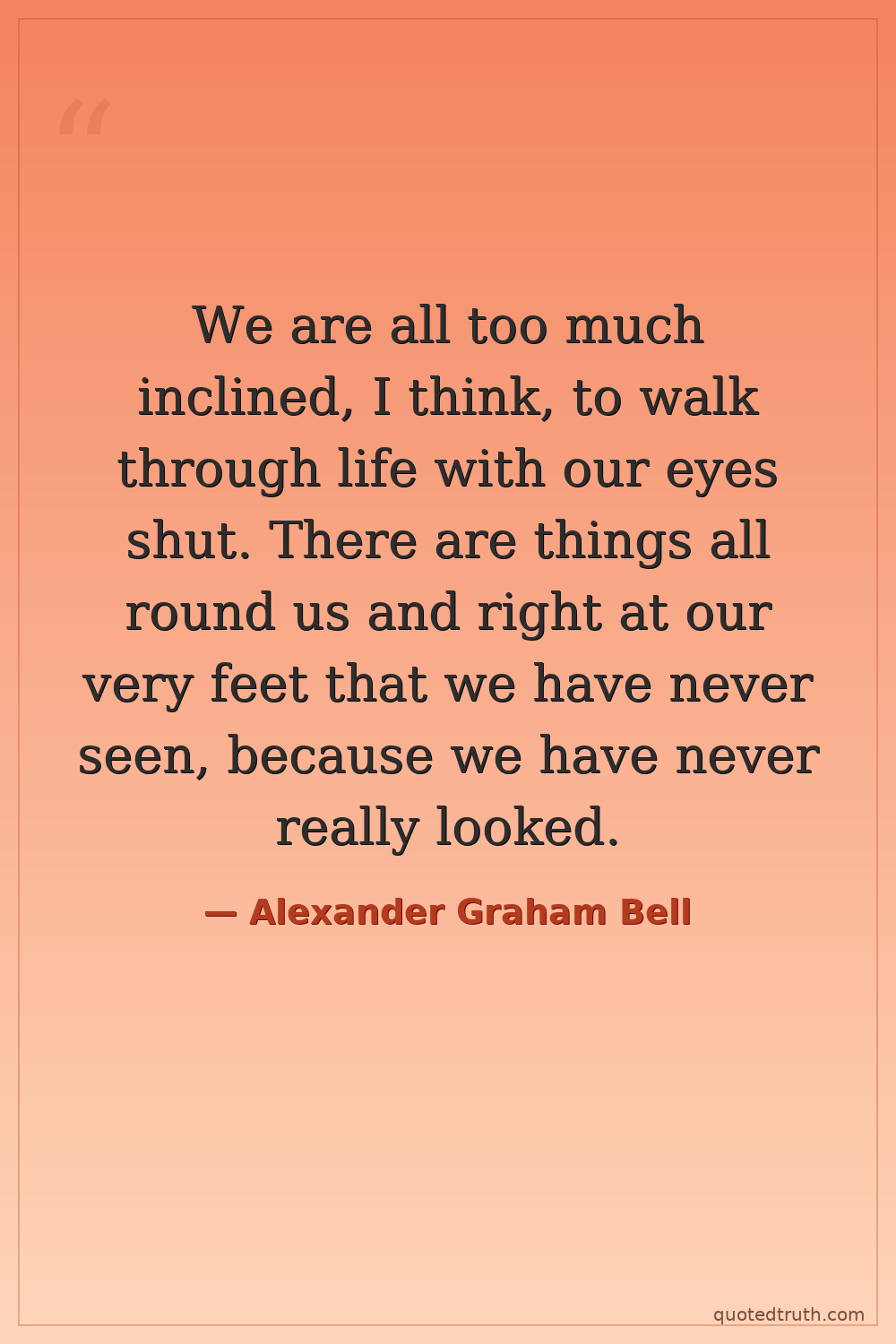
Most people move through life without genuine attention, missing what's plainly in front of them. True discovery doesn't require rare circumstances — it requires deliberate, focused looking. The unseen wonders aren't hidden far away; they exist at our very feet, overlooked simply because we never truly directed our attention toward them. Passive existence substitutes habit and assumption for the active curiosity that actually reveals the world.
Relevance to Alexander Graham Bell
Bell's entire career embodied this principle. He studied human ear mechanics and vocal cord vibration — his father pioneered visible speech for the deaf — before designing the telephone by observing how membranes respond to sound waves. His photophone and metal detector improvements each stemmed from noticing phenomena others dismissed. His lifelong teaching of deaf students reinforced his conviction that patient, precise observation, not genius alone, unlocks what ordinary eyes miss.
The era
Bell's most productive decades coincided with the Second Industrial Revolution, when systematic observation was remaking science. Darwin had just reframed nature as something to be carefully watched rather than assumed. Pasteur, Curie, and Röntgen each made landmark discoveries by attending to what others ignored. In this climate of accelerating invention, Bell's message — that most people sleepwalk past extraordinary phenomena — resonated as both personal philosophy and a challenge to a rapidly industrializing, distraction-prone society.
AI-generated insights based on extensive research and information for context. Factual errors? Email [email protected].