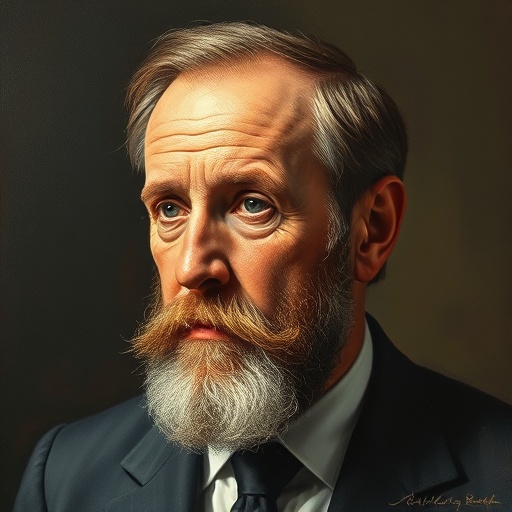
Niels Bohr — "No, I certainly do not believe in this superstition. But you know, they say that…"
No, I certainly do not believe in this superstition. But you know, they say that it does bring luck even if you don't believe in it!
No, I certainly do not believe in this superstition. But you know, they say that it does bring luck even if you don't believe in it!
Click any product to generate a realistic preview. Up to 3 at a time.
* Initial load can take up to 90 seconds — revising the preview in another color is nearly instant.
"We are trapped by language to such a degree that every attempt to make progress in our understanding of the universe must also be an attempt to perfect our language."
"The great lesson of quantum theory is that there is no deep reality."
"What is it that we human beings ultimately depend on? We depend on our words. We are suspended in language. Our task is to communicate experience and ideas to others."
"No, no, you're not thinking; you're just being logical."
"Only a fool is certain of anything. A wise man is always open to doubt."
Response to a visitor asking about a horseshoe above his door.
Date: Mid 20th century
GeneralFound in 1 providers: gemini
1 source checked
The speaker admits no belief in superstition yet keeps the lucky charm anyway, finding humor in the gap between rational conviction and hedging behavior. It captures a playful acknowledgment that some rituals operate outside the logic of belief — their supposed effect doesn't require the practitioner's faith. The joke lands because it exposes a universal human tendency: dismissing superstition in principle while quietly indulging it in practice.
This anecdote — reportedly about a horseshoe above Bohr's office door — perfectly mirrors his professional worldview. As architect of complementarity, Bohr argued that quantum particles could be simultaneously wave and particle: contradictory descriptions that are both valid. Holding two incompatible truths at once was his scientific method, not merely a personality quirk. His humor here isn't self-contradiction; it's the same philosophical agility he applied to atomic physics daily.
Bohr worked at the height of the quantum revolution (1910s–1950s), when science was dismantling certainties standing since Newton. Einstein resisted quantum probability; Bohr championed it. Intellectuals wrestled with whether objective reality existed independent of observation. Against that backdrop, a physicist keeping a horseshoe just in case wryly echoed the era's deepest anxiety: perhaps belief and outcome are entangled in ways reason alone cannot fully untangle.
AI-generated insights based on extensive research and information for context. Factual errors? Email [email protected].
Your cart is empty