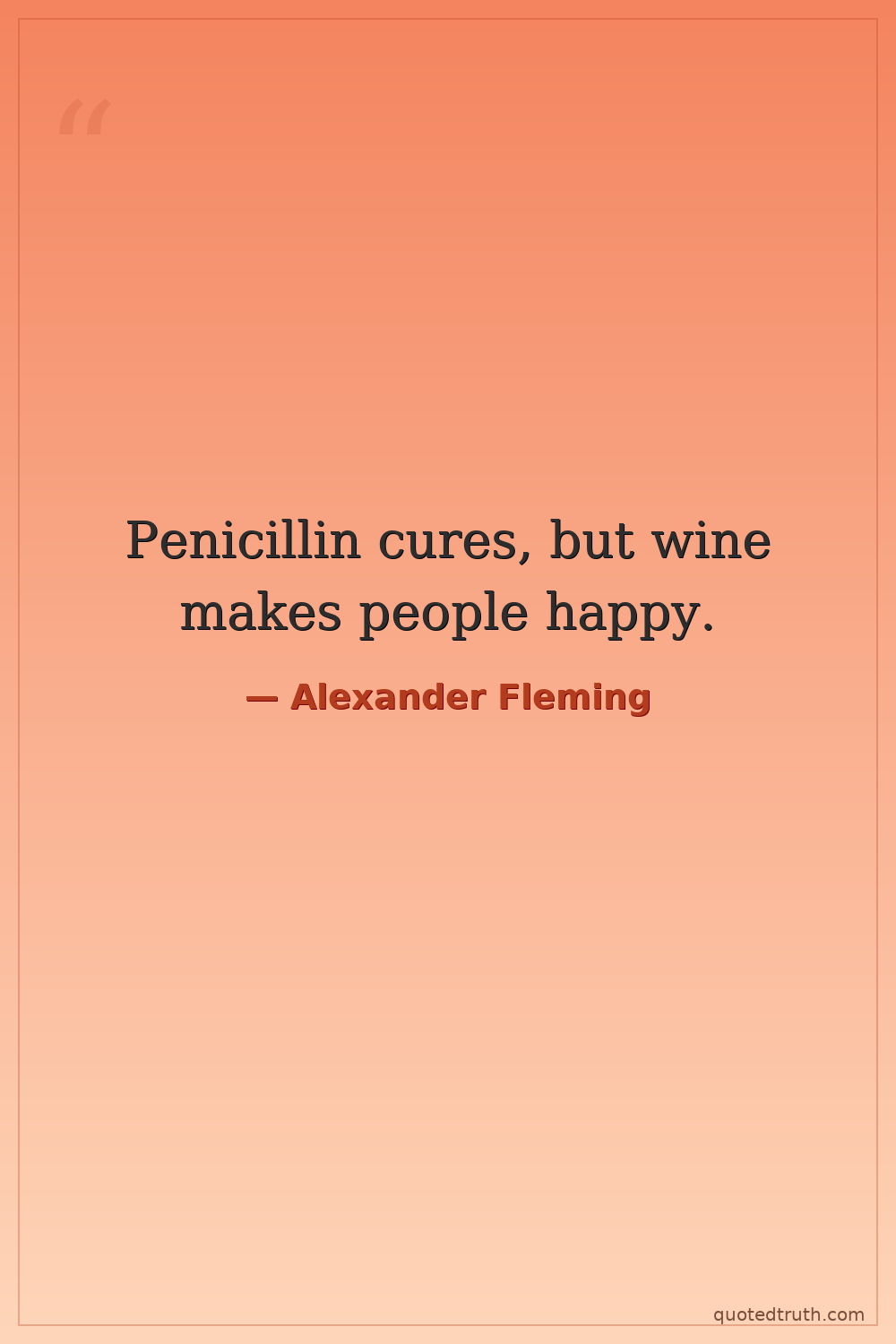
Alexander Fleming — "Penicillin cures, but wine makes people happy."
Penicillin cures, but wine makes people happy.
Penicillin cures, but wine makes people happy.
Click any product to generate a realistic preview. Up to 3 at a time.
* Initial load can take up to 90 seconds — revising the preview in another color is nearly instant.
"It is the common lot of discoverers to be misunderstood."
"I am just a simple bacteriologist who got lucky."
"It is remarkable how easily the public can be misled by sensational statements."
"It is a wonderful thing to be able to save lives with a simple substance."
"The power of observation is crucial in scientific research."
Found in 1 providers: gemini
1 source checked
Medicine can heal physical illness, but it does not address emotional well-being. While treatments like penicillin extend and save lives, simple human pleasures—companionship, celebration, a shared glass of wine—are what give those lives joy and meaning. Healing the body keeps a person alive; happiness is a separate ingredient that makes survival worthwhile. Both matter, but they serve different needs that science alone cannot satisfy.
Fleming, the Scottish bacteriologist who discovered penicillin in 1928 and shared the 1945 Nobel Prize, was famously modest and unpretentious despite revolutionizing medicine. He enjoyed life's pleasures, kept a casual lab, and resisted the saintly image pressed on him. The remark captures his self-deprecating humor: even the man whose mold spore saved millions refused to claim that medicine alone could deliver human happiness, granting wine equal billing.
Fleming's discovery emerged between two world wars, and penicillin's mass production during WWII saved countless Allied soldiers from infected wounds, sepsis, and gangrene. Antibiotics ushered in a mid-20th-century medical revolution that doubled life expectancy. Yet postwar Europe was rebuilding amid rationing, trauma, and grief; survivors needed more than cures. Fleming's quip reflected an era newly confident in science but still leaning on ordinary comforts—pubs, cafés, wine—to recover the joy that war and disease had stripped away.
AI-generated insights based on extensive research and information for context. Factual errors? Email [email protected].
Your cart is empty