What it means
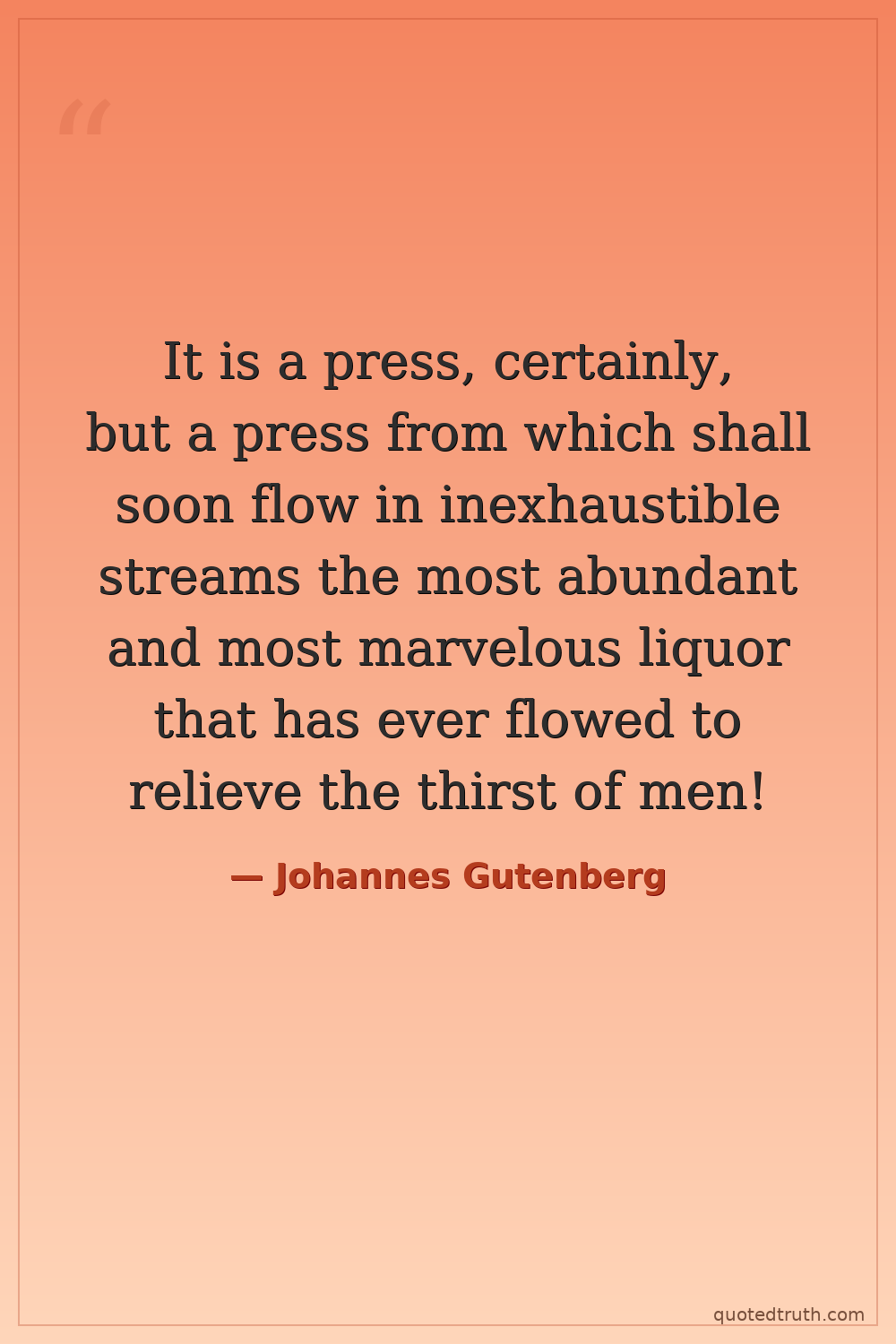
The quote uses a wine-press metaphor: a mechanical press that, instead of juice, produces an endless flow of knowledge. "Liquor" means written ideas and information satisfying humanity's deep intellectual and spiritual hunger. Gutenberg is declaring his invention will democratize access to knowledge at a scale never seen before—not just a tool, but a force that will quench the long-standing human thirst for learning, truth, and connection.
Relevance to Johannes Gutenberg
Gutenberg, a trained goldsmith in Mainz, Germany, applied metallurgical craft to cast durable movable type around 1440. His Gutenberg Bible (c. 1455) proved mass printing was viable. Despite losing his press to creditor Johann Fust through a lawsuit, he grasped its civilizational importance. The press metaphor mirrors his trade—wine presses were common in the Rhine Valley—reflecting his understanding that his machine would transform human knowledge transmission permanently.
The era
In 15th-century Europe, books were hand-copied by scribes and monks, making them costly, scarce, and controlled largely by the Church. Most Europeans were illiterate; owning a book was a privilege of clergy or nobility. Gutenberg's press arrived just decades before the Protestant Reformation, which depended on mass-printed pamphlets to spread dissent. The printing press shattered the Church's information monopoly, accelerating Renaissance humanism, scientific inquiry, and eventually modern democracy.
AI-generated insights based on extensive research and information for context. Factual errors? Email [email protected].