Leonardo da Vinci — "The soul desires to dwell with the body, because without the corporeal instrumen…"
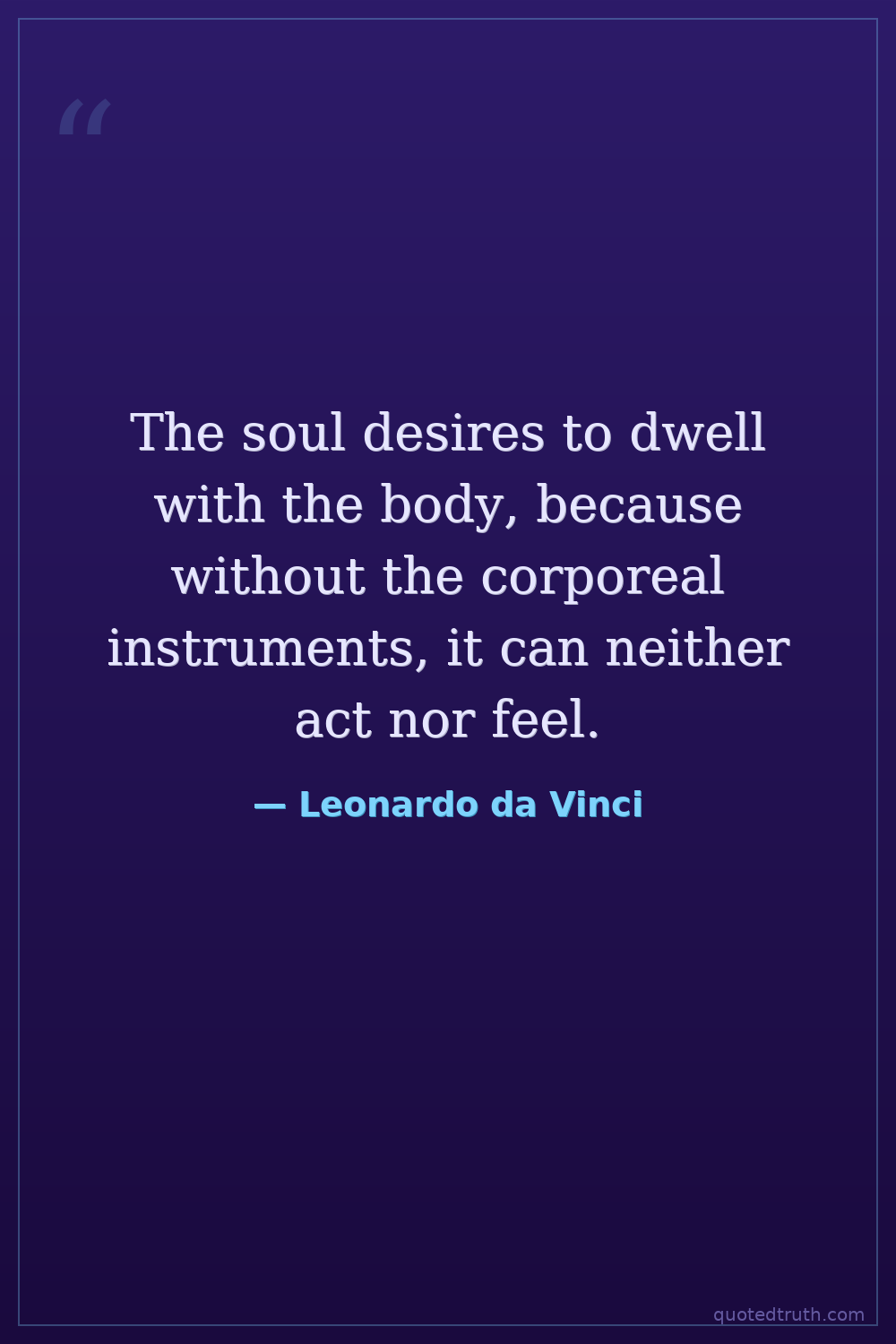
The soul desires to dwell with the body, because without the corporeal instruments, it can neither act nor feel.
The soul desires to dwell with the body, because without the corporeal instruments, it can neither act nor feel.
Click any product to generate a realistic preview. Up to 3 at a time.
* Initial load can take up to 90 seconds — revising the preview in another color is nearly instant.
"The greatest deception men suffer is from their own opinions."
"Small rooms or dwellings discipline the mind, large ones enfeeble it."
"Intellectual passion drives out sensuality."
"Experience does not err. Only your judgments err by expecting from her what is not in her power."
"As a well-spent day brings happy sleep, so a life well spent brings happy death."
Found in 1 providers: grok
1 source checked
The soul, however spiritual, requires the body as its instrument to experience and act in the physical world. Without eyes, hands, and senses, it cannot perceive, create, or affect anything. This is a firmly embodied philosophy: spiritual existence depends on physical existence, not the reverse. The body is not a prison for the soul — it is the soul's only tool for engaging with reality. Existence demands flesh.
Da Vinci spent decades dissecting human corpses, filling thousands of notebook pages with anatomical studies of muscles, nerves, and organs. As a painter, his genius lived in his hands and eyes — observation was his religion. This quote distills his life's practice: knowledge comes through sensory engagement, not abstract contemplation. An engineer who designed machines, an artist who painted bodies, he was living proof that doing and feeling — not pure thought — creates understanding.
The Renaissance challenged medieval Christianity's suspicion of the flesh, recovering classical Greek ideas about the unity of body and soul. Church doctrine often framed the body as a corrupt vessel the soul merely tolerated. Meanwhile, humanism and the rediscovery of Aristotle celebrated earthly life and physical experience. Anatomy was emerging as a serious discipline, and artists competed to accurately depict the human form. Da Vinci's claim that the soul needs the body was quietly radical in this tension.
AI-generated insights based on extensive research and information for context. Factual errors? Email [email protected].
Your cart is empty