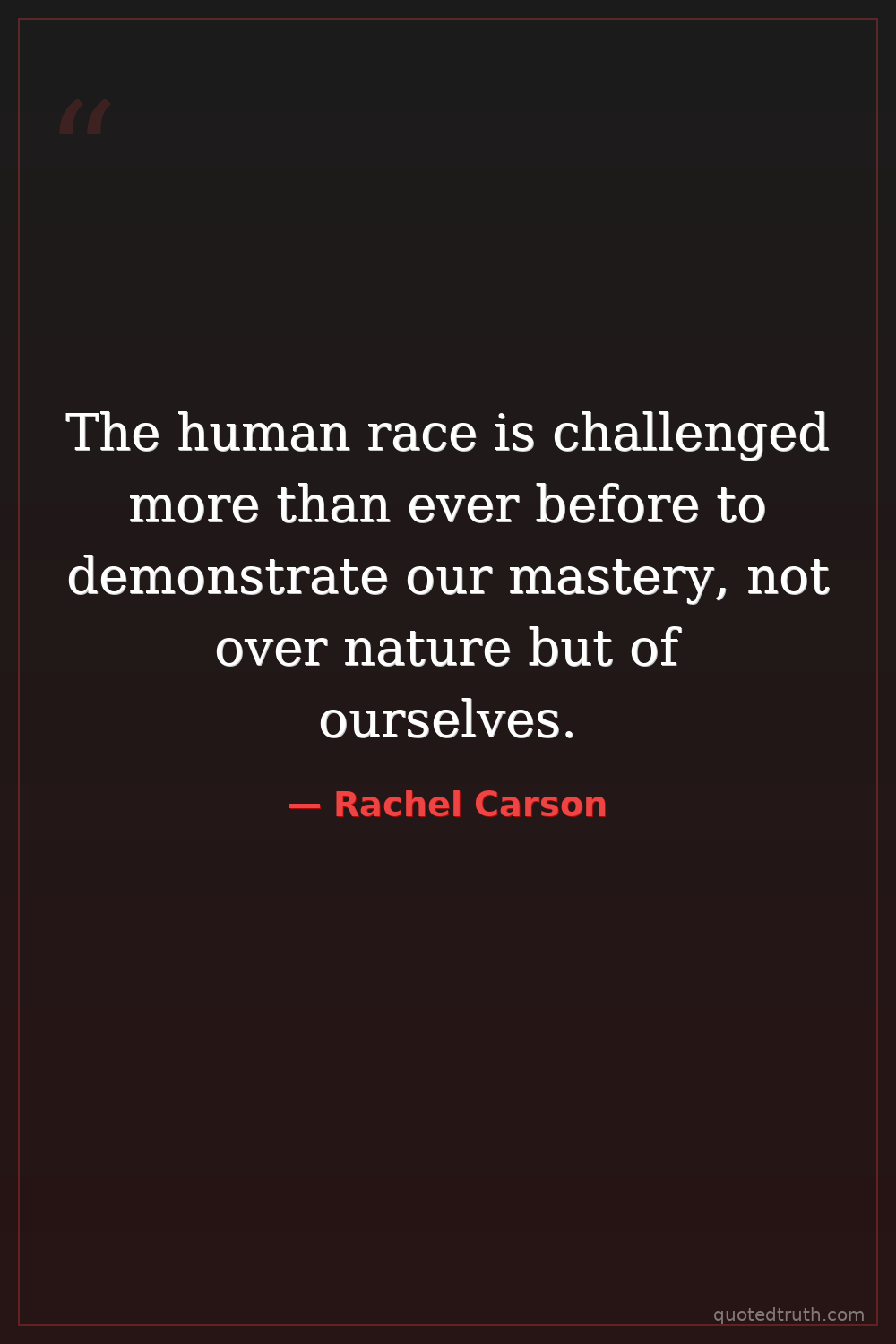
Rachel Carson — "The human race is challenged more than ever before to demonstrate our mastery, n…"
The human race is challenged more than ever before to demonstrate our mastery, not over nature but of ourselves.
The human race is challenged more than ever before to demonstrate our mastery, not over nature but of ourselves.
Click any product to generate a realistic preview. Up to 3 at a time.
* Initial load can take up to 90 seconds — revising the preview in another color is nearly instant.
"The beauty of the living world is a gift to all of us. We must not squander it."
"I am not a scientist in a white coat. I am a writer who happens to write about science."
"Future generations are not going to forgive us for the way we are destroying the planet."
"The ocean is a vast and mysterious realm, full of wonders yet to be discovered."
"The winds, the sea, and the moving tides are what they are. If there is wonder and beauty and majesty in them, science will discover these qualities."
Found in 1 providers: deepseek
1 source checked
Humanity's greatest challenge isn't conquering or controlling the natural world but exercising restraint, wisdom, and self-discipline over our own impulses and technologies. True mastery means governing our greed, shortsightedness, and hubris rather than dominating ecosystems. The real test of human intelligence is choosing not to destroy what sustains us, even when we have the technological capability to do exactly that.
Carson spent her career as a marine biologist and science writer documenting nature's interconnectedness. Silent Spring (1962) exposed how DDT and pesticides devastated bird populations and food chains — not through nature's failure but through human overconfidence in chemical technology. She testified before Congress, faced attacks from the chemical industry, and continued working while dying of cancer. Her life embodied the self-restraint she called for, choosing careful science over industrial convenience.
Carson wrote during the post-WWII industrial boom when synthetic chemicals like DDT were celebrated as miracles of modern science. The nuclear arms race, widespread pesticide use, and rapid industrialization defined an era of boundless technological optimism. Environmental damage was invisible or dismissed as acceptable progress. Silent Spring helped launch the modern environmental movement, directly influencing the EPA's creation in 1970 and DDT's federal ban in 1972.
AI-generated insights based on extensive research and information for context. Factual errors? Email [email protected].
Your cart is empty