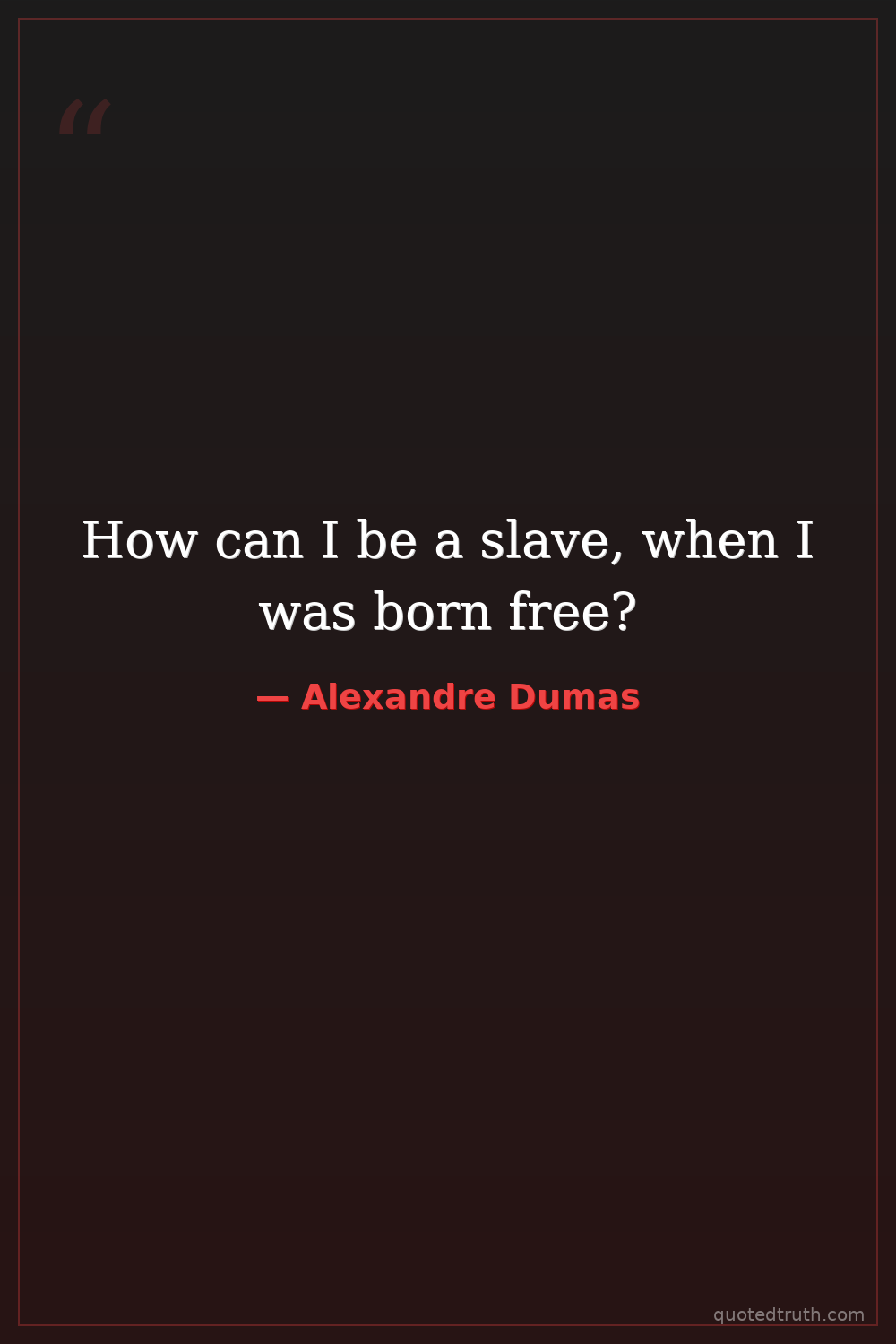
Alexandre Dumas — "How can I be a slave, when I was born free?"
How can I be a slave, when I was born free?
How can I be a slave, when I was born free?
Click any product to generate a realistic preview. Up to 3 at a time.
* Initial load can take up to 90 seconds — revising the preview in another color is nearly instant.
"The greatest events of history are often brought about by the most trivial causes."
"There is no such thing as a small enemy."
"The man who has no imagination has no wings."
"The human heart is a strange thing. It is capable of the greatest love and the greatest hatred."
"Revenge is a dish best served cold."
French Romantic novelist whose The Three Musketeers (1844) and The Count of Monte Cristo (1844-46) defined the historical-adventure novel and were translated into more languages than any other French author. Closely associated with Victor Hugo (French Romantic peer and Les Misérables author). For an intellectual contrast, see Gustave Flaubert, French realist novelist (1821-1880) — Flaubert's Madame Bovary (1856) replaced Dumas's swashbuckling adventure with psychological-realist detail — Flaubert's three-month searches for the right adjective are the precise opposite of Dumas's serial-installment plot-machine. French literature pivoted from Romantic to Realist in a single generation, with Dumas and Flaubert as the cleanest poles.
From 'Georges', a novel dealing with issues of race and slavery, reflecting Dumas's own mixed heritage.
Date: 1843
Social & RacialFound in 1 providers: grok
1 source checked
Your cart is empty