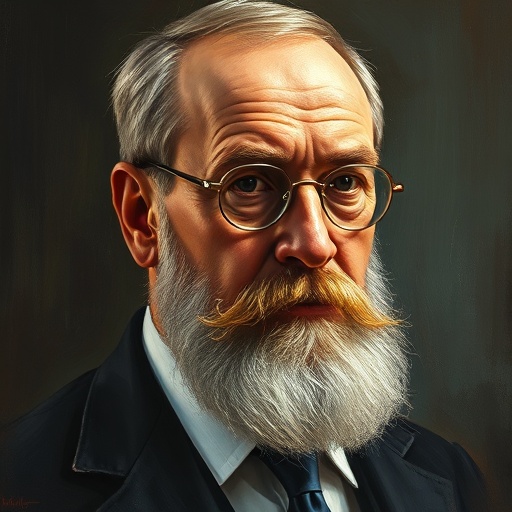
Robert Koch — "One must be prepared to make sacrifices for the sake of science."
One must be prepared to make sacrifices for the sake of science.
One must be prepared to make sacrifices for the sake of science.
Click any product to generate a realistic preview. Up to 3 at a time.
* Initial load can take up to 90 seconds — revising the preview in another color is nearly instant.
"It is remarkable how many different forms the tubercle bacillus can assume."
"The fight against disease is a never-ending battle, but we must never give up."
"The scientific method is the only reliable path to knowledge."
"The development of effective vaccines is a crucial step in controlling infectious diseases."
"The future of humanity depends on our ability to control infectious diseases."
Found in 1 providers: grok
1 source checked
Scientific progress demands personal cost. To advance knowledge meaningfully, a researcher must accept that the work will consume time, comfort, relationships, and sometimes safety. Progress does not come free — it requires choosing the laboratory over easier paths, enduring failure, risking reputation, and sometimes physical danger. The sacrifice is not incidental; it is the price of discovery. Those unwilling to pay it rarely push science meaningfully forward.
Koch lived this principle literally. He conducted his first anthrax experiments in a converted home office while working as a rural physician, with no university support. He traveled to Egypt and India to study cholera amid active outbreaks, risking his own life. His 1890 tuberculin failure publicly damaged his reputation. Relentless laboratory sessions — during which he invented staining techniques, microphotography, and pure-culture methods — ultimately cost him his first marriage.
Koch worked from the 1870s through 1905, when germ theory was still fiercely contested. Tuberculosis killed one in seven Europeans and its bacterial cause was entirely unknown. Bacteriology lacked established methodology, forcing pioneers to invent techniques from scratch. German science was ascending post-unification but resources outside elite Berlin institutions were scarce. Fierce Franco-German rivalry with Pasteur's school meant German discoveries faced nationalistic skepticism alongside rigorous scientific scrutiny.
AI-generated insights based on extensive research and information for context. Factual errors? Email [email protected].
Your cart is empty