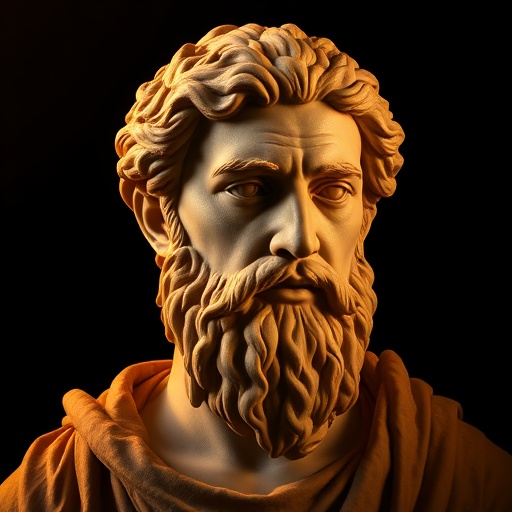
Euclid — "What do I gain by learning these things?"
What do I gain by learning these things?
What do I gain by learning these things?
Click any product to generate a realistic preview. Up to 3 at a time.
* Initial load can take up to 90 seconds — revising the preview in another color is nearly instant.
"Let it be granted that all right angles are equal to one another."
"If a straight line touch a circle, and from the point of contact there be drawn across in the circle a straight line cutting the circle, the angles which it makes with the tangent will be equal to the…"
"Let it be granted that a circle may be described with any center and any radius."
"Let it be granted that a straight line may be drawn from any one point to any other point."
"To inscribe a regular hexagon in a given circle."
Reported response to a student who, after learning the first theorem, asked what he would get by learning such things. Euclid then called his slave and said, 'Give him three pence, since he must make gain out of what he learns.'
Date: c. 300 BCE
EducationalFound in 1 providers: grok
1 source checked
Knowledge doesn't need to pay you back. This quote challenges the transactional view of education — the idea that you should only learn what generates profit or advantage. It asserts that truth and rigor have intrinsic worth independent of material reward. Studying something deeply, simply because it is true and knowable, is itself a sufficient reason. Immediate utility is the wrong measure of whether learning matters.
Euclid spent his life systematizing geometry in Elements — thirteen books of pure, rigorous proofs with no commercial purpose whatsoever. When a student demanded to know what practical benefit geometry offered, Euclid reportedly had a slave hand the student coins sarcastically, saying he 'must make gain out of what he learns.' His entire career embodied the conviction that mathematics exists to reveal truth, not to enrich its students.
Around 300 BCE in Alexandria under Ptolemy I, Greek philosophical tradition — especially Platonism — held that abstract knowledge, particularly mathematics, represented the highest human pursuit. Sophists openly charged fees for practical rhetoric instruction, making pure theoretical study a deliberate counterstatement. Euclid worked within the newly founded Library of Alexandria, an institution built to accumulate knowledge for its own sake, where intellectual prestige came from rigor, not commercial application.
AI-generated insights based on extensive research and information for context. Factual errors? Email [email protected].
Your cart is empty