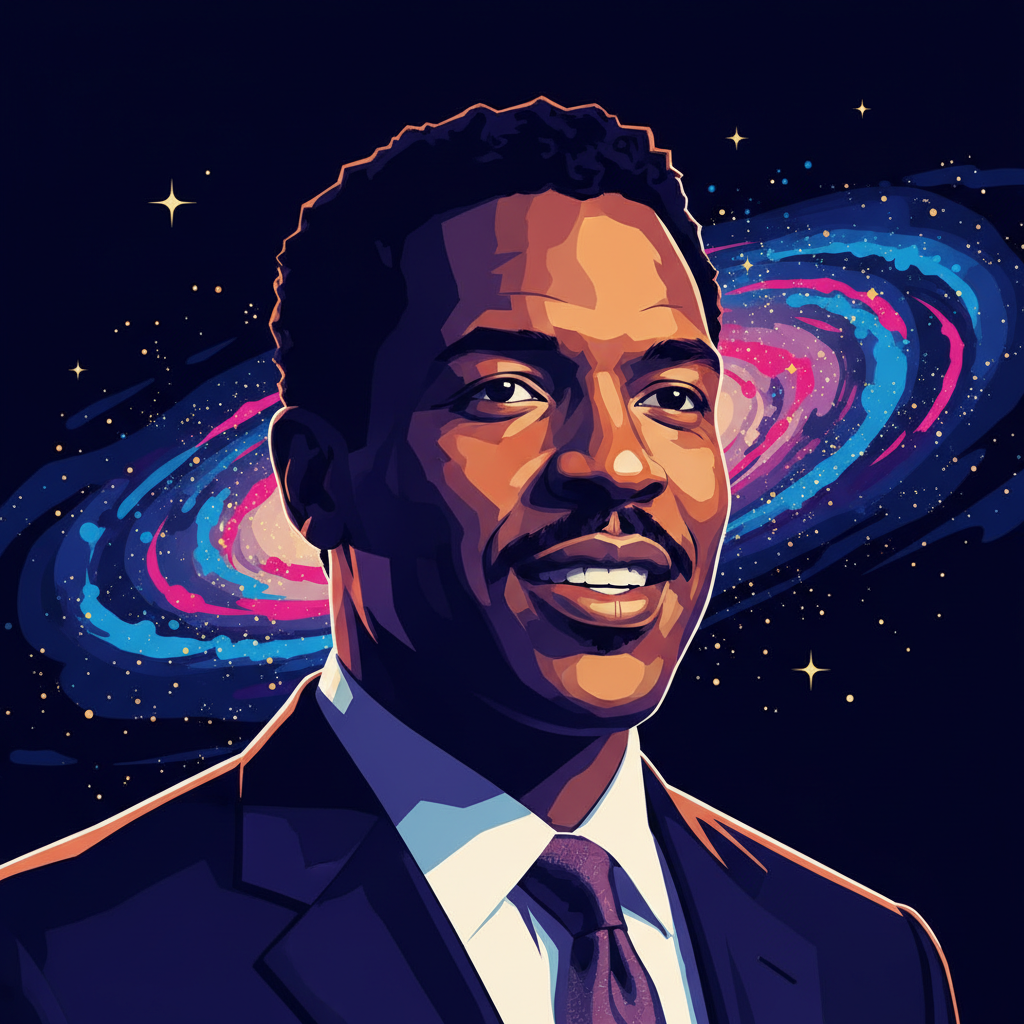
Neil deGrasse Tyson — "I don't have a favorite planet. They're all my children."
I don't have a favorite planet. They're all my children.
I don't have a favorite planet. They're all my children.
Click any product to generate a realistic preview. Up to 3 at a time.
* Initial load can take up to 90 seconds — revising the preview in another color is nearly instant.
"The universe is not just stranger than we imagine, it is stranger than we can imagine."
"I'm not a fan of people who say, 'I believe in science.' Science is not a belief system. Science is a method."
"I think it's important to have a sense of humor about the universe. It's a pretty absurd place, after all."
"I think the universe is a lot weirder than we give it credit for."
"If you're religious, you already have a book of answers. The problem is, it's not a book of questions."
American astrophysicist, Hayden Planetarium director, and Cosmos: A Spacetime Odyssey host who carries the Carl Sagan public-science mantle. Closely associated with Bill Nye (fellow science communicator) and Brian Greene (theoretical physicist and string-theory popularizer). For an intellectual contrast, see Ken Ham, founder of Answers in Genesis and the Creation Museum — Ham's career has been organized around defending biblical 6-day creationism — exactly the science-education position Tyson's mainstream-science communication is structured to refute.
Found in 1 providers: grok
1 source checked
Rejecting the 'pick a favorite' framing, the quote uses parental love as a metaphor for equal scientific devotion. No planet deserves more fascination than another — each is a unique world with its own geology, atmosphere, and history. The humor softens a serious point: real curiosity doesn't rank, it embraces. Every world in the solar system deserves the same wonder, the same scrutiny, the same care.
Tyson, director of the Hayden Planetarium since 1996 and host of StarTalk, built his career on equal-opportunity cosmic wonder. He's famous — or infamous — for championing Pluto's 2006 reclassification as a dwarf planet, earning accusations of planetary favoritism in reverse. The 'all my children' framing directly addresses that charge: his passion isn't selective. Every object in the solar system gets the same rigorous, enthusiastic treatment in his lectures and books.
Tyson came of prominence during the golden age of planetary exploration: Mars rovers Curiosity and Perseverance, Cassini's Saturn mission, and New Horizons' stunning 2015 Pluto flyby. The IAU's 2006 planetary definition debate made 'favorite planet' a mainstream cultural question. The Kepler telescope simultaneously revealed thousands of exoplanets, expanding the solar family concept dramatically. The public debated which worlds deserved attention, making Tyson's non-hierarchical stance quietly radical.
AI-generated insights based on extensive research and information for context. Factual errors? Email [email protected].
Your cart is empty