Confucius — "The Master said, 'Riches and honors are what men desire. If they cannot be obtai…"

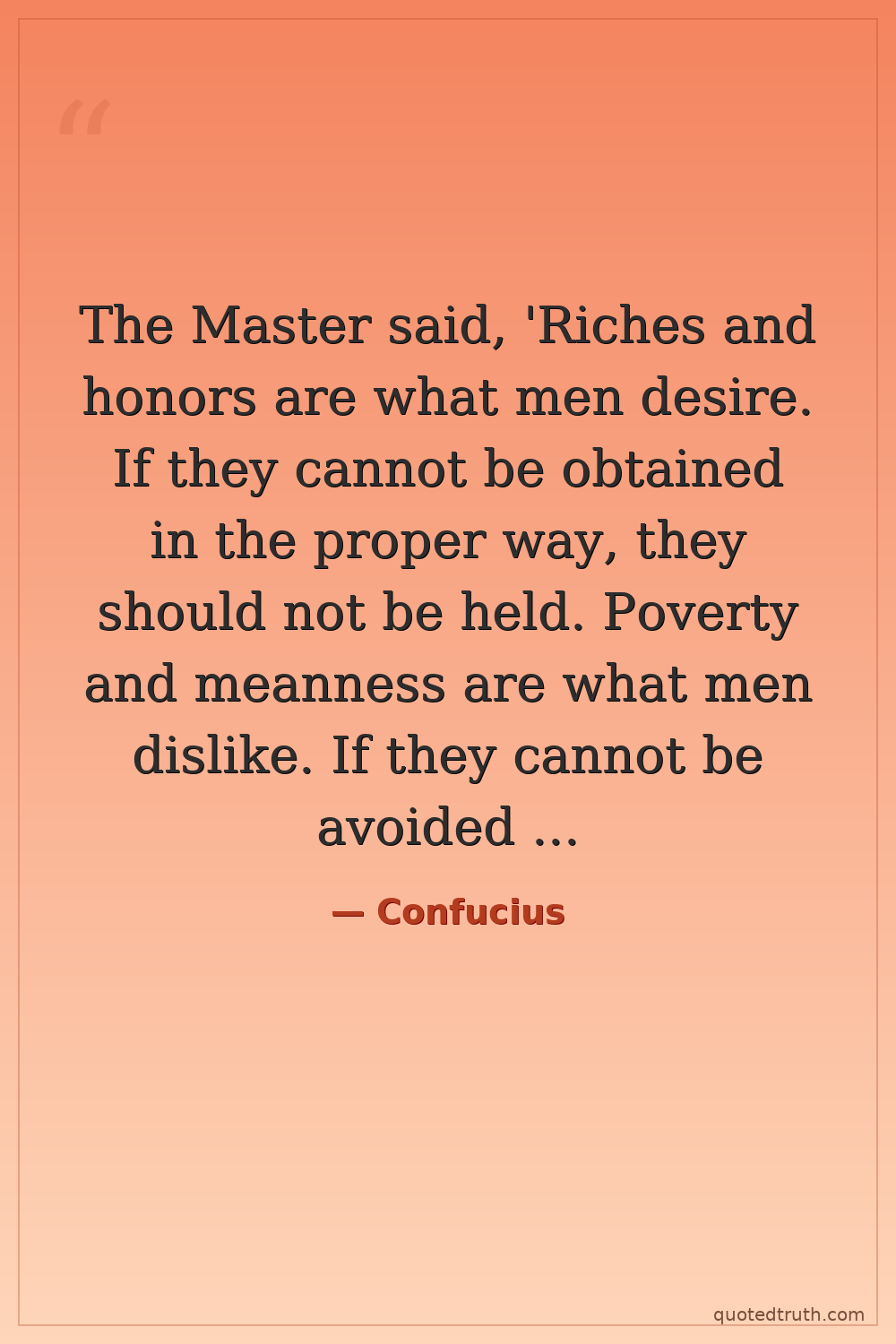
The Master said, 'Riches and honors are what men desire. If they cannot be obtained in the proper way, they should not be held. Poverty and meanness are what men dislike. If they cannot be avoided in the proper way, they should not be avoided.'
Confucius — Confucius Ancient · Chinese philosopher, founder of Confucianism

Get This Quote & Author's Image Illustrated On:

Click any product to generate a realistic preview. Up to 3 at a time.
* Initial load can take up to 90 seconds — revising the preview in another color is nearly instant.

Kitchen

Apparel

Other

About Confucius (551-479 BCE)

Chinese philosopher and teacher whose teachings (compiled by his students in the Analects) became the foundational ethical framework of East Asian civilization for 2,500 years. Closely associated with Mencius (his most-influential follower a century later). For an intellectual contrast, see Laozi, near-contemporary Chinese sage and Tao Te Ching author — Confucius systematized social order through ritual and family hierarchy; Laozi's Taoist effortless-action philosophy argued such systems were the disease, not the cure. The two founding poles of Chinese moral philosophy — every East Asian moral tradition since has positioned itself between them.

The standard scholarly entry points to Confucius's work: Philip J. Ivanhoe (Georgetown, Chinese philosophy) — Confucian Moral Self Cultivation (2000); Edward Slingerland (UBC, Asian Studies) — Effortless Action: Wu-wei as Conceptual Metaphor (2003); Tu Weiming (Harvard, Confucian scholar) — Confucian Thought: Selfhood as Creative Transformation (1985). These are the works graduate seminars cite when teaching Confucius.
Details

Analects, Book IV, Chapter 5

Date: c. 5th century BCE

Work & Money

Verification

Unverifiable

Found in 1 providers: grok

1 source checked

Understanding this quote

What it means

Most people want wealth and status and try to escape poverty and low standing. But the means matter more than the outcome. If you can only gain riches by cheating, betraying, or acting dishonorably, refuse them. If escaping poverty requires the same compromises, accept the hardship instead. Integrity isn't a luxury you practice when convenient; it governs what you'll accept from life and what you'll walk away from.

Relevance to Confucius

Confucius lived this tension directly. He sought government office for decades to implement his reforms, yet repeatedly left posts or refused positions when rulers ignored ritual propriety or acted unjustly. He endured stretches of near-poverty wandering between states rather than serve corrupt courts. His teaching that the junzi (gentleman) prizes righteousness over profit wasn't abstract—it was the standard by which he judged his own career choices and advised disciples like Zilu and Ran Qiu.

The era

Confucius taught during the late Spring and Autumn period (roughly 551–479 BCE), when the Zhou dynasty's authority had collapsed and rival states fought constantly for supremacy. Ambitious officials switched allegiances for pay, assassinated lords, and extracted wealth through warfare and heavy taxation. Against this backdrop of opportunistic careerism, insisting that wealth be earned through 'the proper way' (dao) was a direct rebuke of the era's political culture and a call to restore ritual-based ethics.

AI-generated insights based on extensive research and information for context. Factual errors? Email [email protected].

Your Cart

Your cart is empty