Max Planck — "The creative scientist has to be a man of faith. He must have faith in his resul…"
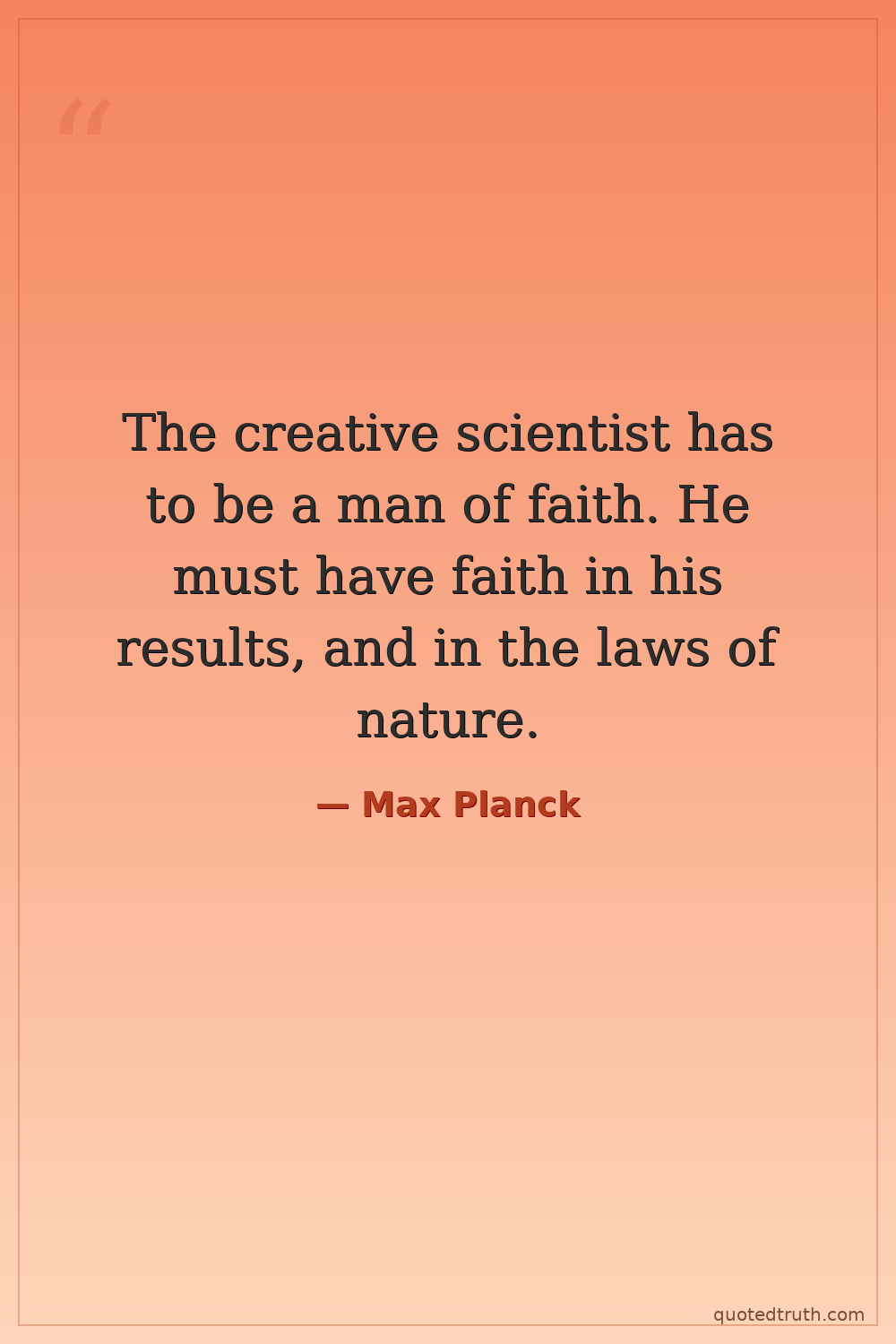
The creative scientist has to be a man of faith. He must have faith in his results, and in the laws of nature.
The creative scientist has to be a man of faith. He must have faith in his results, and in the laws of nature.
Click any product to generate a realistic preview. Up to 3 at a time.
* Initial load can take up to 90 seconds — revising the preview in another color is nearly instant.
"All great discoveries are made by men whose feelings run ahead of their thinking."
"The pursuit of knowledge is an endless journey."
"An experiment is a question which science poses to Nature, and a measurement is the recording of Nature's answer."
"Truth never triumphs—its opponents just die out."
"The soul is the seat of all knowledge and all truth."
Found in 1 providers: grok
1 source checked
Scientific discovery requires more than cold logic. A researcher pursuing new ideas has no guarantee their work will succeed, so they must trust their intuition, trust that their experimental results point to something real, and trust that the universe operates by consistent, knowable rules. Without this underlying conviction, a scientist would abandon difficult problems before breakthroughs emerge, since evidence rarely arrives complete or immediately convincing.
Planck spent six years defending his quantum hypothesis before physicists accepted it, and he initially doubted his own radical 1900 energy-quanta proposal. A devout Lutheran who served as a church elder, he openly reconciled science and religion, arguing both required belief in an ordered reality. His perseverance through personal tragedy, including losing sons in both World Wars, mirrored the scientific faith he describes here.
Planck worked as classical physics collapsed between 1900 and 1930, when quantum mechanics and relativity overturned centuries of Newtonian certainty. Scientists faced genuinely counterintuitive results, probability replacing determinism, and fierce philosophical debates with Einstein, Bohr, and Heisenberg. Amid rising secularism, Weimar intellectual upheaval, and later Nazi ideological interference in German science, Planck publicly defended both rigorous empiricism and spiritual conviction as compatible foundations for pursuing truth.
AI-generated insights based on extensive research and information for context. Factual errors? Email [email protected].
Your cart is empty