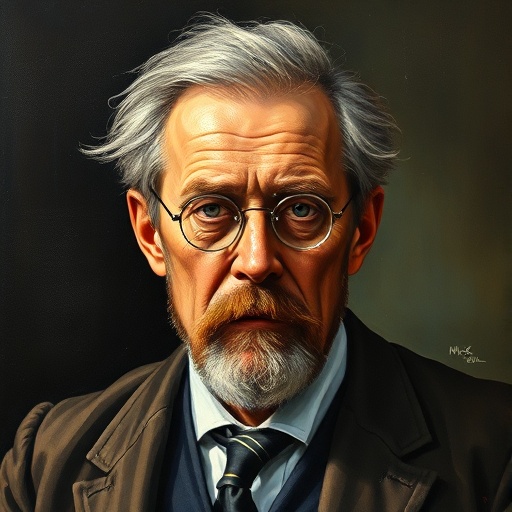
Max Planck — "The highest value of human life lies in its service to humanity."
The highest value of human life lies in its service to humanity.
The highest value of human life lies in its service to humanity.
Click any product to generate a realistic preview. Up to 3 at a time.
* Initial load can take up to 90 seconds — revising the preview in another color is nearly instant.
"The highest court is in the end one's own conscience and conviction—that goes for you and for Einstein and every other physicist—and before any science there is first of all belief. For me, it is beli…"
"The most important task of science is to liberate man from the illusion that he is the center of the world."
"I started from the assumption that the energy of an oscillator is quantized. I did this in an act of desperation."
"The true pioneer is a man who, if necessary, is prepared to go into the wilderness alone, without anyone following him."
"When you change your opinion, you are not a weakling. You are a scientist."
Found in 1 providers: grok
1 source checked
True worth in a human life is measured by how much it benefits others, not by personal wealth, fame, or individual achievement. A life spent improving the condition of humanity, through work, discovery, kindness, or sacrifice, carries greater meaning than one spent solely in self-interest. The statement urges readers to evaluate their existence by contribution rather than consumption, treating service to fellow people as the ultimate standard of a meaningful and dignified life.
Planck lived this principle during Nazi Germany, pleading personally with Hitler to protect Jewish scientists and staying in Germany to preserve its scientific institutions. He endured the execution of his son Erwin for resisting Hitler and the loss of earlier children to war and illness. Despite revolutionizing physics with quantum theory in 1900, he framed science itself as moral service, insisting researchers owed their discoveries to humanity rather than nation, ideology, or personal glory.
Planck spoke during the catastrophic collapse of early twentieth-century Europe: two world wars, the rise of Nazism, the expulsion and murder of Jewish colleagues like Einstein, Meitner, and Haber, and the weaponization of physics toward the atomic bomb. German science, once the world's envy, was being destroyed by ideology. His emphasis on service countered the era's nationalism and its corruption of scholarship, reasserting that knowledge and human life must serve universal human welfare, not regimes.
AI-generated insights based on extensive research and information for context. Factual errors? Email [email protected].
Your cart is empty